Weekly Hits: Pharmaindustrie & US-Technologie


KeyInvest Weekly Hits
Donnerstag, 06.12.2018
  • Thema 1: Pharmaindustrie – Eine gesunde Entwicklung
  • Thema 2: US-Technologie – Kampf um die Vorherrschaft
  • Thema 3: Rohstoffmonitor – November 2018

Pharmaindustrie
Eine gesunde Entwicklung

An der Börse war in den vergangenen Wochen und Monaten ein gewisser Favoritenwechsel zu beobachten. Während die lange Zeit haussierenden Technologiewerte Federn lassen mussten, rückten als defensiv geltende Sektoren in der Gunst der Investoren nach oben. Das gilt auch und gerade für die  Gesundheitsbranche – der STOXX™ Europe 600 Health Care Net Return (NR) Index legte im November um 1.9 Prozent zu. Mit einem ETT (Symbol: ETHEA) können sich Anleger diesen momentumstarken Benchmark effizient und kostengünstig in das Portfolio holen. Die Pharma-Schwergewichte Bayer, GlaxoSmithKline und Novartis bilden die Basis für einen Early Redemption (ER) Kick-In GOAL (Symbol: KCOCDU). Momentan zeigt das Produkt eine Seitwärtsrendite von 12.4 Prozent p.a. Dieser Chance steht selbst beim derzeitigen Worst-Performer Bayer ein ordentliches Sicherheitspolster von 26.8 Prozent gegenüber.

Angesichts der hektischen Börsenumfelds kommt die jüngste Sektor-Rotation nicht von ungefähr. Allerdings kann die Gesundheitsbranche auch mit einem operativen Momentum aufwarten. Beispiel Novartis: Seit Vasant Narasimhan im Februar den Posten als CEO übernommen hat, richtet er den Basler Konzern neu aus. Der Harvard-Absolvent legt den Fokus auf spezialisierte, auf Patienten abgestimmte Arzneien sowie neue Behandlungsansätze. Dabei sollen Plattformen für Zelltherapie, Gentherapie und Radioligand-Therapie entstehen. Den letztgenannten Bereich stärkte Novartis im Oktober mit der 2.1 Milliarden US-Dollar schweren Übernahme von Endocyte. Das US-Biotechunternehmen entwickelt eine nuklearmedizinische Therapie zur Behandlung von Prostatakrebs. Narasimhan traut dem Wirkstoff der 2021 an den Markt kommen soll, Spitzenumsätze von mehr als einer Milliarde US-Dollar zu. Neue Produkte wie  das Herzmedikament Entresto oder Cosentyx gegen Schuppenflechte schoben zuletzt das Geschäft von Novartis an: Im dritten Quartal 2018 verbuchte der Konzern ein währungsbereinigtes Umsatzwachstum von sechs Prozent. Das Management erhöhte daraufhin die Prognose für das Gesamtjahr. (Quelle: Thomson Reuters, Medienbericht, 18.10.2018)
 
Auch Roche, der gemessen an der Gewichtung zweitgrösste Konzern im STOXX™ Europe 600 Health Care Index, hat Rückenwind. Am 4. Dezember legte das Unternehmen  positive Studiendaten für Venclexta zur Behandlung von Blutkrebs vor. Dagegen stiess GlaxoSmithKline (GSK) mit der Übernahme des US-Krebsspezialisten Tesaro auf wenig Begeisterung. Offenbar ist Börsianern der Kaufpreis von 5.1 Milliarden US-Dollar zu hoch – die GSK-Aktie gab deutlich nach. (Quelle: Thomson Reuters Medienbericht, 03.12.2018)


Chancen:
Ungeachtet dessen ist der STOXX™ Europe 600 Health Care Index drauf und dran, nach oben aus dem übergeordneten Abwärtstrend auszubrechen. Mit dem ETT (ETHEA) lässt sich sowohl eine kurzfristige Tradingstrategie als auch ein dauerhafter Buy-and-Hold-Ansatz verfolgen – das Produkt bildet den Basiswert 1:1 ab. Dabei fallen keine Verwaltungsgebühren an.² Beim ER Kick-In GOAL (Symbol: KCOCDU) reicht eine stabile Entwicklung von Bayer, GSK und Novartis, damit die Seitwärtsrendite von 12.4 Prozent p.a. Realität wird. Knapp zwei Monate nach der Anfangsfixierung notiert das Produkt zwar deutlich unter dem Emissionspreis. Gleichwohl beträgt der Barriereabstand selbst bei Bayer, dem aktuell schwächsten Titel aus dem Trio, noch 26.8 Prozent. Wegen der intregrierten Early Redemption Funktion ist bei diesem Kick-In GOAL eine vorzeitige Rückzahlung samt anteiligem Coupon möglich.

Risiken:
Die vorgestellten Produkte sind nicht kapitalgeschützt. Eine negative Entwicklung des Basiswerts führt beim ETT zu entsprechenden Verlusten. Notiert einer der Basiswerte beim Worst of Kick-In GOAL während der Laufzeit einmal auf oder unter dem jeweiligen Kick-In Level (Barriere) und kommt zudem des Early-Redemption-Feature nicht zum Tragen, kann die Rückzahlung am Verfalltag durch Bartilgung entsprechend der (vom Strike aus) schwächsten Performance aus dem Trio erfolgen (höchstens jedoch zum Nominalwert zuzüglich Coupon). In diesem Fall sind Verluste wahrscheinlich. Zudem trägt der Anleger bei Strukturierten Produkten das Emittentenrisiko, so dass das eingesetzte Kapital – unabhängig von der Entwicklung des Basiswertes – im Falle einer Insolvenz der UBS AG verloren gehen kann.
Weitere UBS Produkte sowie Informationen zu Chancen und Risiken finden Sie unter ubs.com/keyinvest.
 
 
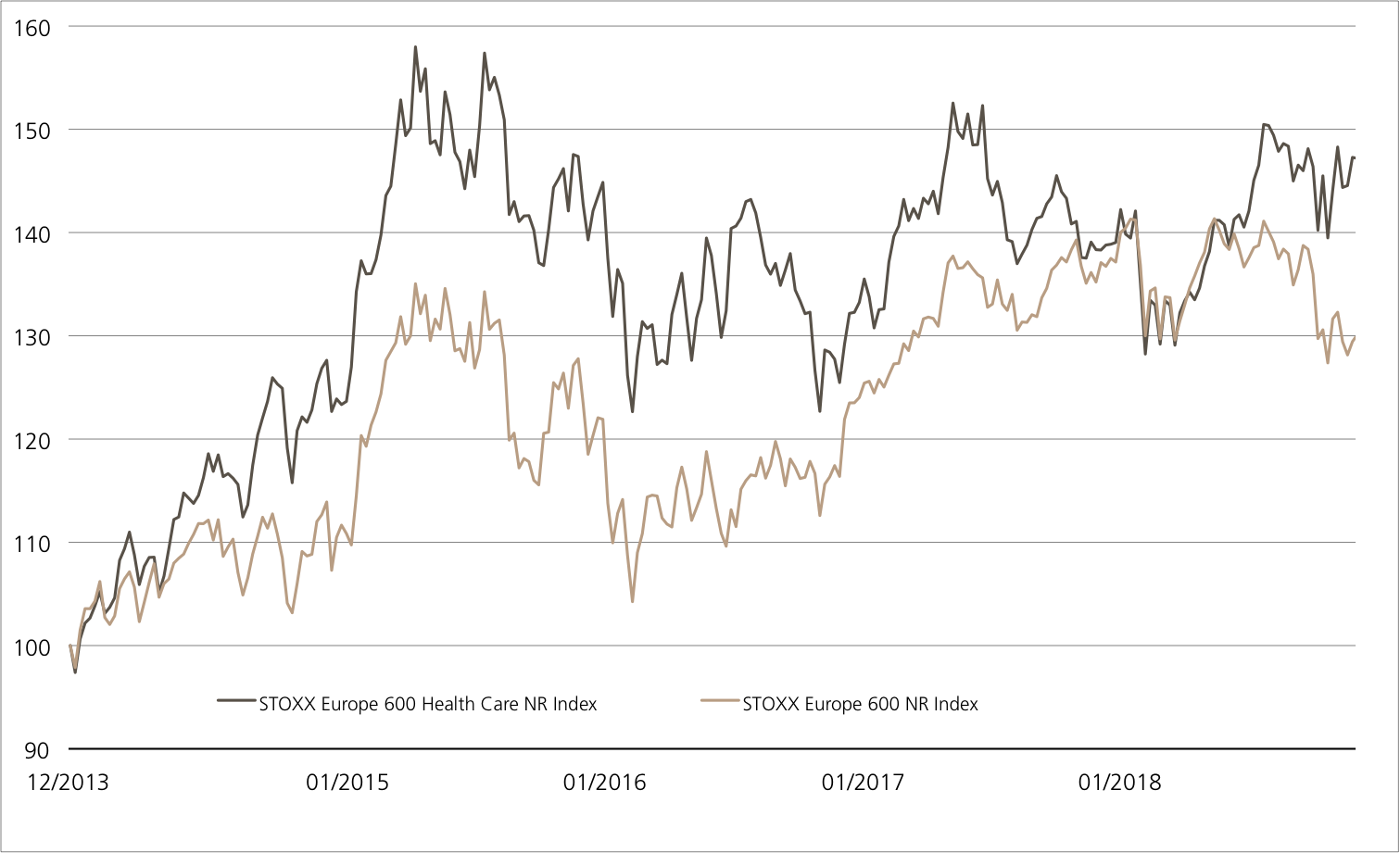
STOXX™ Europe 600 Health Care Net Return Index vs. STOXX™ Europe 600 Net Return Index 5 Jahre¹
Mitte Jahr hatte der STOXX™ Europe 600 Health Care Index den Vorsprung gegenüber dem Markt eingebüsst. Zuletzt konnte sich der Sektor allerdings wieder vom STOXX™ Europe 600 Index absetzen.
 
Quelle: UBS AG, Bloomberg
Stand: 05.12.2018

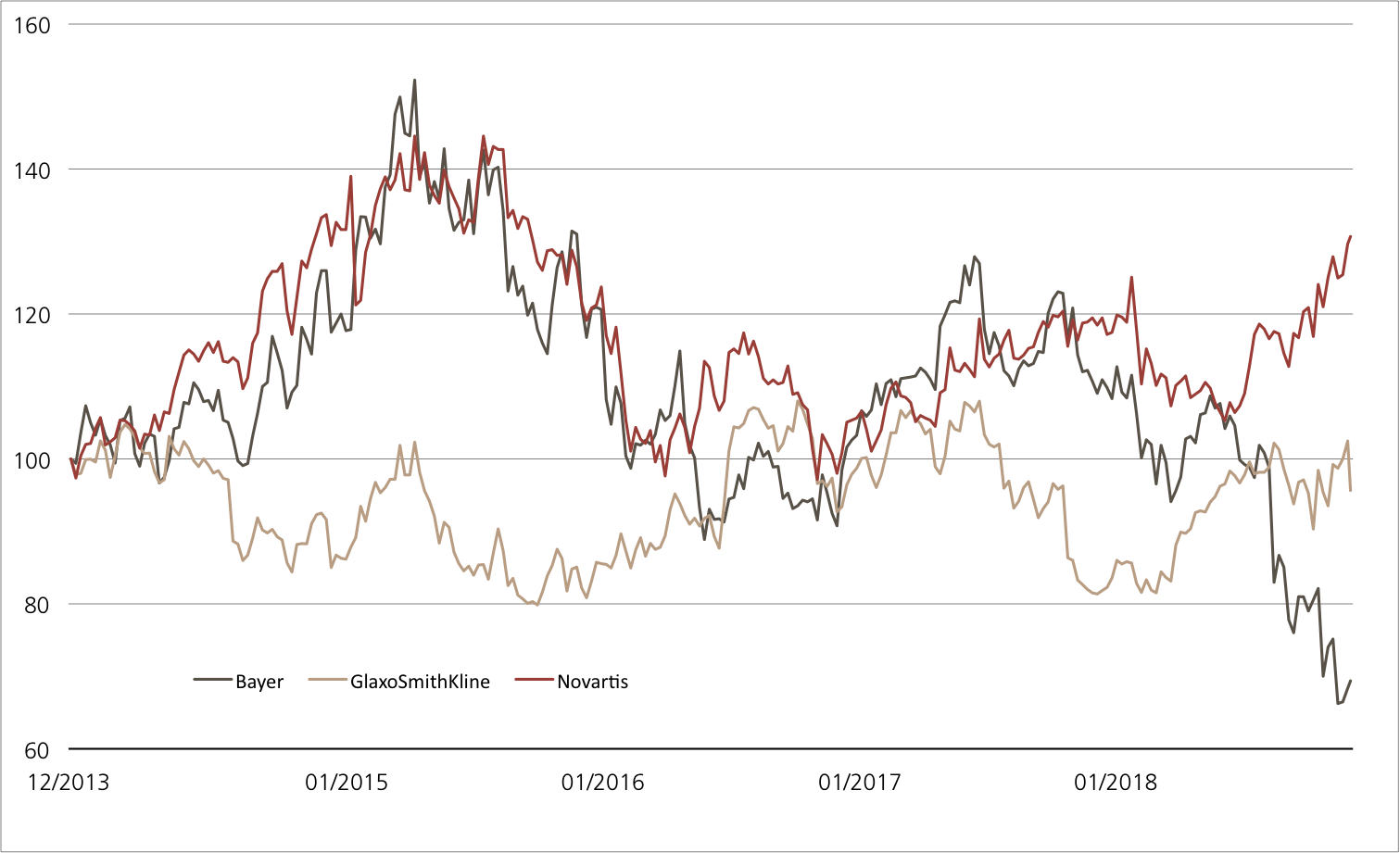
Bayer vs. GlaxoSmithKline vs. Novartis 5 Jahre¹
Zuletzt konnte sich die Novartis-Aktie im Fünf-Jahres-Vergleich von den beiden Konkurrenten absetzen. Während Bayer nur knapp unter der Nulllinie steht, brach GlaxoSmithKline ab Juni 2017 ein.
 
Quelle: UBS AG, Bloomberg
Stand: 05.12.2018

 
¹) Bitte beachten Sie, dass vergangene Wertentwicklungen keine Indikationen für künftige Wertentwicklungen sind.
²) Die Konditionen der ETTs werden jährlich überprüft und können mit einer Frist von 13 Monaten nach Bekanntgabe angepasst werden
 
ETT auf STOXX™ Europe 600 Health Care EUR Net Return Index

Symbol ETHEA
SVSP Name Tracker-Zertifikat
SPVSP Code 1300
Basiswert STOXX™ Europe 600 Health Care EUR Net Return Index 
Bezugsverhältnis 1:1
Handelswährung EUR
Verwaltungsgebühr 0.00% p.a.²
Partizipation 100%
Verfall Open End
Emittentin UBS AG, London
Geld-/Briefkurs EUR 1’1302.00 / 1’310.00
 

7.50% p.a. Early Redemption Kick-In GOAL auf Bayer / GlaxoSmithKline / Novartis

Symbol KCOCDU
SVSP Name Barrier Reverse Convertible
SPVSP Code 1230 (Auto-Callable)
Basiswerte Bayer / GlaxoSmithKline / Novartis
Handelswährung CHF
Coupon 7.50% p.a.
Seitwärtsrendite 24.50% (12.42% p.a.)
Kick-In Level (Abstand) Bayer: EUR 48.0064 (26.83%)
GSK: GBP 9.495 (34.91%)
Novartis: 54.0928 (40.14%)
Verfall 12.10.2020
Emittentin UBS AG, London
Geld-/Briefkurs 90.35% / 91.35%
 

Weitere Produkte sowie Informationen zu Chancen und Risiken finden Sie unter: ubs.com/keyinvest Quelle: UBS AG, Bloomberg Stand: 05.12.2018
 
Marktübersicht
Index Stand Woche¹
SMI™ 8’939.96 Pkt. 0.5%
SLI™ 1’377.32 Pkt. 0.0%
S&P 500™ 2’700.06 Pkt. -1.6%
EURO STOXX 50™ 3’150.27 Pkt. -0.6%
S&P™ BRIC 40 3’989.49 Pkt. 0.8%
CMCI™ Compos. 898.60 Pkt. 2.0%
Gold (Feinunze) 1’242,60 USD 1.0%

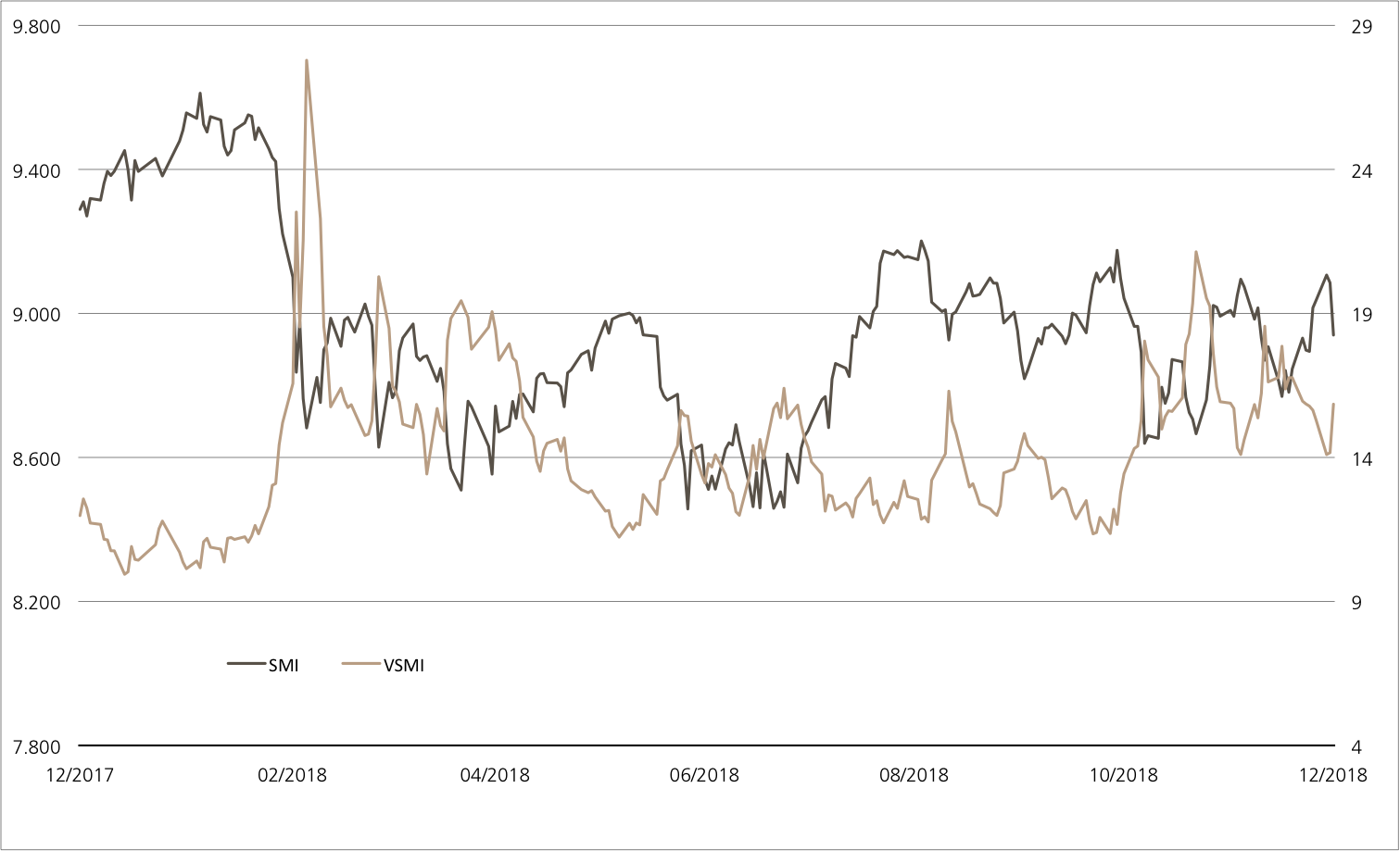
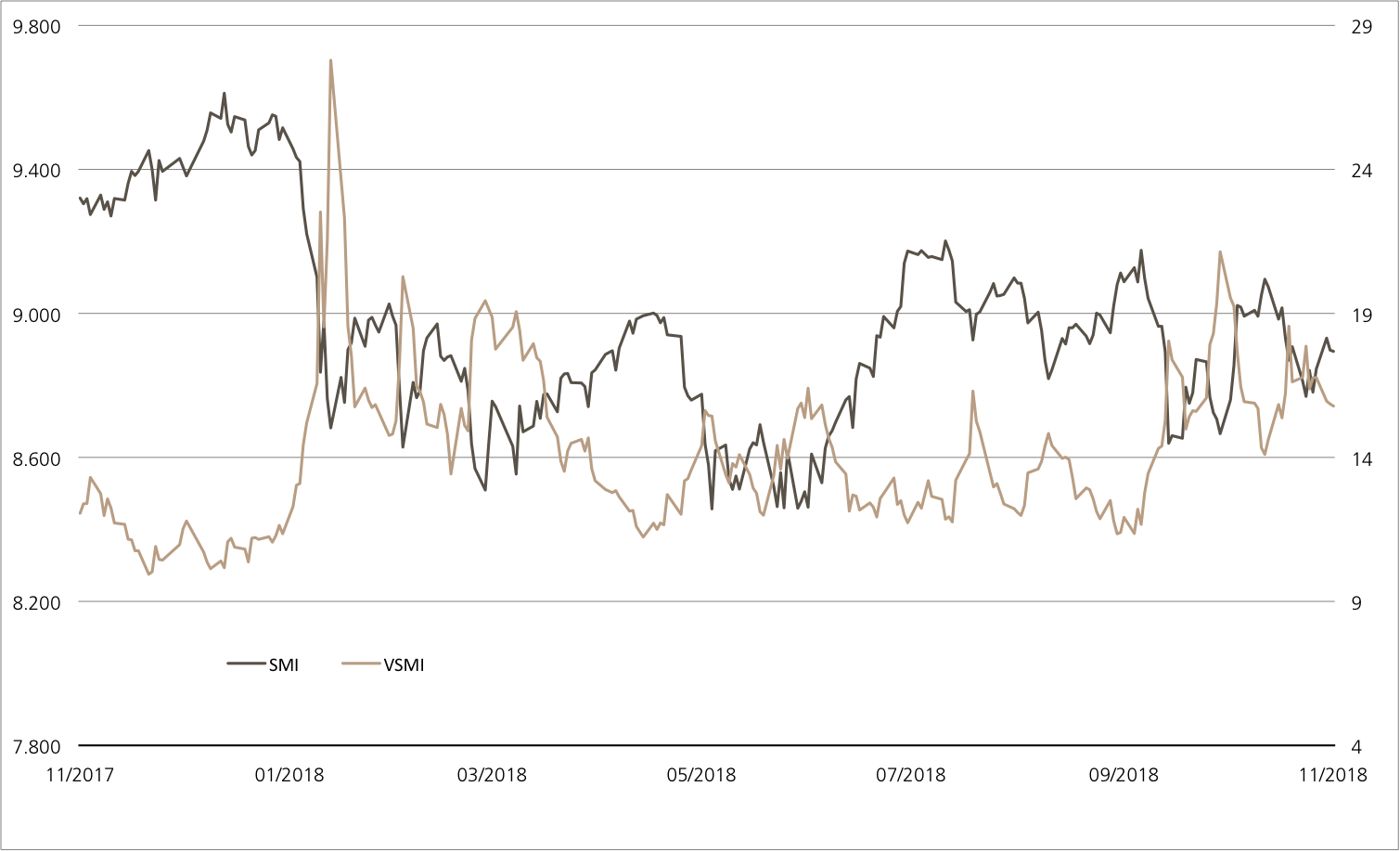
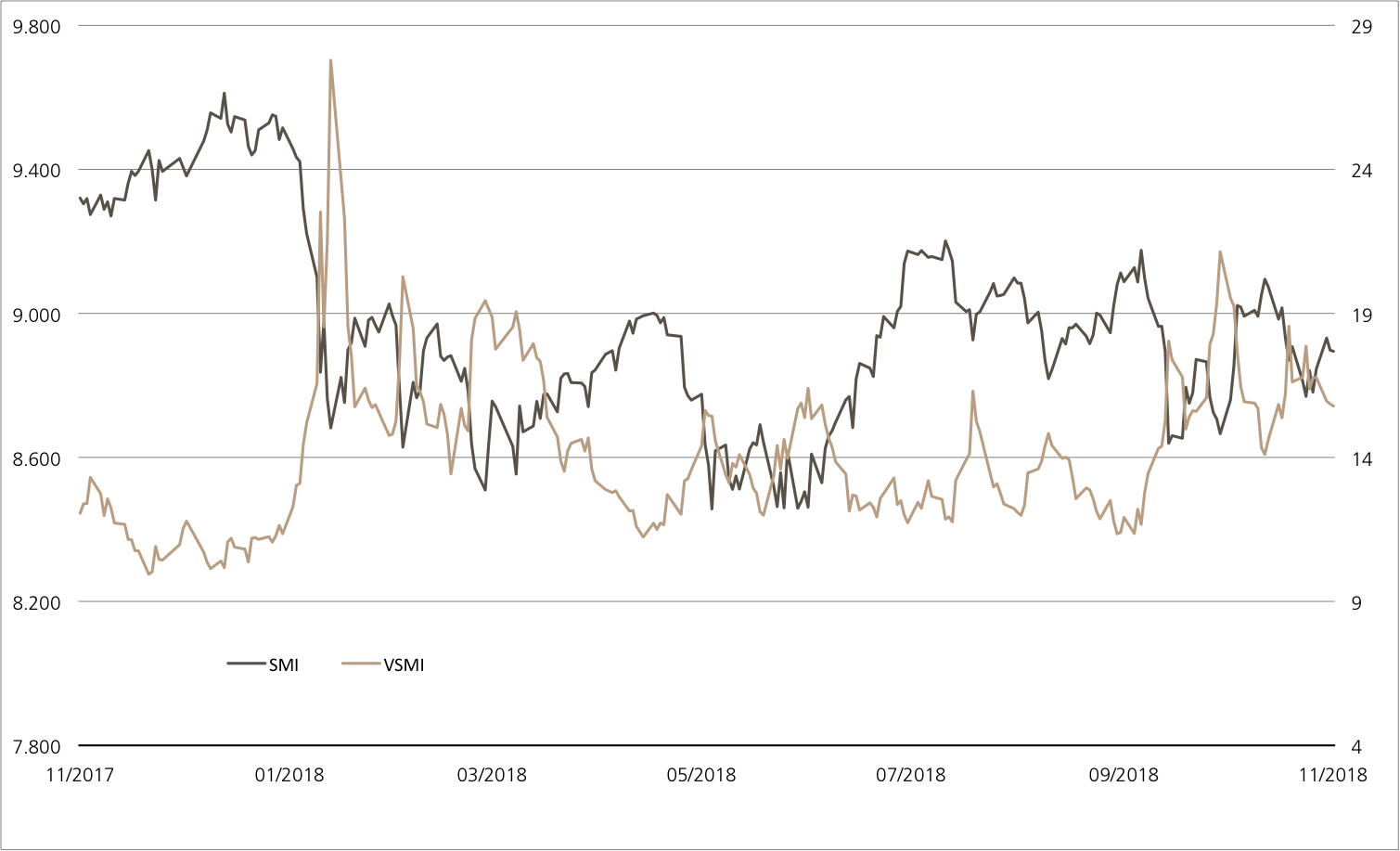
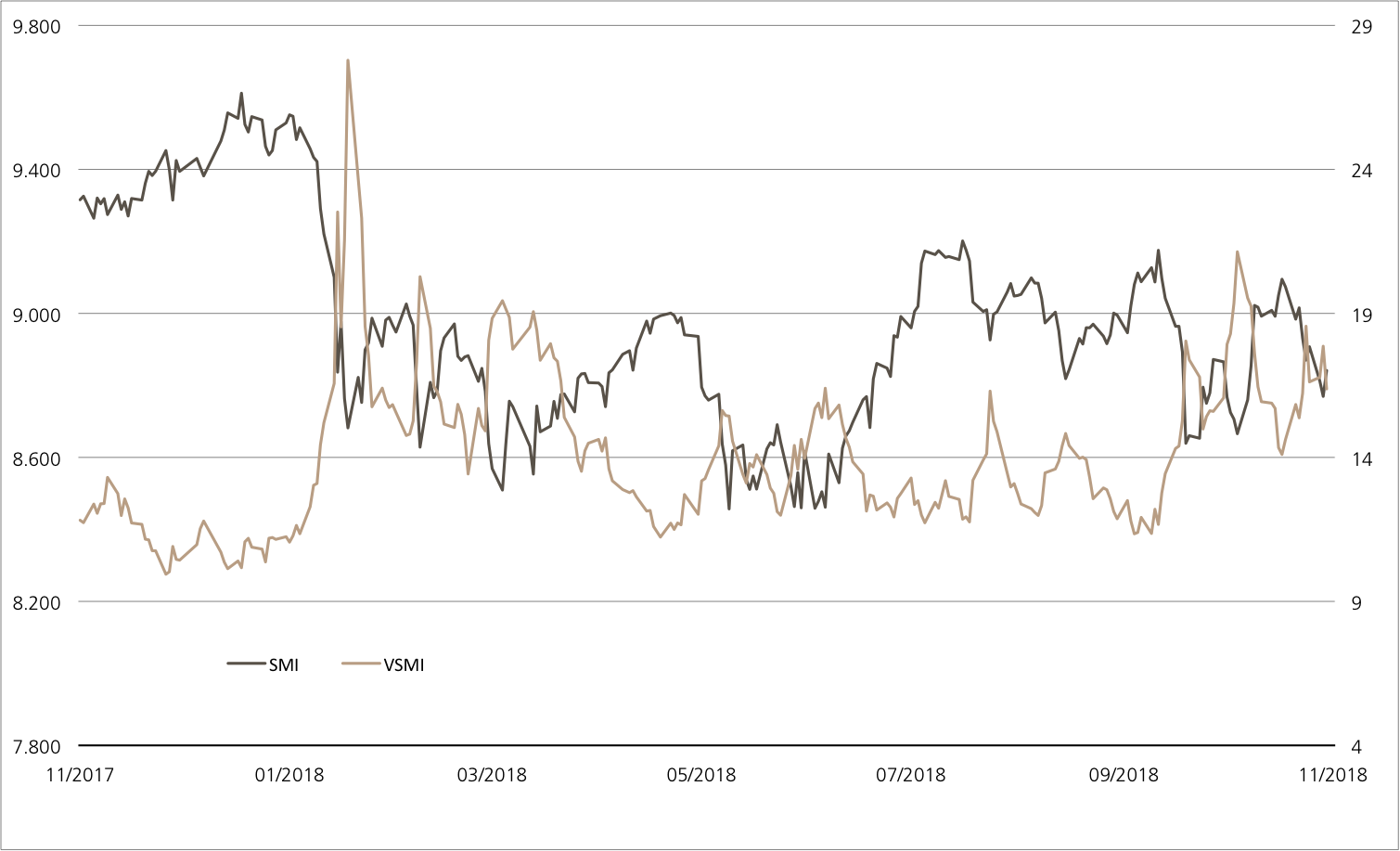
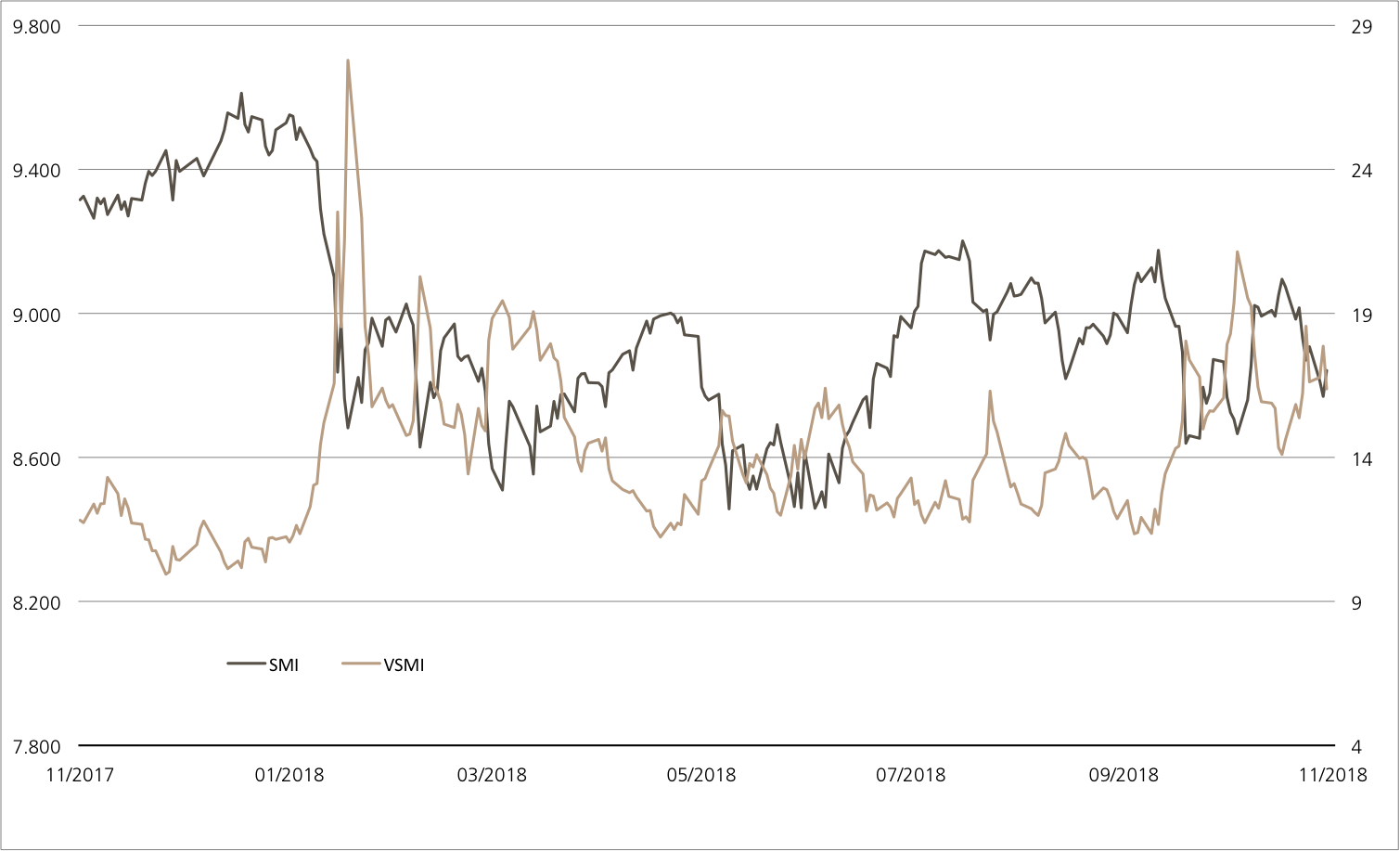
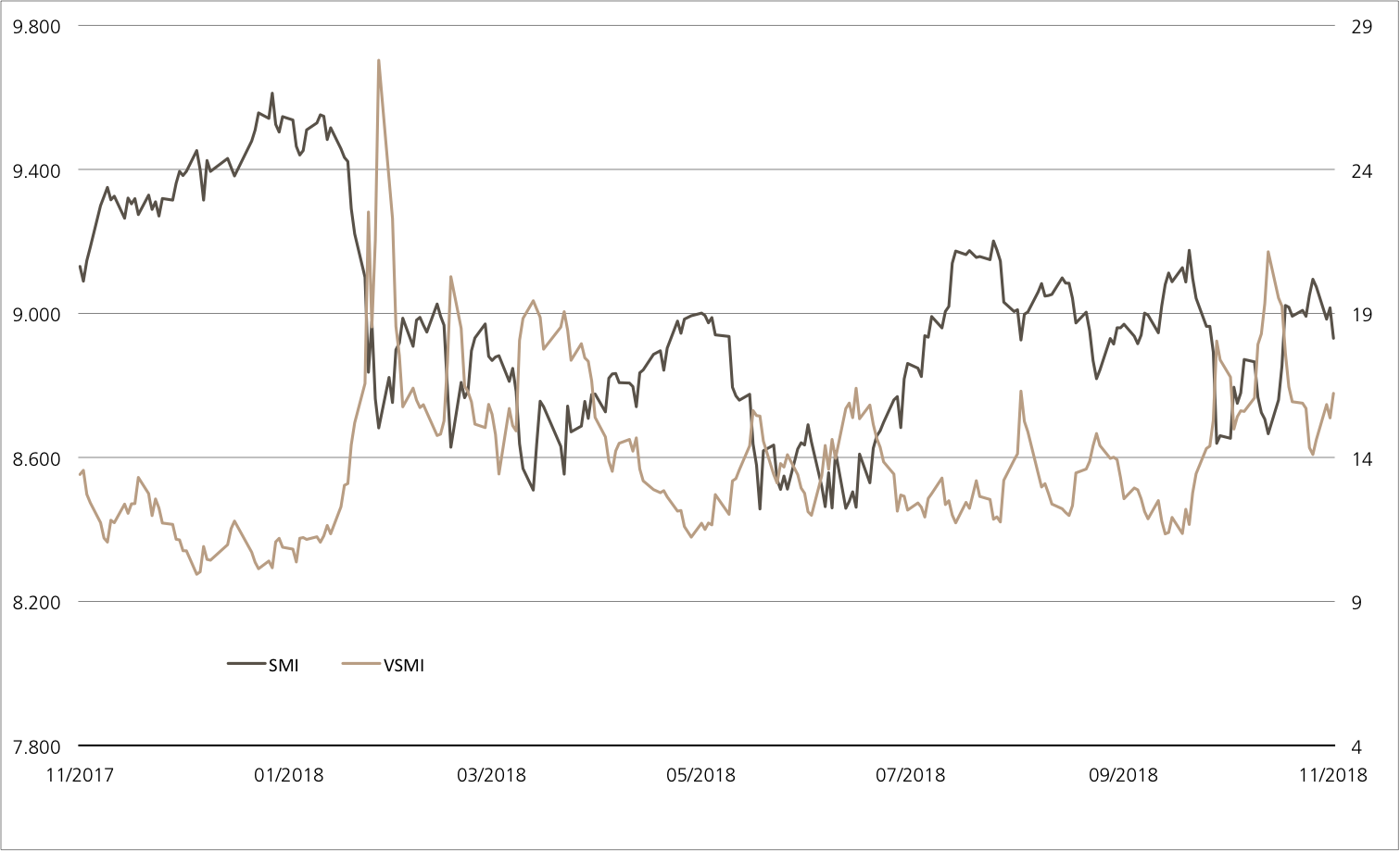
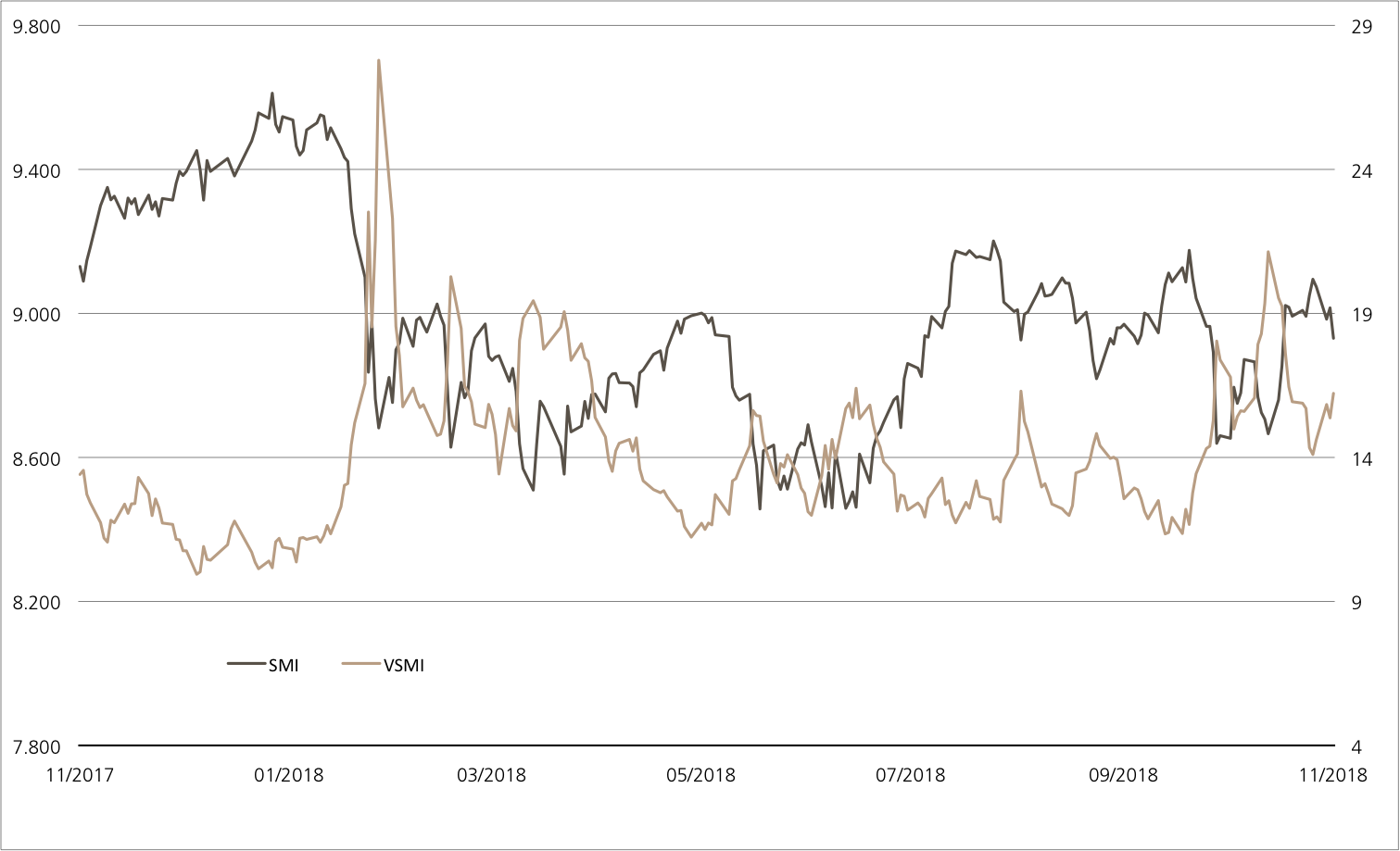
SMI™ vs. VSMI™ 1 Jahr

 
¹ Veränderung auf Basis des Schlusskurses des Vortages im Vergleich zum Schlusskurs vor einer Woche.
Der VSMI™ Index wird seit 2005 berechnet. Er zeigt die Volatilität der im SMI™ Index enthaltenen Aktien. Massgeblich für die Berechnung ist ein Portfolio, welches nicht auf Preisschwankungen, sondern ausschliesslich auf Veränderungen der Volatilität reagiert. Dabei greift die VSMI™ Methodik auf die quadrierten Volatilitäten, im Fachjargon „Varianzen“, der an der Eurex gehandelten SMI-Optionen mit einer konstanten Restlaufzeit von 30 Tagen zurück.


US-Technologie
Kampf um die Vorherrschaft

 
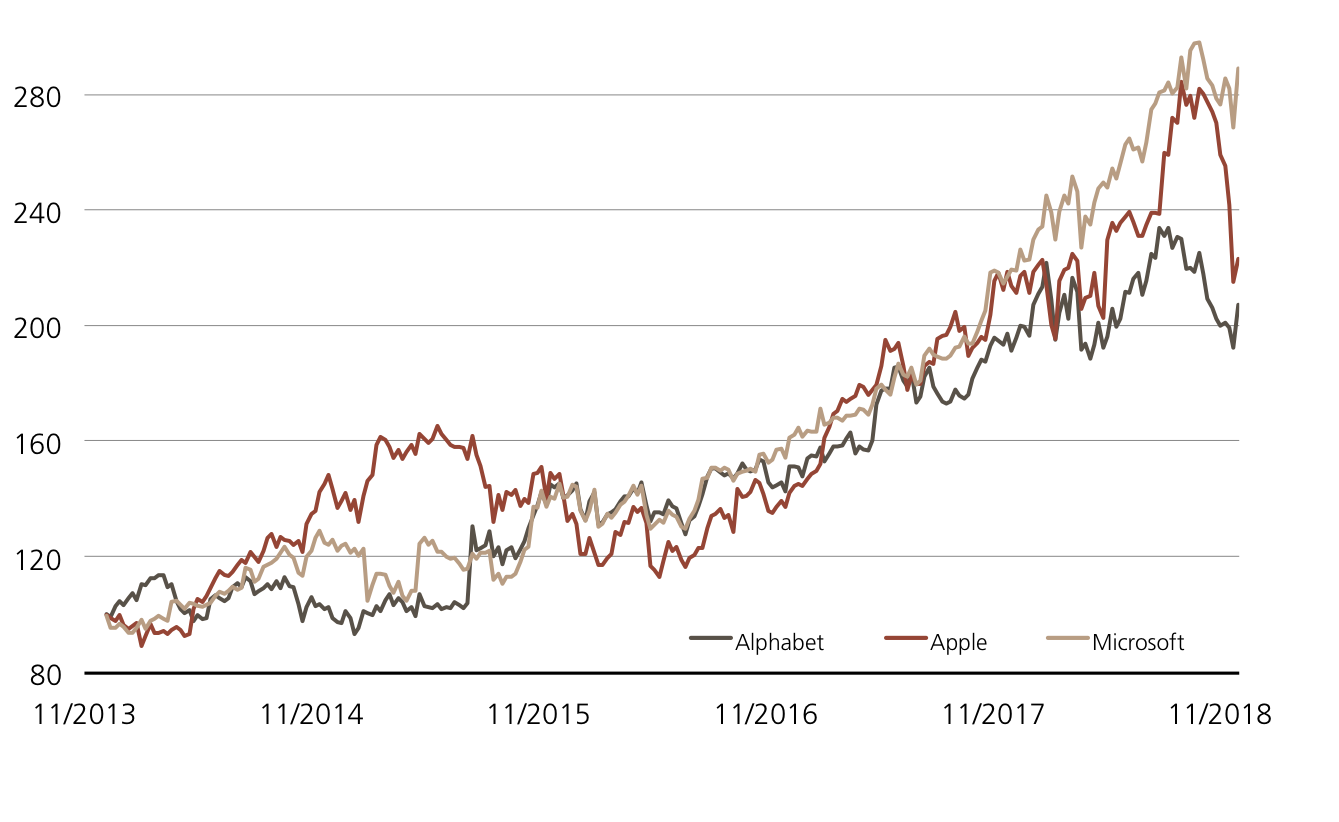
Der Kampf um die Krone als Börsenschwergewicht ist in vollem Gange. Amazon, Microsoft und Apple wechselten sich zuletzt auf der Spitzenposition als wertvollstes Unternehmen ab. Auch die viertplatzierte Alphabet ist in Schlagweite. Von operativer Seite sorgt vor allem Microsoft derzeit für positive Schlagzeilen. Im abgelaufenen Quartal konnte das Computer-Urgestein einmal mehr die Erwartungen der Analysten übertreffen. Mit einem Plus von rund 30 Prozent in 2018 entwickelte sich die Microsoft-Aktie auch deutlich dynamischer als Erz-Rivale Apple.¹ Komplett ohne Kursavancen kommt der Early Redemption (ER) Worst of Kick-In GOAL (Symbol: KCTKDU) auf Alphabet, Apple und Microsoft aus. Das Anfang November emittierte Produkt stellt aktuell eine Gewinnchance von 11.4 Prozent p.a. in Aussicht. Dieser Maximalertrag wird durch einen Risikopuffer von nahezu 30 Prozent teilgeschützt.


Lange Zeit galt Microsoft als «Digitaler Dinosaurier», sozusagen vom Aussterben bedroht. Doch der seit 2014 amtierende CEO Satya Nadella entstaubte das 1975 gegründete Unternehmen und schaffte es mit der Fokussierung auf die Cloud, das Ruder herumzureissen. Mittlerweile ist der Konzern mit seiner Cloud-Lösung «Azure» zur Nummer zwei hinter Amazon und noch vor der Alphabet-Tochter Google aufgestiegen. Allein im ersten Quartal des Geschäftsjahres 2018/19 legte Azure um 76 Prozent zu. Der Erfolg kommt auch an der Börse gut an. Am 28. November besetzte Microsoft erstmals seit dem Jahr 2000 wieder die Spitzenposition als weltvollstes börsennotiertes Unternehmen und stiess gleichzeitig Apple vom Thron. Beim iPhone-Hersteller läuft es operativ zwar ebenfalls gut, jedoch keimten zuletzt Sorgen an der Börse auf. Berichte von Zulieferern legen nahe, dass die Verkäufe der aktuellen iPhone-Generation unter den Erwartungen liegen. (Quelle: Handelsblatt, Medienbericht, 01.12.2018)
 

Chancen:
Auch wenn die Aufwärtsfahrt der Tech-Aktien zuletzt etwas stockte, im Vergleich zu Silvester 2017 notieren die Branchengrössen Alphabet, Apple und Microsoft noch deutlich im positiven Bereich.¹ Eine weitere Verschnaufpause des Trios würde dem ER Worst of Kick-In GOAL (Symbol: KCTKDU) keine Probleme bereiten. Der Coupon von 9.50 Prozent p.a. wird unabhängig vom Kursverlauf bezahlt. Aktuell liegt die Maximalrendite sogar noch höher, da der Kick-In GOAL unter pari notiert. Um sie zu erreichen, ist es wichtig, dass die Barriere der Basiswerte unversehrt bleiben. Den geringsten Puffer weist mit 28.7 Prozent derzeit Apple auf. Sollten das Trio an einem der vierteljährlichen Beobachtungstage (erster Termin: 07.11.2019) gemeinsam auf oder über dem Startlevel notieren, wird das Produkt aufgrund der ER-Funktion vorzeitig fällig.

Risiken:
ER Kick-In GOALs sind nicht kapitalgeschützt. Notiert einer der Basiswerte während der Laufzeit einmal auf oder unter dem jeweiligen Kick-In Level (Barriere) und kommt zudem des Early Redemption Feature nicht zum Tragen, kann die Tilgung am Verfalltag durch Bartilgung entsprechend der (vom Strike aus) schwächsten Performance aus dem Trio erfolgen (höchstens jedoch zum Nominalwert zuzüglich Coupon). In diesem Fall sind Verluste wahrscheinlich. Zudem trägt der Anleger bei Strukturierten Produkten das Emittentenrisiko, so dass das eingesetzte Kapital – unabhängig von der Entwicklung des Basiswertes – im Falle einer Insolvenz der UBS AG verloren gehen kann.
Weitere UBS Produkte sowie Informationen zu Chancen und Risiken finden Sie unter ubs.com/keyinvest.
 
Alphabet Inc. A vs. Apple vs. Microsoft 5 Jahre¹
Quelle: UBS AGStand: 05.12.2018

9.50% p.a. ER Worst of Kick-In GOAL auf Alphabet / Apple / Micorosoft
Symbol KCTKDU
SVSP Name Barrier Reverse Convertible
SPVSP Code 1230 (Auto-Callable)
Basiswerte Alphabet Inc. A /  Apple / Microsoft
Handelswährung USD
Coupon 9.50% p.a.
Seitwärtsrendite 22.78% (11.40% p.a.)
Kick-In Level (Abstand) Alphabet: USD 664.944 (37.42%)
Apple: USD 125.97 (28.71%)
Microsoft: USD 67.176 (38.10%)
Verfall 23.10.2020
Emittentin UBS AG, London
Geld-/Briefkurs 95.37% / 96.37%
 

Termsheet Weitere Produkte sowie Informationen zu Chancen und Risiken finden Sie unter: ubs.com/keyinvest   Quelle: UBS AG Stand: 05.12.2018

 
¹) Bitte beachten Sie, dass vergangene Wertentwicklungen keine Indikationen für künftige Wertentwicklungen sind.
²) Die Konditionen der ETTs werden jährlich überprüft und können mit einer Frist von 13 Monaten nach Bekanntgabe angepasst werden


Rohstoffmonitor November 2018
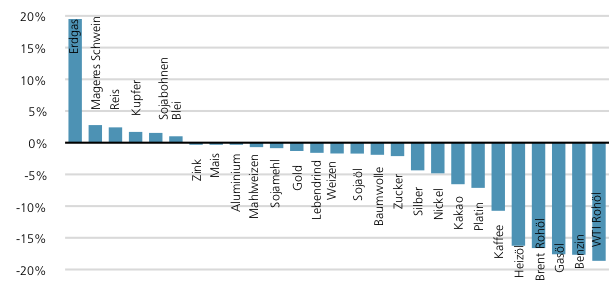
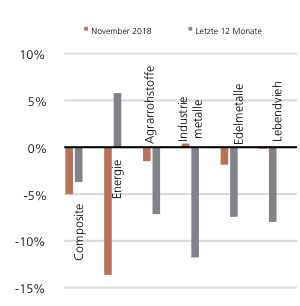
Performance Einzelrohstoffe:Die Mehrheit der Rohstoffe aus dem CMCI-Spektrum büsste im November an Wert ein. Wie schon im Vormonat erlebte das Energiesegment einen Ausverkauf. Als Gründe für den Preisverfall gelten insbesondere die Sorgen vor einer Abkühlung der Weltkonjunktur sowie eine steigende US-Ölförderung. Gespannt warten die Marktteilnehmer nun auf das am 6. und 7. Dezember anstehende OPEC-Treffen in Wien. Dann wird sich zeigen, ob sich die Organisation zusammen mit weiteren Förderländern auf eine Kürzung der Produktion verständigen kann.

Monatsperformance Einzelrohstoffe im Juni 2018 (USD)¹

Total-Return-Performance der UBS Bloomberg CMCI Einzelrohstoff-Indizes im November 2018 in US-Dollar.


Stand: 30.11.2018Quelle: UBS AG
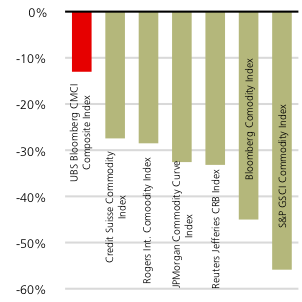
CMCI™ Sektor-Indizes:Obwohl Erdgas aus der Reihe tanzte und sich im November um annähernd ein Fünftel verteuerte, ging es mit dem Energiesegment steil nach unten: Der entsprechend Sektorindex büsste mehr als 13 Prozent an Wert ein. Angesichts der hohen Gewichtung von Öl & Co. im CMCI Composite Index überrascht es nicht, dass für den diversifizierte Benchmark per Ende November ein Minus von 5.0 Prozent zu Buche stand. Das gilt umso mehr, da auch die Segmente Agrarrohstoffe und Edelmetalle Federn lassen musste. Dagegen verbuchten Industriemetalle, angeführt von Kupfer, einen kleinen Zugewinn. Lebendvieh zeigte eine in etwa stabile Preisentwicklung.
 
Rohstoff-Index-Vergleich seit CMCI-Lancierung im Januar 2007 (USD)¹
Performance ausgesuchter Rohstoff-Indizes im Vergleich zum UBS Bloomberg CMCI™ Composite Index seit dessen Lancierung im
Januar 2007.
Quelle: UBS AG
Stand: 30.11.2018

Performance UBS Bloomberg CMCI™ Sektor-Indizes (USD)¹
Total-Return-Performance der einzelnen UBS Bloomberg CMCI Sektor-Indizes im November 2018.
Quelle: UBS AG
Stand: 30.11.2018

 
Meistgehandelte UBS ETC auf CMCI™:Diese Auswertung zeigt, dass Anleger im November auch auf  fallende Kurse bei WTI-Rohöl setzten. 28.2 Prozent der Handelsumsätze mit UBS ETCs auf Basiswerte aus dem CMCI-Spektrum entfielen im November auf das 2x Short Factor Certificate (Symbol: OIL2S). Zweistelligen Anteile am Volumen verzeichnete darüber hinaus zwei klassische Partizipationsprodukte auf Brent respektive WTI.
 
Meistgehandelte UBS ETCs auf UBS Bloomberg CMCI™ Indizes im November 2018
Produkt Symbol Währung Monatsperformance¹ Anteil am Gesamtvolumen
UBS ETC on CMCI 2X SH CMCI WTI 3-M OIL2S USD 49.5% 28.2%
UBS ETC on CMCI Brent Crude TCOCI USD -17.9% 19.0%
UBS ETC on CMCI WTI Crude Oil ECLCI EUR -21.9% 10.9%
UBS Bloomberg CMCI Agriculture 1Y TAG1YU USD -1.9% 4.6%
UBS ETC on CMCI WTI Crude Oil CCLCI CHF -21.7% 4.0%
UBS ETC on CMCI Composite CCMCI CHF -6.4% 3.9%
UBS Bloomberg CMCI Nickel TR Index (U TLNCIU USD -5.9% 3.9%
UBS ETC on CMCI WTI Crude Oil TCLCI USD -21.7% 3.2%
UBS ETC on CMCI Nickel TLNCI USD -6.5% 2.8%
Prozentual meistgehandelte UBS ETCs im Vergleich zum Gesamtlvolumen aller UBS ETCs auf CMCI Indizes an der SIX Structured Products Exchange.
Quelle: UBS AG
Stand: 30.11.2018
 

Die in diesem Dokument enthaltenen Informationen werden ausschliesslich zu Informations- und Werbezwecken zur Verfügung gestellt und stellen weder Empfehlungen noch Anlageberatung von UBS AG, einer ihrer Tochtergesellschaften oder verbundenen Unternehmen («UBS») dar. Dieses Dokument wird nicht von einer UBS Research Abteilung ausgegeben und ist deshalb nicht als unabhängige Anlageforschung zu erachten. Es stellt weder einen Verkaufsprospekt, noch ein Angebot oder eine Einladung zur Offertenstellung dar, irgendeine Art von Anlage zu tätigen. Beachten Sie bitte, dass die Anlagebeispiele die Ansichten von UBS Research möglicherweise nicht vollständig wiedergeben. Dieses Dokument und die darin beschriebenen Produkte und Dienstleistungen sind allgemeiner Natur und beziehen sich weder auf die persönlichen Anlageziele noch die finanzielle Situation oder besonderen Bedürfnisse eines spezifischen Empfängers. Anlageentscheide sollten stets im Portfoliokontext getroffen werden und Ihre persönliche Situation und Ihre entsprechende Risikobereitschaft und Risikofähigkeit berücksichtigen. Sie werden hiermit auf diese Risiken (die mitunter erheblich sein können) hingewiesen. Bevor Sie einen Anlageentscheid treffen, lesen Sie bitte die spezifischen Produkteinformationen und die Broschüre «Besondere Risiken im Effektenhandel». Bitte kontaktieren Sie Ihren Kundenberater, der Sie gerne bei Ihren Anlageideen unterstützt und Ihnen die spezifischen Produktinformationen zur Verfügung stellt. UBS übernimmt diesbezüglich keinerlei Haftung für das Verhalten von Dritten. Wir weisen Sie darauf hin, dass sich UBS das Recht vorbehält, Dienstleistungen, Produkte und Preise jederzeit ohne vorhergehende Ankündigung zu ändern, und dass sich die wiedergegebenen Informationen und Meinungen jederzeit ändern können. Es wird weder eine ausdrückliche noch stillschweigende Gewährleistung oder Garantie in Bezug auf die Richtigkeit, Vollständigkeit oder Verlässlichkeit der wiedergegebenen Informationen abgegeben, es sei denn, es handelt sich um Informationen, die sich auf die UBS AG beziehen. Zudem stellt dieses Dokument keine umfassende Beschreibung oder Zusammenfassung der genannten Märkte und Entwicklungen dar. Gewisse Zahlen beziehen sich auf vergangene Wertentwicklungen oder stellen simulierte Wertentwicklungen dar und sind somit keine zuverlässigen Indikatoren für künftige Ergebnisse. Bei einigen Zahlen handelt es sich möglicherweise lediglich um Prognosen, und Prognosen sind kein zuverlässiger Indikator für zukünftige Entwicklungen. Gewisse Diagramme und/oder Darstellungen von Wertentwicklungen basieren möglicherweise nicht auf 12-Monate-Perioden, was ihre Vergleichbarkeit und Aussagekraft reduziert. Wechselkurse können sich negativ auf den Wert, den Preis oder die Einnahmen von Produkten und Dienstleistungen auswirken, die in den Materialien genannt werden. Gebühren sind möglicherweise nicht enthalten und reduzieren die Wertentwicklung entsprechend. Die steuerliche Behandlung hängt von den individuellen Umständen jedes Kunden ab und kann sich in Zukunft ändern. UBS erbringt keine Rechts- oder Steuerberatungsdienste und gibt weder allgemeine noch auf die spezifischen Umstände und Bedürfnisse eines Kunden bezogene Erklärungen im Hinblick auf die steuerliche Behandlung von Anlagen oder der damit verbundenen Anlagerenditen ab. Die Empfänger sollten eine unabhängige rechtliche und steuerliche Beratung im Hinblick auf die Auswirkungen der Produkte/Dienstleistungen in der jeweiligen Rechtsordnung sowie die Eignung der Produkte und Dienstleistungen in Anspruch nehmen. UBS, ihre Verwaltungsräte, Geschäftsführer und Mitarbeiter oder Kunden halten oder hielten möglicherweise Anteile oder Hausse- und Baisse-Positionen («Longoder Short-Positionen») an den hierin genannten Wertpapieren oder sonstigen Finanzinstrumenten und können jederzeit als Auftraggeber oder Beauftrage Käufe und/oder Verkäufe tätigen. UBS fungiert oder fungierte möglicherweise als Marktmacher («Market-Maker») bei den Wertpapieren oder sonstigen Finanzinstrumenten. Des Weiteren unterhält oder unterhielt UBS möglicherweise eine Geschäftsbeziehung mit oder erbringt oder erbrachte Investmentbanking-, Kapitalmarktdienstleistungen und/oder sonstige Finanzdienstleistungen für die jeweiligen Unternehmen. Dieses Dokument und die darin enthaltenen Informationen sind ausschliesslich für Personen mit Domizil Schweiz gedacht. Sie dürfen unter keinen Umständen in Rechtsordnungen verbreitet werden, in denen eine solche Verbreitung gegen geltende Gesetze oder Regulierungen verstösst. Sie dürfen insbesondere nicht in den USA und/oder an USPersonen oder in Rechtsordnungen verteilt werden, in denen der Vertrieb durch uns eingeschränkt ist.Die im Dokument enthaltenen Informationen stammen, sofern nicht anders angegeben, von UBS. UBS übernimmt keine Gewährleistung (weder ausdrücklich noch stillschweigend) für Richtigkeit, Vollständigkeit und Aktualität der Informationen. Sie können jederzeit und ohne vorherige Ankündigung geändert werden. UBS ist nicht verpflichtet, die hierin enthaltenen Informationen zu aktualisieren oder auf dem neuesten Stand zu halten.Das vorliegende Material beinhaltet Daten, welche aus dem Backtesting von Daten resultieren, und wurde von UBS in gutem Glauben und unter Anwendung standardisierter Methoden erstellt. Diese Methoden basieren auf eigenen Modellen, empirischen Daten, Annahmen und anderen Informationen, die wir für korrekt und angemessen erachten. Gewisse Links führen zu Websites Dritter. Diese sind dem Einfluss der UBS vollständig entzogen, weshalb UBS für Richtigkeit, Vollständigkeit und Rechtmässigkeit des Inhalts solcher Websites sowie für darauf enthaltene Angebote und (Dienst-) Leistungen keinerlei Verantwortung übernimmt.Für gewisse Dienstleistungen und Produkte gelten gesetzliche Bestimmungen. Diese Dienstleistungen und Produkte können daher nicht weltweit uneingeschränkt angeboten werden.Hinweise zu den Grafiken: Nur für Illustrationszwecke. Vergangene Performance ist kein zuverlässiger Indikator für die künftige Performance. © UBS 2017. Das Schlüsselsymbol und UBS gehören zu den eingetragenen und nicht eingetragenen Markenzeichen von UBS. Alle Rechte bleiben vorbehalten.  Der SMI™ Index sowie entsprechende Marken und der SLI™ Index sowie entsprechende Marken und der der Swiss Performance Index™ Index (SPITM) sowie entsprechende Marken und der VSMI™ sowie entsprechende Marken sind Eigentum der SIX Swiss Exchange AG. Alle Rechte vorbehalten. Der S&P 500™ Index sowie entsprechende Marken und der S&P 500 Industrials Index™ sowie entsprechende Marken sind Eigentum der Standard & Poor›s Financial Services LLC. Alle Rechte vorbehalten. Der Euro STOXX 50™ Index sowie entsprechende Marken und der STOXX Europe 600 Banks Index sowie entsprechende Marken sind Eigentum der Stoxx AG. Alle Rechte vorbehalten. Der CMCI™ Composite Index sowie entsprechende Marken sind Eigentum der UBS AG. Alle Rechte vorbehalten. Der DAX™ Index sowie entsprechende Marken sind Eigentum der Deutsche Börse AG. Alle Rechte vorbehalten. Der JPM™ German Government Bond Index sowie entsprechende Marken sind Eigentum der JPM International Limited. Alle Rechte vorbehalten. Der NIKKEI 225™ Index sowie entsprechende Marken sind Eigentum der Nihon Keizai Shimbun Incorporation. Alle Rechte vorbehalten. Der EPRA Index™ sowie entsprechende Marken sind Eigentum der European Public Real Estate Association. Alle Rechte vorbehalten. Der FTSE™ Index sowie entsprechende Marken sind Eigentum der London Stock Exchange Group Holdings Limited. Alle Rechte vorbehalten. Der MSCI™ World Index sowie entsprechende Marken sind Eigentum der MSCI Incorporation. Alle Rechte vorbehalten. Der KOSPI™ Index sowie entsprechende Marken sind Eigentum der Korea Exchange Incorporation. Alle Rechte vorbehalten. Der HSCEI™ Index, der Hang Seng China EnterprisesTM Index sowie entsprechende Marken sind Eigentum der Hang Seng Data Services Limited. Alle Rechte vorbehalten.

Weekly Hits: Pharmaindustrie & US-Technologie2019-02-14T13:21:54+01:00

Weekly Hits: Sommet du G20 & Un trio intéressant

KeyInvest Weekly Hits

Vendredi, 30.11.2018

G20
  • Thème 1: Sommet du G20 - Le tango des superpuissances
  • Thème 2: Logitech / Oerlikon / Straumann - Un trio intéressant de mid cap

Sommet du G20
Le tango des superpuissances

Les chefs d’Etats et de gouvernements des plus grandes économies de la planète se réuniront les 30 novembre et 1er décembre prochains à l’occasion du sommet du G20. A Buenos Aires, les regards devraient surtout se tourner vers Donald Trump et Xi Jinping. Le président américain et son homologue chinois discuteront probablement en tête-à-tête du différend commercial qui les oppose actuellement. UBS CIO GWM estime que les marchés accueilleraient avec bienveillance des signes d’apaisement. Les experts sont d’avis que de bonnes surprises sont possibles dans les mois à venir dans deux autres domaines. CIO GWM s’est basé sur cette estimation pour augmenter la surpondération des actions mondiales dans l’allocation d’actifs. Les investisseurs peuvent reproduire cette stratégie via un ETT (symbole: ETWRLD) sur l’indice MSCI™ World Net Total Return. Il est également possible de poursuivre une approche internationale avec le Callable Kick-In GOAL (symbole: KCWDDU) sur l’EURO STOXX 50™, le S&P 500™ et le SMI™. Toutefois, ce produit n’est pas tributaire d’une hausse des cours pour générer le rendement maximal de 6,00% par an. En revanche, les trois célèbres indices entrent dans la période de deux ans avec une marge de sécurité de 45%.

Une manifestation de tous les superlatifs: les pays participant au sommet du G20 représentent 85% de la performance économique mondiale et 75% des échanges mondiaux. Dans le même temps, ils hébergent les deux tiers de la population mondiale. (Source: www.g20.org) L’un des principaux sujets à l’ordre du jour du sommet devrait être le différend commercial larvé qui oppose les Etats-Unis et la Chine depuis des mois. En amont, il n’y avait pas grand espoir qu’une éventuelle rencontre personnelle entre le président américain Donald Trump et le dirigeant chinois Xi Jinping apporte une solution. CIO GWM partage en principe cette attitude attentiste. Mais les experts considèrent qu’il y a 20% de chances qu’un résultat réjouissant pour le marché soit atteint, prenant par exemple la forme d’un accord au moins provisoire.

Pour ce qui est des mois à venir, CIO GWM a identifié deux autres domaines dans lesquels il pourrait y avoir de bonnes surprises. D’une part, la Chine essaie de compenser les effets négatifs des droits de douane prélevés par les Etats-Unis par des mesures fiscales et de politique monétaire. Selon les experts, des signes montrent que cette anticipation commence à porter ses fruits. D’autre part, la croissance en Europe au premier semestre 2019 pourrait surprendre positivement. CIO GWM considère qu’une escalade du conflit commercial et des relèvements des taux américains supérieurs aux attentes constituent actuellement les principaux risques. Dans l’ensemble, les stratèges estiment que le moment est favorable pour investir compte tenu des dernières corrections sur le marché d’actions. Parallèlement aux éventuelles surprises susmentionnées, ils renvoient également aux faibles niveaux de valorisations. (Source: UBS CIO GWM: UBS House View, Monthly Letter, 15 novembre 2018)

Opportunités: l’ETT (symbole: ETWRLD) sur l’indice MSCI™ World Net Total Return permet un positionnement diversifié sur le marché d’actions mondial. Le sous-jacent englobe plus de 1600 entreprises venant de 23 pays développés. Le Callable Kick-In GOAL (symbole: KCWDDU) sur l’EURO STOXX 50™, le S&P 500™ et le SMI™ constitue une alternative à la participation directe à l’indice international. Nonobstant l’évolution du cours des trois indices sous-jacents, le produit sert un coupon à hauteur de 6,00% par an. Pour autant qu’aucun sous-jacent ne franchisse la barrière basse de 55% par rapport au cours initial, les investisseurs récupèrent l’intégralité du nominal à l’échéance. Si l’émettrice utilise la fonction Callable, la durée peut être réduite à un an. A compter du 5 décembre 2019, elle dispose d’un droit de résiliation tous les trois mois.

Risques: il n’existe aucune protection du capital pour les produits présentés. Il peut y avoir des pertes avec l’ETT lorsque l’indice sous-jacent baisse. Si, pendant la durée de l’investissement, l’un des sous-jacents du Kick-In GOAL atteint une seule fois le Kick-In Level ou est inférieur à celui-ci, et que la fonction de Callable ne s’applique pas, le remboursement par amortissement en espèces à l’échéance est basé sur la performance la plus faible (base Strike) du trio d’indices (au maximum toutefois à la valeur nominale majorée du coupon). Dans un tel cas, des pertes sont probables. Par ailleurs, avec les produits structurés, l’investisseur supporte le risque d’émetteur. Cela signifie qu’en cas d’insolvabilité d’UBS SA, le capital investi peut être perdu, indépendamment de l’évolution du sous-jacent.

Vous trouverez davantage de produits UBS et des informations sur les opportunités et les risques à l’adresse ubs.com/keyinvest.

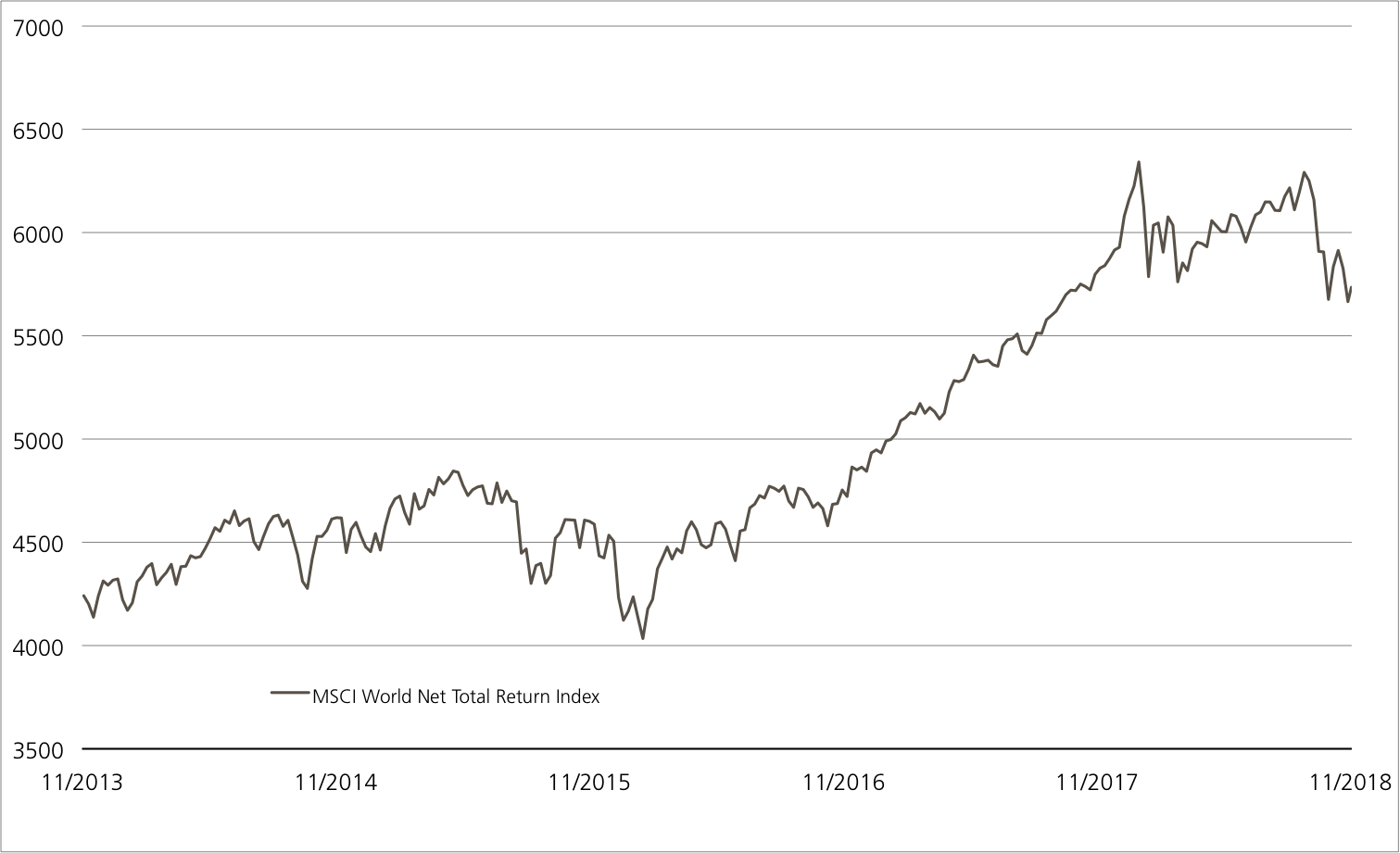
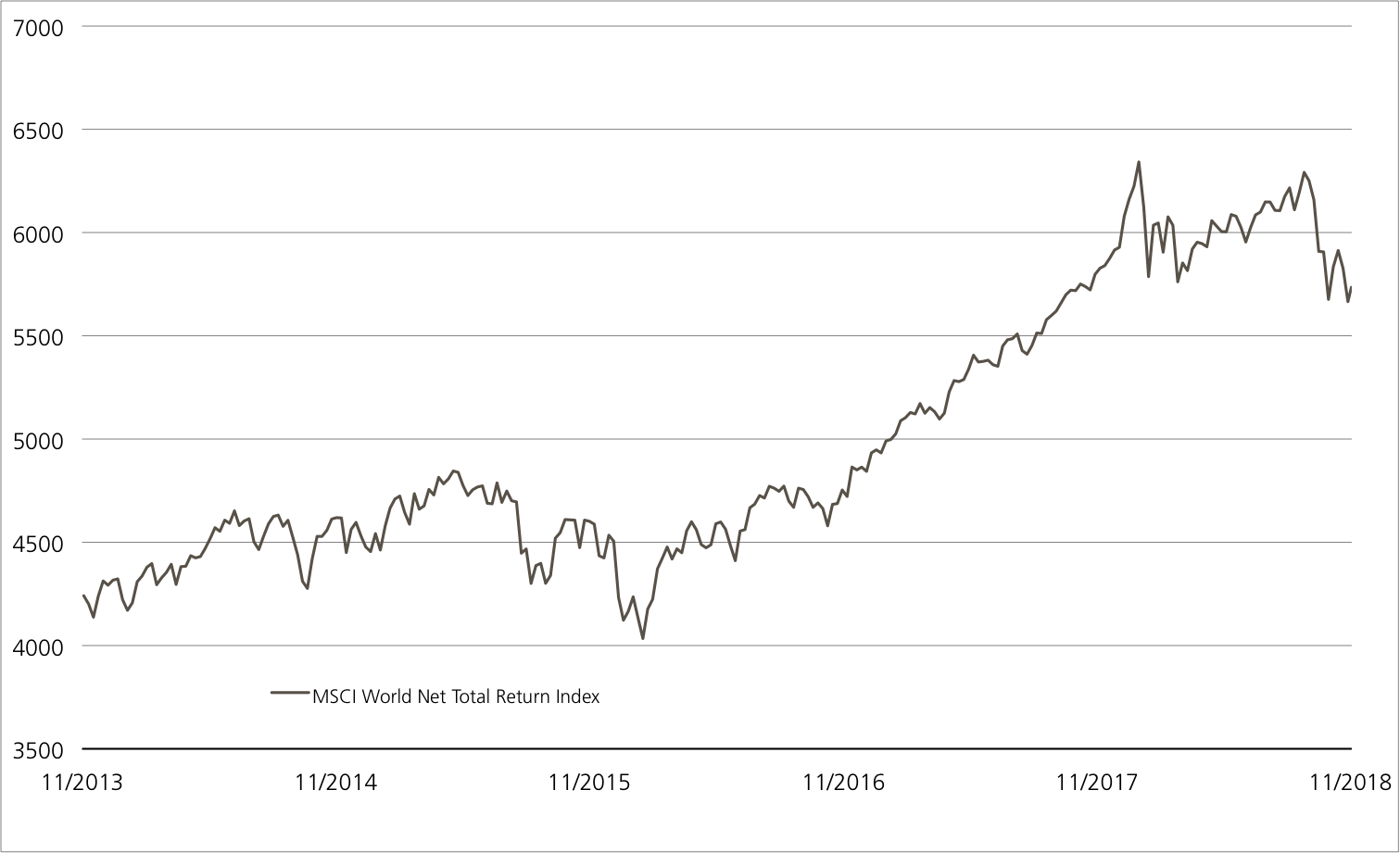
Indice MSCI™ World Net Total Return à 5 ans¹

Fin septembre, la «sélection mondiale» s’est une fois de plus nettement rapprochée de son plus haut record de début 2018. Mais peu avant le sommet, l’indice MSCI™ World Net TR est reparti à la baisse.

Source: UBS AG, Bloomberg

Valeurs du: 28.11.2018

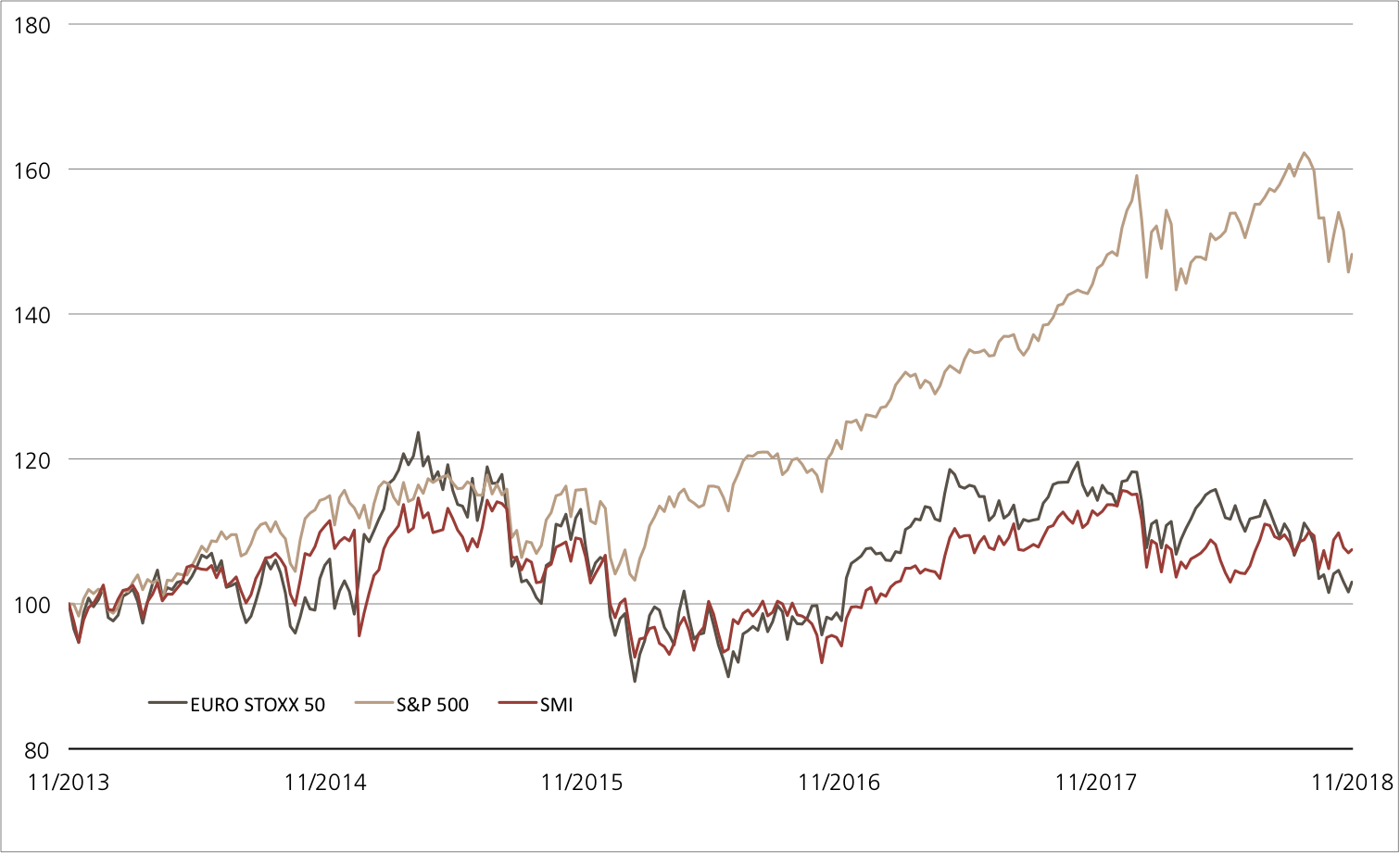
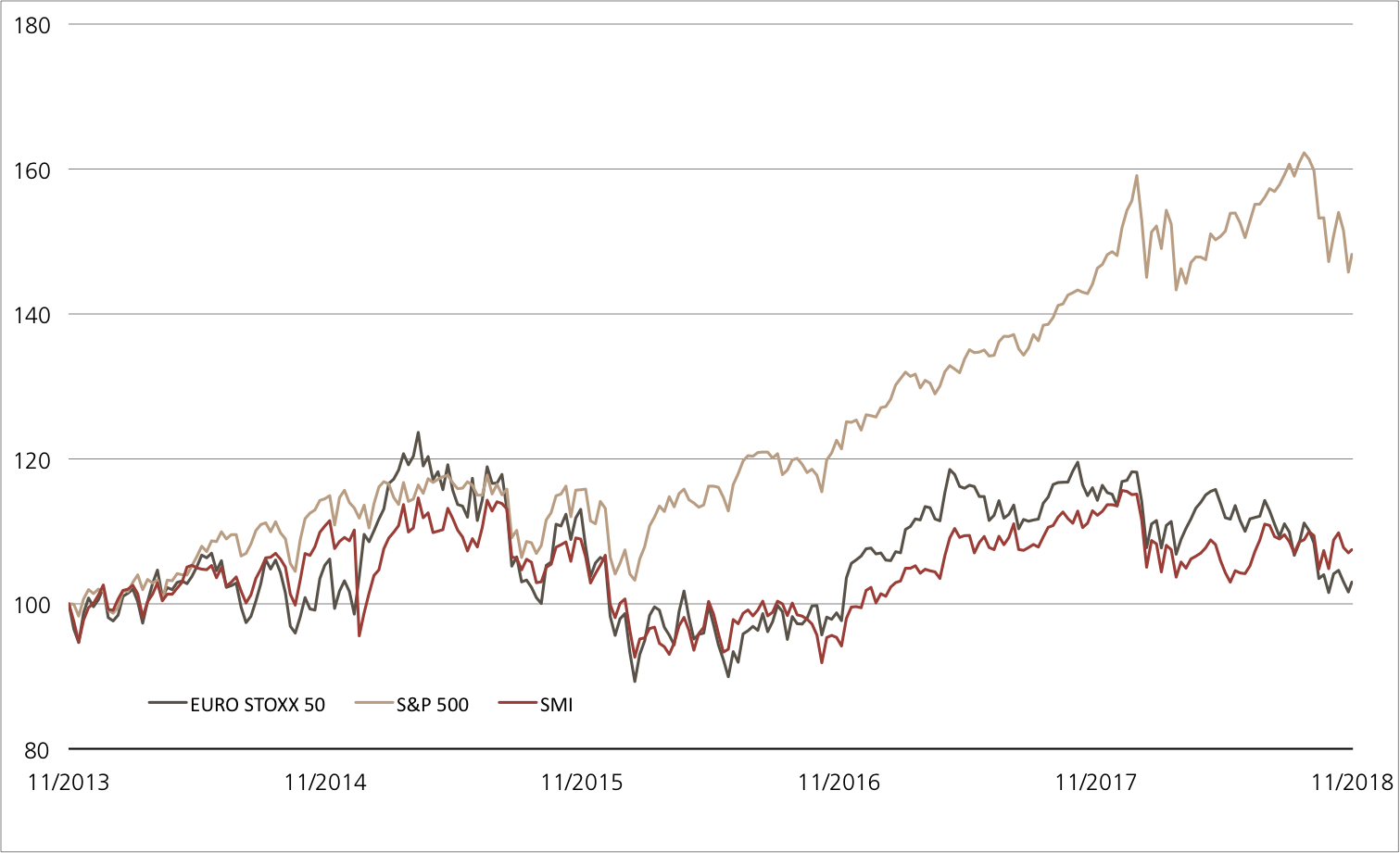
EURO STOXX 50™ vs S&P 500™ vs SMI™
(5 ans, aux fins d’illustration uniquement, données en %)¹

Au cours des cinq dernières années, Wall Street était la référence ultime sur les marchés d’actions internationaux. Par rapport au S&P 500™, les indices de référence européens sont clairement laissés pour compte.

Source: UBS AG, Bloomberg

Valeurs du: 28.11.2018

¹) La performance passée n’indique pas les résultats futures.
²) Les condition des ETTs sont vérifiés annuellement et peuvent être ajustées avec un délai de 13 mois après la publication.

ETT sur MSCI™ World Net Total Return Index

Symbol ETWRLD
SVSP Name Tracker Certifikat
SPVSP Code 1300
Sous-jacent MSCI™ World Net Total Return Index
Devise USD
Rapport de souscription 10:1
Frais de gestion 0.00% p.a.²
Participation 100%
Echéance Open End
Émetteur UBS AG, London
Bid/Ask USD 570.00 / 576.00
 

6.00% p.a. Callable Worst of Kick-In GOAL sur EURO STOXX 50™ / S&P 500™ / SMI™

Symbol KCWDDU
SVSP Name Barrier Reverse Convertible
SPVSP Code 1230 (Auto-Callable)
Sous-jacent EURO STOXX 50™ / S&P 500™ / SMI™
Devise USD
Coupon 6.00% p.a.
Kick-In Level 55.00%
Echéance 07.12.2020
Émetteur UBS AG, London
Date de fixation du prix 05.12.2018, 14:00 h
 

Vous trouverez davantage de produits UBS et des informations sur les opportunités et les risques à l’adresse ubs.com/keyinvest.

Source: UBS AG, Bloomberg

Valeurs du: 28.11.2018

Apérçu du marché

Index Citation Semaine¹
SMI™ 8’894.58 0.6%
SLI™ 1’377.63 0.7%
S&P 500™ 2’743.49 3.5%
Euro STOXX 50™ 3’168.29 0.5%
S&P™ BRIC 40 3’956.98 2.7%
CMCI™ Compos. 881.07 -2.0%
Gold (troy ounce) 1’229.80 USD 0.1%

¹ Changement basé sur le cours de clôture du jour précédent par rapport au cours de clôture de la semaine dernière.

SMI™ vs. VSMI™ 1 année

L’index VSMI™ est calculé depuis 2005. Il affiche la volatilité des actions inclus dans le SMI™ index. Pour la calculation, un portefeuille est utilisé qui ne réagit qu’au variations de la volatilité au lieu des variations des prix. En le faisant, la méthodologie du VSMI™ utilise la volatilité carré, connu sous le terme variance, des options sur le SMI avec 30 jours jusqu’à l’échéance négociées à la Bourse Eurex.

Source: UBS AG, Bloomberg

Valeurs du: 28.11.2018

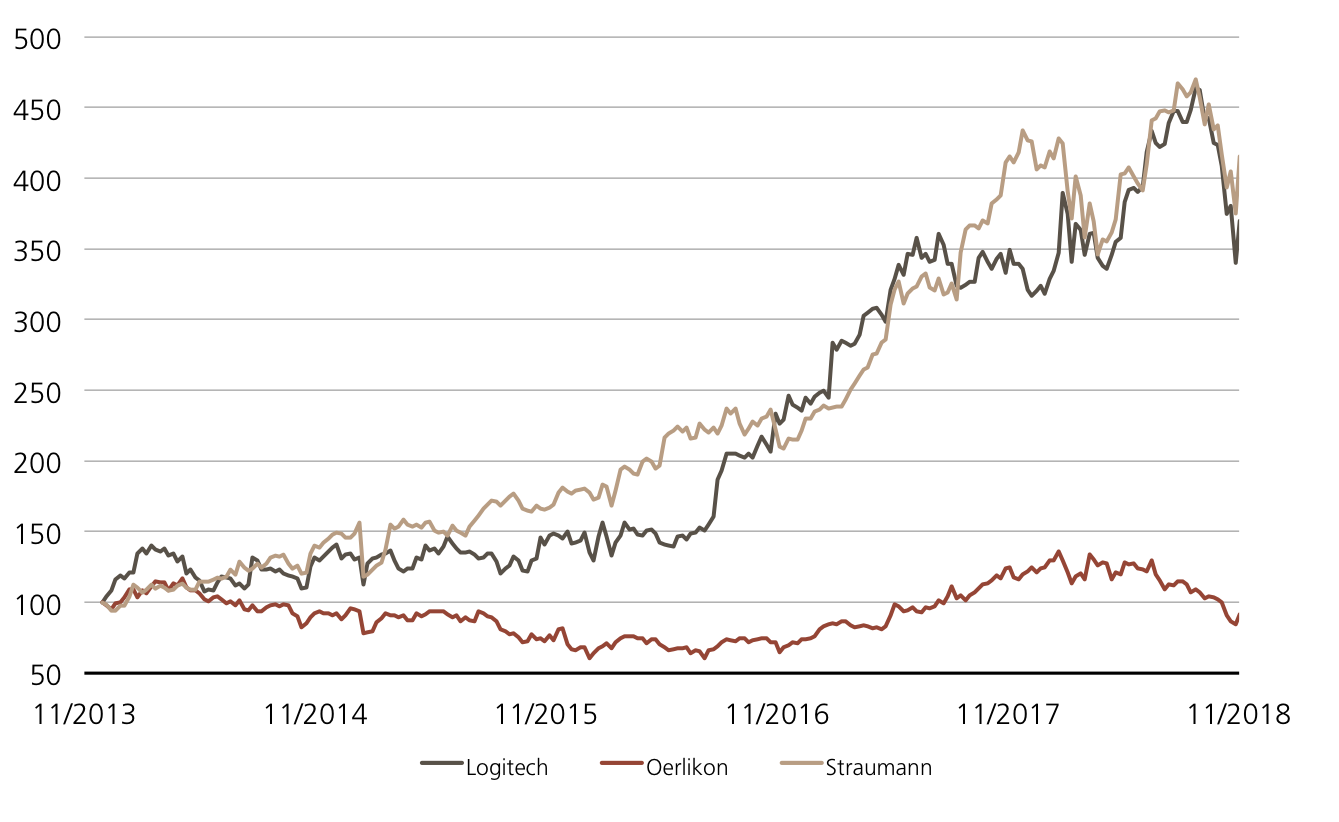
Logitech / Oerlikon / Straumann
Un trio intéressant de mid cap

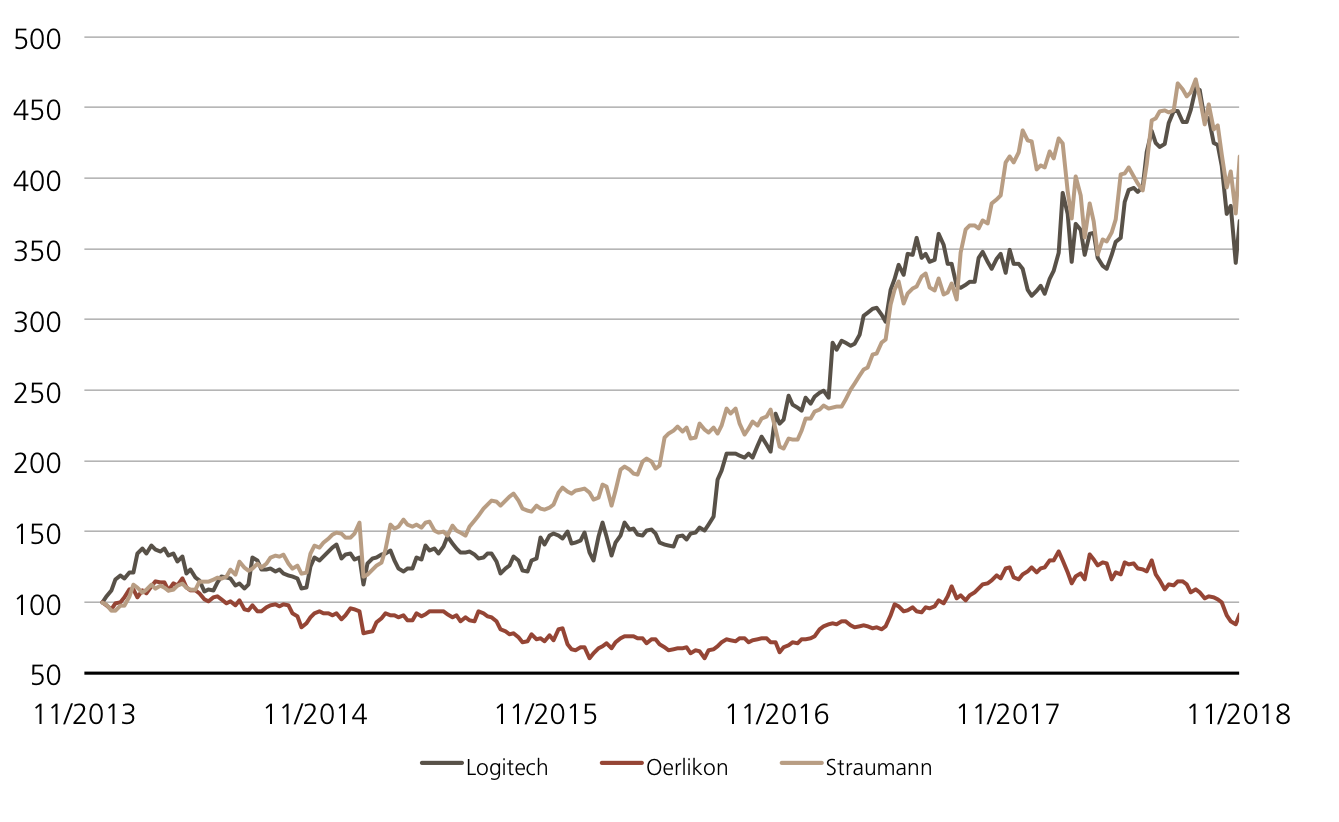
Compte tenu des tensions qui pèsent actuellement sur la phase boursière, les bonnes nouvelles sont plutôt rares. Et pourtant, il y en a, par exemple chez Straumann. Le fabricant leader d’implants de Bâle a revu ses prévisions déjà deux fois à la hausse cette année compte tenu de son carnet de commandes bien rempli. Chez Logitech également, il y a du nouveau. Ainsi, le fabricant d’accessoires informatiques a mis fin, le week-end dernier, aux négociations de rachat du fabricant américain de casques audio Plantronics. Dans le même temps, le groupe industriel OC Oerlikon a indiqué vouloir encore approfondir son partenariat avec Airbus. Le nouvel Early Redemption (ER) Worst of Kick-In GOAL (symbole: KCWPDU) offre aux investisseurs la possibilité d’investir dans le trio de mid cap suisses avec une protection partielle sous condition. Le produit propose un coupon de 10,00% par an pour une marge de sécurité de 40%.

Straumann connaît actuellement une croissance exceptionnelle. Au troisième trimestre, la société a enregistré une hausse organique de son chiffre d’affaires de 18,1%, soit de 2 points de pourcentage de plus que les prévisions. Sur ce, le spécialiste dentaire a de nouveau relevé ses prévisions annuelles. Pour 2018, il s’attend désormais à une croissance de croissance organique proche des 20% (jusqu’à présent, autour de 15%) et à une poursuite de l’amélioration de sa marge EBITDA. Marco Gadola, le CEO, se réjouit particulièrement de la forte gamme de produits, comme les nouveaux mini-implants d’un diamètre de seulement 2,4 mm. Logitech voulait aussi de nouveaux produits et lorgnait sur le fabricant américain de casques audio Plantronics. Selon Thomson Reuters, la transaction devait s’élever à 2,2 milliards de dollars américains et constituer, de loin, la plus grande acquisition de Logitech. Toutefois, selon des sources internes, des divergences au niveau du prix l’ont faite échouer. (Source : Thomson Reuters, revue de presse, 26 novembre 2018) Chez Oerlikon, la croissance organique se poursuit. Airbus a attribué à une solution de surface du groupe l’important statut de «Qualified Supplier». Par ailleurs, Oerlikon a réaffirmé ses objectifs pour 2018 en raison des bons chiffres à neuf mois.

Opportunités: l’ER Worst of Kick-In GOAL (symbole: KCWPDU) est la solution adéquate pour les investisseurs désireux d’intégrer les titres du SMIM™ dans leur dépôt. Le produit en souscription génère un coupon de 10,00% par an indépendamment de l’évolution des cours du trio. Le remboursement du nominal est couplé aux sous-jacents. Aucune baisse n’est à craindre tant que la barrière de 60% du niveau initial reste intacte. Avec la fonction ER, le rendement maximal peut toutefois être atteint plus tôt. Condition: les sous-jacents doivent atteindre ou dépasser ensemble le cours initial à l’un des jours d’observation trimestriel (première date: 4 juin 2019).

Risques: les ER Kick-In GOALS ne bénéficient d’aucune protection du capital. Si, pendant la durée de l’investissement, l’un des sous-jacents atteint une seule fois la barrière respective («Kick-In Level») ou est inférieur à celle-ci, et que la fonction de remboursement anticipé ne s’applique pas, le remboursement par amortissement en espèces à l’échéance est basé sur la performance la plus faible (base Strike) du trio (au maximum toutefois à la valeur nominale majorée du coupon). Dans un tel cas, des pertes sont probables. Par ailleurs, avec les produits structurés, l’investisseur supporte le risque d’émetteur. Cela signifie qu’en cas d’insolvabilité d’UBS SA, le capital investi peut être perdu, indépendamment de l’évolution du sous-jacent.

Vous trouverez davantage de produits UBS et des informations sur les opportunités et les risques à l’adresse ubs.com/keyinvest.

Logitech vs. OC Oerlikon vs. Straumann
(5 ans, aux fins d’illustration uniquement, données en %)¹

Source: UBS AG, Bloomberg

Valeurs du: 28.11.2018

10.00% p.a. Early Redemption Worst of Kick-In GOAL auf Logitech / OC Oerlikon / Straumann

Symbol KCWPDU
SVSP Name Barrier Reverse Convertible
SPVSP Code 1230 (Auto-Callable)
Sous-jacent Logitech / OC Oerlikon / Straumannn
Devise CHF
Coupon 10.00% p.a.
Kick-In Level 60.00%
Echéance 05.06.2020
Émetteur UBS AG, London
Date de fixation du prix 05.12.2018, 15:00 h
 

Vous trouverez davantage de produits UBS et des informations sur les opportunités et les risques à l’adresse ubs.com/keyinvest.

Source: UBS AG, Bloomberg

Valeurs du: 28.11.2018

¹) La performance passée n’indique pas les résultats futures.
²) Les condition des ETTs sont vérifiés annuellement et peuvent être ajustées avec un délai de 13 mois après la publication.

This material has been prepared by UBS AG or one of its affiliates («UBS»). This material is for distribution only as permitted by law. It is not prepared for the needs of any specific recipient. It is published solely for information and is not a solicitation or offer to buy or sell any securities or related financial instruments (“Instruments”). UBS makes no representation or warranty, either express or implied, on the completeness or reliability of the information contained in this document (“Information”) except that concerning UBS AG and its affiliates. The Information should not be regarded by recipients as a substitute for using their own judgment. Any opinions expressed in this material may change without notice and may be contrary to opinions expressed by other business areas of UBS as a result of using different assumptions or criteria. UBS is under no obligation to update the Information. UBS, its officers, employees or clients may have or have had an interest in the Instruments and may at any time transact in them. UBS may have or have had a relationship with entities referred to in the Information. Neither UBS nor any of its affiliates, or their officers or employees, accepts any liability for any loss arising from use of the Information. This presentation is not a basis for entering into a transaction. Any transaction between you and UBS will be subject to the detailed provisions of the term sheet, confirmation or electronic matching systems relating to that transaction. Clients wishing to effect transactions should contact their local sales representative.
This information is communicated by UBS AG and/or its affiliates («UBS»). * (see below) UBS may from time to time, as principal or agent, have positions in, or may buy or sell, or make a market in any securities, currencies, financial instruments or other assets underlying the product to which this website relates (the «Structured Product»). UBS may provide investment banking and other services to and/or have officers who serve as directors of the companies referred to in this website. UBS’s trading and/or hedging activities related to the Structured Product may have an impact on the price of the underlying asset and may affect the likelihood that any relevant barrier or relevant trigger event is crossed or triggered. UBS has policies and procedures designed to minimise the risk that officers and employees are influenced by any conflicting interest or duty and that confidential information is improperly disclosed or made available. UBS may pay or receive brokerage or retrocession fees in connection with the Structured Product described herein. In respect of any Structured Product that is a security, UBS may, in certain circumstances, sell the Structured Product to dealers and other financial institutions at a discount to the issue price or rebate to them for their own account some proportion of the issue price. Further information is available on request. Structured Products are complex and may involve a high risk of loss. Prior to purchasing the Structured Product you should consult with your own legal, regulatory, tax, financial and accounting advisors to the extent you consider it necessary, and make your own investment, hedging and trading decisions (including decisions regarding the suitability of the Structured Product) based upon your own judgement and advice from those advisers you consider necessary. Save as otherwise expressly agreed in writing, UBS is not acting as your financial adviser or fiduciary in relation to the Product. UBS generally hedges its exposure to Structured Products, although it may elect not to hedge or to partially hedge any Structured Product. UBS’s hedging activity may be conducted through transactions in the underlying asset, index or instrument or in options, futures or other derivatives related to the underlying asset, index or instrument on publicly traded markets or otherwise, and may have an impact on the price of the under-lying asset. If a transaction is cash settled, UBS will generally unwind or offset any hedge it has for such Structured Product in close proximity to the relevant valuation time or period. In some cases, this activity may affect the value of the Structured Product. Unless stated otherwise in this document, (i) this document is for information purposes only and should not be construed as an offer, personal recommendation or solicitation to purchase the Structured Product and should not be treated as giving investment advice, and (ii) the terms of any investment in the Structured Product will be exclusively subject to the detailed provisions, including risk considerations, contained in the more detailed legal documentation that relates to the Structured Product (being the confirmation, information memorandum, prospectus or other issuer documentation as relevant). UBS makes no representation or warranty relating to any information herein which is derived from independent sources. This document shall not be copied or reproduced without UBS’s prior written permission. In respect of any Structured Product that is a security, no action has been or will be taken in any jurisdiction that would permit a public offering of the Product, save where explicitly stated in the issuer documentation. The Structured Product must be sold in accordance with all applicable selling restrictions in the jurisdictions in which it is sold.
© UBS 2018. All rights reserved. UBS prohibits the forwarding of this information without the approval of UBS.
Weekly Hits: Sommet du G20 & Un trio intéressant2019-02-15T12:20:44+01:00

Weekly Hits: G20 summit & Interesting trio

KeyInvest Weekly Hits

Friday, 30.11.2018

G20
  • Topic 1: G20 summit - Tango of the superpowers
  • Topic 2: Logitech/Oerlikon/Straumann - An interesting mid-cap trio

G20 summit
Tango of the superpowers

On November 30th and December 1st, the heads of states and governments of the leading economies will meet for the G20 summit; However, the spotlight in Buenos Aires will mainly be on Donald Trump und Xi Jinping. The US President and his Chinese counterpart may potentially discuss the current trade dispute in a private meeting. According to UBS CIO GWM, signs that tensions are easing would be met with open arms on the markets. The experts believe it possible that positive surprises will occur in two other areas with a view to the coming months. This assessment was the reasoning behind CIO GWM increasing the overweighting of global equities in the asset allocation. With an ETT (symbol: ETWRLD) on the MSCI™ World Net Total Return Index, investors can replicate this strategy. A global approach can also be taken with the Callable Kick-In GOAL (symbol: KCWDDU) on EURO STOXX 50™, S&P 500™ and SMI™. Nevertheless, this product is not reliant on rising prices to deliver the maximum annual return of 6%. Rather, the three prominent indexes start the two-year term with a safety buffer of 45%.

It’s the ultimate event – the countries that will be in attendance at the G20 summit represent 85% of the global economic output and 75% of global trade. They also are home to two-thirds of the world’s population (source: www.g20.org). One of the main topics of the summit will be the trade dispute between the US and China, which has been simmering for months. In the run-up to the event, hopes were not particularly high that a potential face-to-face meeting between US President Donald Trump and China’s ruler Xi Jinping would lead to a solution. CIO GWM is generally of the same opinion. However, the experts believe that there is a 20% chance of a market-friendly result, for example in the form of at least a temporary agreement.

Looking ahead to the coming months, CIO GWM has identified two additional areas where there could be positive surprises. For example, it states that China is attempting to compensate for the negative effects of US punitive tariffs with fiscal measures and by adjusting its monetary policy. According to CIO GWM, there are signs that this proactive attitude is beginning to take effect. In addition, growth in Europe in the first half of 2019 could produce a positive surprise. Meanwhile, CIO GWM identifies the main risks as being an escalation of the tariff dispute and US interest rate hikes exceeding expectations. Following the recent equity market correction, strategists believe that it is now a favorable time to enter the market. This is also due to the drop in the valuation level and the potential for surprises outlined above. (Source: UBS CIO GWM: “UBS House View Monthly Letter”, November 15, 2018)

Opportunities: The ETT (symbol: ETWRLD) on the MSCI™ World Net Total Return Index allows investors to take up a diversified position on the global equity market. More than 1,600 companies from 23 developed countries are contained in the underlying. The Callable Kick-In GOAL (symbol: KCWDDU) on EURO STOXX 50™, S&P 500™ and SMI™ offers an alternative to direct participation in the global benchmark. Irrespective of the performance of the underlying indexes, the product pays a coupon of 6% per year. As long as none of the underlyings equal or fall below the barrier at a low 55% of the initial prices, investors will receive their nominal repaid in full on the date of maturity. If the issuer exercises the callable function, the term can be ended after just one year. Starting with December 5, 2019, there is a right to termination every three months.

Risks: The aforementioned products do not have capital protection. The ETT will make a loss if the underlying index decreases. If the underlying assets for the Kick-In GOALs touch or fall below the respective kick-in level and the callable feature does not apply, the amount repaid on the date of maturity may be in cash, reflecting the worst performance of the three indexes (but not more than nominal value plus coupon). In this case, it is likely that losses will be incurred. Investors in structured products are also exposed to issuer risk, which means that the capital invested may be lost if UBS AG becomes insolvent, regardless of the performance of the underlying.

More UBS products and further information on the risks and opportunities are available at ubs.com/keyinvest.

MSCI™ World Net Total Return Index 5 years¹

At the end of September, the “world select” came very close to equaling the all-time high reached at the beginning of 2018. Shortly before this summit, however, the MSCI™ World Net TR Index suffered a downturn.

Source: UBS AG, Bloomberg

As of 28.11.2018

EURO STOXX 50™ vs. S&P 500™ vs. SMI™
(5 years; for illustrative purposes only; figures in %)¹

For the past five years, Wall Street has been the measure of all things related to the global equity markets. Compared to the S&P 500™, the European benchmarks are clearly lagging behind.

Source: UBS AG, Bloomberg

As of: 28.11.2018

¹) Please be aware that past performance does not indicate future results.
²) The conditions of ETTs are reviewed on a yearly basis and can be adjusted with a deadline of 13 months after the announcement.

ETT on MSCI™ World Net Total Return Index

Symbol ETWRLD
SVSP Name Tracker-Zertifikat
SPVSP Code 1300
Underlying MSCI™ World Net Total Return Index
Currency USD
Ratio 10:1
Administration fee 0.00% p.a.²
Expiry Open End
Participation 100%
Issuer UBS AG, London
Bid/Ask USD 570.00 / 576.00
 

6.00% p.a. Callable Worst of Kick-In GOAL on EURO STOXX 50™ / S&P 500™ / SMI™

Symbol KCWDDU
SVSP Name Barrier Reverse Convertible
SPVSP Code 1230 (Auto-Callable)
Underlying EURO STOXX 50™ / S&P 500™ / SMI™
Currency USD
Coupon 6.00% p.a.
Kick-In Level 55.00%
Expiry 07.12.2020
Issuer UBS AG, London
Subscription until 05.12.2018, 14:00 h
 

More UBS products and further information on the risks and opportunities are available at ubs.com/keyinvest.

Source: UBS AG, Bloomberg

As of: 28.11.2018

Market overview

Index Quotation Week¹
SMI™ 8’894.58 0.6%
SLI™ 1’377.63 0.7%
S&P 500™ 2’743.49 3.5%
Euro STOXX 50™ 3’168.29 0.5%
S&P™ BRIC 40 3’956.98 2.7%
CMCI™ Compos. 881.07 -2.0%
Gold (troy ounce) 1’229.80 USD 0.1%

¹ Change based on the closing price of the previous day compared to the closing price a week ago.

SMI™ vs. VSMI™ 1 year

smi vs vsmi

The VSMI™ Index is calculated since 2005. It shows the volatility of the stocks within the SMI™ index. A portfolio which reacts only to changes in volatility instead of volatility itself is relevant for the calculation. Thereby, the VSMI™ methodology uses the squared volatility, known as variance, of the SMI options with remaining time to expiry of 30 days traded at the Eurex.

Source: UBS AG, Bloomberg

As of: 28.11.2018

Logitech/Oerlikon/Straumann
An interesting mid-cap trio

There is a distinct lack of good news on the stock market in these current tense times. And yet, there are instances here and there, for example at Straumann. The leading implant manufacturer from Basel has already increased its forecast twice this year due to its flourishing business. There is also exciting news at Logitech. Last weekend, the computer accessories manufacturer ended takeover talks with US headphone manufacturer Plantronics. Meanwhile, the OC Oerlikon industrial group announced its plans to further expand its partnership with Airbus. The new Early Redemption (ER) Worst of Kick-In GOAL (symbol: KCWPDU) offers investors the opportunity to invest in the Swiss mid-cap trio with conditional partial protection. The product pays out a double-digit percentage coupon of 10% every year and also provides a risk buffer of 40%.

Straumann is currently enjoying strong growth. In the third quarter, organic sales growth amounted to 18.1% and was thus two percentage points higher than expected. As a result, the dental specialist raised its forecast for the year once again. Organic growth in the high (previously: medium) 10% range and a further improvement in the EBITDA margin are now expected for 2018. CEO Marco Gadola is happy with the strong product range, such as the new mini implants with a diameter of just 2.4 millimeters. Logitech also wanted to bring in new products and thus focused on US headphone manufacturer Plantronics. According to Thomson Reuters, the transaction would have cost more than USD 2.2 billion, which would be by far the largest acquisition made by Logitech. However, according to insiders, the deal collapsed due to differing price expectations. (Source: Thomson Reuters media report, November 26, 2018) In the meantime, Oerlikon is enjoying continuing organic growth. The group’s Surface Solutions segment has been awarded the prized status of “Qualified Supplier” by Airbus. In addition, Oerlikon confirmed its targets for 2018 after recording pleasing nine-month figures.

Opportunities: The ER Worst of Kick-In GOAL (symbol: KCWPDU) is the perfect solution for investors wanting to include the SMIM™ shares in their portfolios. The product available for subscription pays an annual coupon of 10% regardless of the price performance of the three shares. The repayment of the nominal is linked to the underlyings. Provided that the barrier of 60% of the starting prices remains intact, investors will remain safe from losses. The maximum return can also be achieved earlier due to the early redemption function. Requirement: The underlyings all have to be at or above their starting price on one of the quarterly observation days (first date: June 4, 2019).

Risks: ER Kick-In GOALs do not have capital protection. If the underlyings equal or fall below the respective kick-in level (barrier) and the early redemption feature does not apply, the amount repaid on the date of maturity may be in cash, reflecting the worst performance of the three shares (but not more than nominal value plus coupon). In this case, it is likely that losses will be incurred. Investors in structured products are also exposed to issuer risk, which means that the invested capital may be lost if UBS AG becomes insolvent, regardless of the performance of the underlying.

More UBS products and further information on the risks and opportunities are available at ubs.com/keyinvest.

Logitech vs. OC Oerlikon vs. Straumann
(5 years; for illustrative purposes only; figures in %)¹

Source: UBS AG, Bloomberg

As of: 28.11.2018

7.00% p.a. ER Kick-In GOAL on Continental, Michelin

Symbol KCWPDU
SVSP Name Barrier Reverse Convertible
SPVSP Code 1230 (Auto-Callable)
Underlyings Logitech / OC Oerlikon / Straumannn
Currency CHF
Coupon 10.00% p.a.
Kick-In Level 60.00%
Expiry 05.06.2020
Issuer UBS AG, London
Subscription until 05.12.2018, 15:00 h
 

More UBS products and further information on the risks and opportunities are available at ubs.com/keyinvest.

Source: UBS AG, Bloomberg

As of: 28.11.2018

¹) Please be aware that past performance does not indicate future results.
²) The conditions of ETTs are reviewed on a yearly basis and can be adjusted with a deadline of 13 months after the announcement.

This material has been prepared by UBS AG or one of its affiliates («UBS»). This material is for distribution only as permitted by law. It is not prepared for the needs of any specific recipient. It is published solely for information and is not a solicitation or offer to buy or sell any securities or related financial instruments (“Instruments”). UBS makes no representation or warranty, either express or implied, on the completeness or reliability of the information contained in this document (“Information”) except that concerning UBS AG and its affiliates. The Information should not be regarded by recipients as a substitute for using their own judgment. Any opinions expressed in this material may change without notice and may be contrary to opinions expressed by other business areas of UBS as a result of using different assumptions or criteria. UBS is under no obligation to update the Information. UBS, its officers, employees or clients may have or have had an interest in the Instruments and may at any time transact in them. UBS may have or have had a relationship with entities referred to in the Information. Neither UBS nor any of its affiliates, or their officers or employees, accepts any liability for any loss arising from use of the Information. This presentation is not a basis for entering into a transaction. Any transaction between you and UBS will be subject to the detailed provisions of the term sheet, confirmation or electronic matching systems relating to that transaction. Clients wishing to effect transactions should contact their local sales representative.
This information is communicated by UBS AG and/or its affiliates («UBS»). * (see below) UBS may from time to time, as principal or agent, have positions in, or may buy or sell, or make a market in any securities, currencies, financial instruments or other assets underlying the product to which this website relates (the «Structured Product»). UBS may provide investment banking and other services to and/or have officers who serve as directors of the companies referred to in this website. UBS’s trading and/or hedging activities related to the Structured Product may have an impact on the price of the underlying asset and may affect the likelihood that any relevant barrier or relevant trigger event is crossed or triggered. UBS has policies and procedures designed to minimise the risk that officers and employees are influenced by any conflicting interest or duty and that confidential information is improperly disclosed or made available. UBS may pay or receive brokerage or retrocession fees in connection with the Structured Product described herein. In respect of any Structured Product that is a security, UBS may, in certain circumstances, sell the Structured Product to dealers and other financial institutions at a discount to the issue price or rebate to them for their own account some proportion of the issue price. Further information is available on request. Structured Products are complex and may involve a high risk of loss. Prior to purchasing the Structured Product you should consult with your own legal, regulatory, tax, financial and accounting advisors to the extent you consider it necessary, and make your own investment, hedging and trading decisions (including decisions regarding the suitability of the Structured Product) based upon your own judgement and advice from those advisers you consider necessary. Save as otherwise expressly agreed in writing, UBS is not acting as your financial adviser or fiduciary in relation to the Product. UBS generally hedges its exposure to Structured Products, although it may elect not to hedge or to partially hedge any Structured Product. UBS’s hedging activity may be conducted through transactions in the underlying asset, index or instrument or in options, futures or other derivatives related to the underlying asset, index or instrument on publicly traded markets or otherwise, and may have an impact on the price of the under-lying asset. If a transaction is cash settled, UBS will generally unwind or offset any hedge it has for such Structured Product in close proximity to the relevant valuation time or period. In some cases, this activity may affect the value of the Structured Product. Unless stated otherwise in this document, (i) this document is for information purposes only and should not be construed as an offer, personal recommendation or solicitation to purchase the Structured Product and should not be treated as giving investment advice, and (ii) the terms of any investment in the Structured Product will be exclusively subject to the detailed provisions, including risk considerations, contained in the more detailed legal documentation that relates to the Structured Product (being the confirmation, information memorandum, prospectus or other issuer documentation as relevant). UBS makes no representation or warranty relating to any information herein which is derived from independent sources. This document shall not be copied or reproduced without UBS’s prior written permission. In respect of any Structured Product that is a security, no action has been or will be taken in any jurisdiction that would permit a public offering of the Product, save where explicitly stated in the issuer documentation. The Structured Product must be sold in accordance with all applicable selling restrictions in the jurisdictions in which it is sold.
© UBS 2018. All rights reserved. UBS prohibits the forwarding of this information without the approval of UBS.
Weekly Hits: G20 summit & Interesting trio2019-02-15T12:14:12+01:00

Weekly Hits: G20-Gipfel & Interessantes Mid-Cap-Trio


KeyInvest Weekly Hits
Donnerstag, 29.11.2018
  • Thema 1: G20-Gipfel – Tango der Supermächte
  • Thema 2: Logitech / Oerlikon / Straumann – Interessantes Mid-Cap-Trio

G20-Gipfel
Tango der Supermächte

Am 30. November und 1. Dezember kommen die  Staats- und Regierungschefs der führende Volkswirtschaften zum G20-Gipfel zusammen. In Buenos Aires dürften vor allem Donald Trump und Xi Jinping im Fokus stehen. Der US-Präsident und sein chinesischer Kollege diskutieren möglicherweise im Vier-Augen-Gespräch über den aktuellen Handelsstreit. Laut UBS CIO GWM würden die Märkte Zeichen der Entspannung mit Wohlwollen aufnehmen. In zwei weiteren Bereichen halten die Experten mit Blick auf die kommenden Monate positive Überraschungen für möglich. Diese Einschätzung war für CIO GWM ein Grund dafür, die Übergewichtung von globalen Aktien in der Vermögensallokation auszubauen. Mit einem ETT (Symbol: ETWRLD) auf den MSCI™ World Net Total Return Index können Anleger diese Strategie abbilden. Ein globaler Ansatz lässt sich auch mit dem Callable Kick-In GOAL (Symbol: KCWDDU) auf EURO STOXX 50™, S&P 500™ und SMI™ verfolgen. Allerdings ist dieses Produkt nicht auf steigende Kurse angewiesen, um die Maximalrendite von 6.00 Prozent p.a. abzuwerfen. Vielmehr starten die drei prominenten Indizes mit einem Sicherheitspolster von 45 Prozent in die zweijährige Laufzeit.

Es ist ein Anlass der Superlative: Die am G20-Gipfel teilnehmenden Ländern stehen für 85 Prozent der globalen Wirtschaftsleistung und 75 Prozent des Welthandels. Gleichzeitig beheimaten sie zwei Drittel der Weltbevölkerung. (Quelle: www.g20.org) Zu den bestimmenden Themen des Gipfels dürfte der seit Monaten schwelende Handelsstreit zwischen den USA und China zählen. Im Vorfeld waren die Hoffnungen nicht sonderlich gross, dass es bei einem möglichen persönlichen Treffen von US-Präsident Donald Trump mit Chinas Machthaber Xi Jinping zu einer Lösung kommt. Grundsätzlich teilt CIO GWM diese Erwartungshaltung. Allerdings sehen die Experten eine Wahrscheinlichkeit von 20 Prozent für ein marktfreundliches Ergebnis, beispielsweise in Form einer zumindest vorübergehenden Einigung.
 
Mit Blick auf die kommenden Monate hat CIO GWM zwei weitere Bereiche ausgemacht, in denen es zu positiven Überraschungen kommen könnte. So versuche China, mit fiskalischen und geldpolitischen Mitteln, die negativen Effekte aus den US-Strafzöllen zu kompensieren. Laut CIO GWM gibt es Zeichen dafür, dass diese pro-aktive Haltung zu wirken beginnt. Darüber hinaus könnte das Wachstum in Europa im ersten Semester 2019 positiv überraschen. Als zentrale Risiken bezeichnet CIO GWM derweil neben einer Eskalation des Zollstreits über die Erwartungen hinausgehende US-Zinserhöhungen. Alles in allem sehen die Strategen in der jüngsten Korrektur am Aktienmarkt einen günstigen Einstiegszeitpunkt. Neben dem skizzierten Überraschungspotenzial verweisen sie auf das reduzierte Bewertungsniveau. (Quelle: UBS CIO GWM: «UBS House View Monthly Letter», 15.11.2018)


Chancen:
Der ETT (Symbol: ETWRLD) auf den MSCI™ World Net Total Return Index ermöglicht eine diversifizierte Positionierung am globalen Aktienmarkt. Im Basiswert sind mehr als 1’600 Unternehmen aus 23 entwickelten Ländern enthalten. Eine Alternative zu direkten Partizipation am globalen Benchmark bietet der Callable Kick-In GOAL (Symbol: KCWDDU) auf EURO STOXX 50™, S&P 500™ und SMI™. Ungeachtet dem Kursverlauf der drei zugrunde liegenden Indizes zahlt das Produkt einen Coupon in Höhe von 6.00 Prozent p.a. Solange kein Basiswert auf oder unter die Barriere bei tiefen 55 Prozent der Anfangsfixierung fällt, erhalten Anleger am Verfalltag das Nominal vollständig zurück. Falls die Emittentin von der Callable Funktion Gebrauch macht, kann die Laufzeit bereits nach einem Jahr enden. Beginnend mit dem 5. Dezember 2019 besteht alle drei Monate ein Kündigungsrecht.

Risiken:
Die vorgestellten Produkte sind nicht kapitalgeschützt. Beim ETT kommt es zu Verlusten, wenn der zugrundeliegende Index fällt. Notiert einer der Basiswerte des Kick-In GOALs während der Laufzeit einmal auf oder unter dem jeweiligen Kick-In Level (Barriere) und kommt zudem das Callable Feature nicht zum Tragen, kann die Tilgung am Verfalltag durch Bartilgung entsprechend der (vom Strike aus) schwächsten Performance aus dem Indextrio erfolgen (höchstens jedoch zum Nominalwert zuzüglich Coupon). In diesem Fall sind Verluste wahrscheinlich. Zudem trägt der Anleger bei strukturierten Produkten das Emittentenrisiko, so dass das eingesetzte Kapital – unabhängig von der Entwicklung des Basiswertes – im Falle einer Insolvenz der UBS AG verloren gehen kann.

Weitere UBS Produkte sowie Informationen zu Chancen und Risiken finden Sie unter ubs.com/keyinvest.
 
 
MSCI™ World Net Total Return Index 5 Jahre¹
Ende September kam die «Weltauswahl» dem Anfang 2018 erreichten Allzeithoch noch einmal ziemlich nahe. Doch kurz vor diesem Gipfel drehte der MSCI™ World Net TR Index nach unten.
 
Quelle: UBS AG, Bloomberg
Stand: 28.11.2018

EURO STOXX 50™ vs. S&P 500™ vs. SMI™
(5 Jahre, nur zu illustrativen Zwecken, Angaben in%)¹
Die Wall Street war an den globalen Aktienmärkten in den vergangenen fünf Jahren das Mass aller Dinge. Gegenüber dem S&P 500™ haben die europäischen Benchmarks eindeutig das Nachsehen.
 
Quelle: UBS AG, Bloomberg
Stand: 28.11.2018

 
¹) Bitte beachten Sie, dass vergangene Wertentwicklungen keine Indikationen für künftige Wertentwicklungen sind.
²) Die Konditionen der ETTs werden jährlich überprüft und können mit einer Frist von 13 Monaten nach Bekanntgabe angepasst werden
 
ETT auf den MSCI™ World Net Total Return Index

Symbol ETWRLD
SVSP Name Tracker-Zertifikat
SVSP Code 1300
Basiswert MSCI™ World Net Total Return Index
Bezugsverhältnis 10:1
Handelswährung USD
Verwaltungsgebühr 0.00% p.a.²
Partizipation 100%
Verfall Open End
Emittentin UBS AG, London
Geld-/Briefkurs USD 570.00 / 576.00
 

6.00% p.a. Callable Worst of Kick-In GOAL auf EURO STOXX 50™ / S&P 500™ / SMI™

Symbol KCWDDU
SVSP Name Barrier Reverse Convertible
SVSP Code 1230 (Callable)
Basiswerte EURO STOXX 50™ / S&P 500™ / SMI™
Handelswährung USD
Coupon 6.00% p.a.
Kick-In Level (Barriere)
55.00%
Verfall 07.12.2020
Emittentin UBS AG, London
Zeichnung bis 05.12.2018, 14:00 Uhr
 

Weitere Produkte sowie Informationen zu Chancen und Risiken finden Sie unter: ubs.com/keyinvest Quelle: UBS AG, Bloomberg Stand: 28.11.2018
 
Marktübersicht
Index Stand Woche¹
SMI™ 8’894.58 Pkt. 0.6%
SLI™ 1’377.63 Pkt. 0.7%
S&P 500™ 2’743.49 Pkt. 3.5%
EURO STOXX 50™ 3’168.29 Pkt. 0.5%
S&P™ BRIC 40 3’956.98 Pkt. 2.7%
CMCI™ Compos. 881.07 Pkt. -2.0%
Gold (Feinunze) 1’229.80 USD 0.1%

SMI™ vs. VSMI™ 1 Jahr

 
¹ Veränderung auf Basis des Schlusskurses des Vortages im Vergleich zum Schlusskurs vor einer Woche.
Der VSMI™ Index wird seit 2005 berechnet. Er zeigt die Volatilität der im SMI™ Index enthaltenen Aktien. Massgeblich für die Berechnung ist ein Portfolio, welches nicht auf Preisschwankungen, sondern ausschliesslich auf Veränderungen der Volatilität reagiert. Dabei greift die VSMI™ Methodik auf die quadrierten Volatilitäten, im Fachjargon „Varianzen“, der an der Eurex gehandelten SMI-Optionen mit einer konstanten Restlaufzeit von 30 Tagen zurück.


Logitech / Oerlikon / Straumann
Interessantes Mid-Cap-Trio

 
Gute Nachrichten sind in der aktuell angespannten Börsenphase eher Mangelware. Und doch gibt es sie, zum Beispiel bei Straumann. Der führende Implantatehersteller aus Basel hat aufgrund florierender Geschäfte dieses Jahr bereits zwei Mal die Prognose angehoben. Auch bei Logitech gibt es spannende News. So beendete der Computerzubehör-Hersteller vergangenes Wochenende die Übernahmegespräche mit dem US-Kopfhörer-Produzenten Plantronics. Der Industriekonzern OC Oerlikon gab derweil bekannt, die Partnerschaft mit Airbus weiter zu vertiefen. Der neue Early Redemption (ER) Worst of Kick-In GOAL (Symbol: KCWPDU) bietet Anlegern die Möglichkeit, mit bedingten Teilschutz in das Schweizer Mid-Cap-Trio zu investieren. Das Produkt schüttet einen prozentual zweistelligen Coupon in Höhe von 10.00 Prozent p.a. aus und bietet gleichzeitig einen Risikopuffer von 40 Prozent.
 
Straumann ist derzeit auf einem steilen Wachstumskurs. Im dritten Quartal betrug das organische Umsatzplus 18.1 Prozent und lag damit zwei Prozentpunkte über den Erwartungen. Daraufhin hob der Dentalspezialist erneut die Jahresprognose an. Für 2018 wird nun mit einem organischen Wachstum im hohen (bisher: mittleren) Zehn-Prozent-Bereich sowie einer weiteren Verbesserung der EBITDA-Marge gerechnet. Positiv stimmt CEO Marco Gadola die starke Produktpalette, wie zum Beispiel die neuen Mini-Implantate mit einem Durchmesser von nur 2.4 Millimeter. Frische Produkte wollte sich auch Logitech ins Haus holen und schielte dabei auf den US-Kopfhörer-Produzenten Plantronics. Nach Angaben von Thomson Reuters wäre die Transaktion mehr als 2.2 Milliarden US-Dollar schwer gewesen und damit der mit Abstand grösste Zukauf von Logitech. Allerdings platzte der Deal Insidern zufolge an den unterschiedlichen Preisvorstellungen. (Quelle: Thomson Reuters, Medienbericht, 26.11.2018) Bei Oerlikon hält derweil das organische Wachstum an. Eine Oberflächenlösung des Konzerns hat von Airbus den wichtigen Status «Qualified Supplier» bekommen. Zudem bekräftigte Oerlikon die Ziele für 2018 nach guten Neun-Monats-Zahlen.
 

Chancen:
Wer sich die SMIM™-Titel ins Depot holen möchte, dem steht mit dem ER Worst of Kick-In GOAL (Symbol: KCWPDU) eine passende Lösung zur Verfügung. Das in Zeichnung stehende Produkt wirft unabhängig vom Kursverlauf des Trios einen Coupon von 10.00 Prozent p.a. ab. Die Rückzahlung des Nominal ist an die Basiswerte gekoppelt. Solange die Barriere bei 60 Prozent des Startniveaus unversehrt bleibt, sind keine Abschläge zu befürchten. Aufgrund der ER-Funktion ist der Höchstertrag bereits früher möglich. Voraussetzung: Die Basiswerte müssen an einem der vierteljährlichen Beobachtungstage (erster Termin: 04.06.2019) gemeinsam auf oder über dem Ausgangskurs notieren.

Risiken:
ER Kick-In GOALs sind nicht kapitalgeschützt. Notiert einer der Basiswerte während der Laufzeit einmal auf oder unter dem jeweiligen Kick-In Level (Barriere) und kommt zudem des Early Redemption Feature nicht zum tragen, kann die Tilgung am Verfalltag durch Bartilgung entsprechend der (vom Strike aus) schwächsten Performance aus dem Trio erfolgen (höchstens jedoch zum Nominalwert zuzüglich Coupon). In diesem Fall sind Verluste wahrscheinlich. Zudem trägt der Anleger bei Strukturierten Produkten das Emittentenrisiko, so dass das eingesetzte Kapital – unabhängig von der Entwicklung des Basiswertes – im Falle einer Insolvenz der UBS AG verloren gehen kann.
Weitere UBS Produkte sowie Informationen zu Chancen und Risiken finden Sie unter ubs.com/keyinvest.
 
Logitech vs. OC Oerlikon vs. Straumann
(5 Jahre, nur zu illustrativen Zwecken, Angaben in%)¹
Quelle: UBS AGStand: 28.11.2018

 
10.00% p.a. Early Redemption Worst of Kick-In GOAL auf Logitech / OC Oerlikon / Straumann
Symbol KCWPDU
SVSP Name Barrier Reverse Convertible
SVSP Code 1230 (Auto-Callable)
Basiswerte Logitech / OC Oerlikon / Straumannn
Handelswährung CHF
Coupon 10.00% p.a.
Kick-In Level (Barriere)
60.00%
Verfall 05.06.2020
Emittentin UBS AG, London
Zeichnung bis 05.12.2018, 15:00 Uhr
 

Termsheet Weitere Produkte sowie Informationen zu Chancen und Risiken finden Sie unter: ubs.com/keyinvest   Quelle: UBS AG Stand: 28.11.2018

 
¹) Bitte beachten Sie, dass vergangene Wertentwicklungen keine Indikationen für künftige Wertentwicklungen sind.
²) Die Konditionen der ETTs werden jährlich überprüft und können mit einer Frist von 13 Monaten nach Bekanntgabe angepasst werden


Die in diesem Dokument enthaltenen Informationen werden ausschliesslich zu Informations- und Werbezwecken zur Verfügung gestellt und stellen weder Empfehlungen noch Anlageberatung von UBS AG, einer ihrer Tochtergesellschaften oder verbundenen Unternehmen («UBS») dar. Dieses Dokument wird nicht von einer UBS Research Abteilung ausgegeben und ist deshalb nicht als unabhängige Anlageforschung zu erachten. Es stellt weder einen Verkaufsprospekt, noch ein Angebot oder eine Einladung zur Offertenstellung dar, irgendeine Art von Anlage zu tätigen. Beachten Sie bitte, dass die Anlagebeispiele die Ansichten von UBS Research möglicherweise nicht vollständig wiedergeben. Dieses Dokument und die darin beschriebenen Produkte und Dienstleistungen sind allgemeiner Natur und beziehen sich weder auf die persönlichen Anlageziele noch die finanzielle Situation oder besonderen Bedürfnisse eines spezifischen Empfängers. Anlageentscheide sollten stets im Portfoliokontext getroffen werden und Ihre persönliche Situation und Ihre entsprechende Risikobereitschaft und Risikofähigkeit berücksichtigen. Sie werden hiermit auf diese Risiken (die mitunter erheblich sein können) hingewiesen. Bevor Sie einen Anlageentscheid treffen, lesen Sie bitte die spezifischen Produkteinformationen und die Broschüre «Besondere Risiken im Effektenhandel». Bitte kontaktieren Sie Ihren Kundenberater, der Sie gerne bei Ihren Anlageideen unterstützt und Ihnen die spezifischen Produktinformationen zur Verfügung stellt. UBS übernimmt diesbezüglich keinerlei Haftung für das Verhalten von Dritten. Wir weisen Sie darauf hin, dass sich UBS das Recht vorbehält, Dienstleistungen, Produkte und Preise jederzeit ohne vorhergehende Ankündigung zu ändern, und dass sich die wiedergegebenen Informationen und Meinungen jederzeit ändern können. Es wird weder eine ausdrückliche noch stillschweigende Gewährleistung oder Garantie in Bezug auf die Richtigkeit, Vollständigkeit oder Verlässlichkeit der wiedergegebenen Informationen abgegeben, es sei denn, es handelt sich um Informationen, die sich auf die UBS AG beziehen. Zudem stellt dieses Dokument keine umfassende Beschreibung oder Zusammenfassung der genannten Märkte und Entwicklungen dar. Gewisse Zahlen beziehen sich auf vergangene Wertentwicklungen oder stellen simulierte Wertentwicklungen dar und sind somit keine zuverlässigen Indikatoren für künftige Ergebnisse. Bei einigen Zahlen handelt es sich möglicherweise lediglich um Prognosen, und Prognosen sind kein zuverlässiger Indikator für zukünftige Entwicklungen. Gewisse Diagramme und/oder Darstellungen von Wertentwicklungen basieren möglicherweise nicht auf 12-Monate-Perioden, was ihre Vergleichbarkeit und Aussagekraft reduziert. Wechselkurse können sich negativ auf den Wert, den Preis oder die Einnahmen von Produkten und Dienstleistungen auswirken, die in den Materialien genannt werden. Gebühren sind möglicherweise nicht enthalten und reduzieren die Wertentwicklung entsprechend. Die steuerliche Behandlung hängt von den individuellen Umständen jedes Kunden ab und kann sich in Zukunft ändern. UBS erbringt keine Rechts- oder Steuerberatungsdienste und gibt weder allgemeine noch auf die spezifischen Umstände und Bedürfnisse eines Kunden bezogene Erklärungen im Hinblick auf die steuerliche Behandlung von Anlagen oder der damit verbundenen Anlagerenditen ab. Die Empfänger sollten eine unabhängige rechtliche und steuerliche Beratung im Hinblick auf die Auswirkungen der Produkte/Dienstleistungen in der jeweiligen Rechtsordnung sowie die Eignung der Produkte und Dienstleistungen in Anspruch nehmen. UBS, ihre Verwaltungsräte, Geschäftsführer und Mitarbeiter oder Kunden halten oder hielten möglicherweise Anteile oder Hausse- und Baisse-Positionen («Longoder Short-Positionen») an den hierin genannten Wertpapieren oder sonstigen Finanzinstrumenten und können jederzeit als Auftraggeber oder Beauftrage Käufe und/oder Verkäufe tätigen. UBS fungiert oder fungierte möglicherweise als Marktmacher («Market-Maker») bei den Wertpapieren oder sonstigen Finanzinstrumenten. Des Weiteren unterhält oder unterhielt UBS möglicherweise eine Geschäftsbeziehung mit oder erbringt oder erbrachte Investmentbanking-, Kapitalmarktdienstleistungen und/oder sonstige Finanzdienstleistungen für die jeweiligen Unternehmen. Dieses Dokument und die darin enthaltenen Informationen sind ausschliesslich für Personen mit Domizil Schweiz gedacht. Sie dürfen unter keinen Umständen in Rechtsordnungen verbreitet werden, in denen eine solche Verbreitung gegen geltende Gesetze oder Regulierungen verstösst. Sie dürfen insbesondere nicht in den USA und/oder an USPersonen oder in Rechtsordnungen verteilt werden, in denen der Vertrieb durch uns eingeschränkt ist.Die im Dokument enthaltenen Informationen stammen, sofern nicht anders angegeben, von UBS. UBS übernimmt keine Gewährleistung (weder ausdrücklich noch stillschweigend) für Richtigkeit, Vollständigkeit und Aktualität der Informationen. Sie können jederzeit und ohne vorherige Ankündigung geändert werden. UBS ist nicht verpflichtet, die hierin enthaltenen Informationen zu aktualisieren oder auf dem neuesten Stand zu halten.Das vorliegende Material beinhaltet Daten, welche aus dem Backtesting von Daten resultieren, und wurde von UBS in gutem Glauben und unter Anwendung standardisierter Methoden erstellt. Diese Methoden basieren auf eigenen Modellen, empirischen Daten, Annahmen und anderen Informationen, die wir für korrekt und angemessen erachten. Gewisse Links führen zu Websites Dritter. Diese sind dem Einfluss der UBS vollständig entzogen, weshalb UBS für Richtigkeit, Vollständigkeit und Rechtmässigkeit des Inhalts solcher Websites sowie für darauf enthaltene Angebote und (Dienst-) Leistungen keinerlei Verantwortung übernimmt.Für gewisse Dienstleistungen und Produkte gelten gesetzliche Bestimmungen. Diese Dienstleistungen und Produkte können daher nicht weltweit uneingeschränkt angeboten werden.Hinweise zu den Grafiken: Nur für Illustrationszwecke. Vergangene Performance ist kein zuverlässiger Indikator für die künftige Performance. © UBS 2017. Das Schlüsselsymbol und UBS gehören zu den eingetragenen und nicht eingetragenen Markenzeichen von UBS. Alle Rechte bleiben vorbehalten.  Der SMI™ Index sowie entsprechende Marken und der SLI™ Index sowie entsprechende Marken und der der Swiss Performance Index™ Index (SPITM) sowie entsprechende Marken und der VSMI™ sowie entsprechende Marken sind Eigentum der SIX Swiss Exchange AG. Alle Rechte vorbehalten. Der S&P 500™ Index sowie entsprechende Marken und der S&P 500 Industrials Index™ sowie entsprechende Marken sind Eigentum der Standard & Poor›s Financial Services LLC. Alle Rechte vorbehalten. Der Euro STOXX 50™ Index sowie entsprechende Marken und der STOXX Europe 600 Banks Index sowie entsprechende Marken sind Eigentum der Stoxx AG. Alle Rechte vorbehalten. Der CMCI™ Composite Index sowie entsprechende Marken sind Eigentum der UBS AG. Alle Rechte vorbehalten. Der DAX™ Index sowie entsprechende Marken sind Eigentum der Deutsche Börse AG. Alle Rechte vorbehalten. Der JPM™ German Government Bond Index sowie entsprechende Marken sind Eigentum der JPM International Limited. Alle Rechte vorbehalten. Der NIKKEI 225™ Index sowie entsprechende Marken sind Eigentum der Nihon Keizai Shimbun Incorporation. Alle Rechte vorbehalten. Der EPRA Index™ sowie entsprechende Marken sind Eigentum der European Public Real Estate Association. Alle Rechte vorbehalten. Der FTSE™ Index sowie entsprechende Marken sind Eigentum der London Stock Exchange Group Holdings Limited. Alle Rechte vorbehalten. Der MSCI™ World Index sowie entsprechende Marken sind Eigentum der MSCI Incorporation. Alle Rechte vorbehalten. Der KOSPI™ Index sowie entsprechende Marken sind Eigentum der Korea Exchange Incorporation. Alle Rechte vorbehalten. Der HSCEI™ Index, der Hang Seng China EnterprisesTM Index sowie entsprechende Marken sind Eigentum der Hang Seng Data Services Limited. Alle Rechte vorbehalten.

Weekly Hits: G20-Gipfel & Interessantes Mid-Cap-Trio2019-02-14T13:22:36+01:00

Weekly-Hits édition de 23.11.2018

KeyInvest Weekly Hits

Vendredi, 23.11.2018

  • Thème 1: Consommation - Une frénésie d’achats planétaire
  • Thème 2: Continental et Michelin - Plus que des pneus noirs

Consommation
Une frénésie d’achats planétaire

Aux Etats-Unis, Thanksgiving marque traditionnellement le début du plus grand événement commercial de l’année: le «Black Friday». Mais ce n’est pas le seul moment où les consommateurs dépensent des milliards de dollars: trois jours plus tard, l’e-commerce a sa propre fête, le «Cyber Monday». La période pourrait se révéler particulièrement fructueuse pour Amazon, qui a officiellement lancé la «cybersemaine» dès le 19 novembre en proposant tous les jours des offres alléchantes. Avec le «Singles’ Day», qui se déroule le 11 novembre dans l’Empire du milieu, les groupes chinois de l’Internet comme Alibaba devancent les Américains aussi bien en termes de date que de volume. Entre-temps, le potentiel du commerce en ligne a également été identifié par de grandes chaînes comme Walmart et Target, qui proposent aussi leurs produits sur la Toile. Avec les Kick-In GOALs en souscription sur Alibaba, Amazon, eBay (symbole: KCWUDU) ainsi que Target, Walmart, Macy’s (symbole: KCWLDU), il est possible d’investir de façon partiellement protégée dans les géants internationaux du commerce. Outre des marges de sécurité élevées pouvant aller jusqu’à 50%, les produits offrent des perspectives de taux de rendement à deux chiffres.

En Chine, la dernière journée de folles promotions a recueilli un franc succès. Le Singles’ Day, première fête commerciale au monde, a battu des records. Au cours de ces 24 heures, le géant local Alibaba a écoulé, à lui seul, des marchandises pour un montant équivalent à 30,7 milliards de dollars US, soit 27% de plus que l’année précédente. Selon l’agence de presse Xinhua, rien que dans les deux premières minutes, le rival chinois d’Amazon a réalisé près de 1,5 milliard de dollars US de recettes. Ces résultats sont de bon augure pour le marathon d’achat américain qui approche. Il ne faut cependant pas s’attendre à des chiffres comparables. Selon des indications d’Adobe Digital Insights, l’année dernière, les ventes ont atteint 5 milliards de dollars US lors du Black Friday, auxquels se sont ajoutés 6,6 milliards de dollars US à l’occasion du Cyber Monday. Bien que d’ampleur légèrement moindre aux Etats-Unis qu’en Chine, ces journées d’achat sont cruciales pour les entreprises. Ainsi, Amazon a dégagé lors du Cyber Monday 2017 un chiffre d’affaires supérieur à celui de tous les autres jours de l’année.

Des chiffres d’eMarketer illustrent la domination d’Amazon. D’après les calculs de cet institut d’études de marché, le géant de l’e-commerce enregistre 49,1% de toutes les dépenses de vente au détail en ligne du pays (soit 5% du chiffre d’affaires total de la vente au détail). eBay arrive en deuxième position, mais loin derrière, avec une part de 6,6%. Dans les dix premiers figurent également des grands magasins traditionnels. Walmart est quatrième avec une part du gâteau de l’e-commerce américain de 3,7% et Macy’s huitième avec 1,2% (source : eMarketer, juillet 2018). Pour Walmart, numéro un mondial de la grande distribution, les affaires tournent bien même en dehors du Black Friday. Au troisième trimestre, le chiffre d’affaires du groupe a progressé de 1,4% par rapport à l’année précédente. Pour l’exercice 2018/2019 (31.01), l’entreprise a revu à la hausse ses attentes pour le résultat ajusté par action, le situant entre 4,75 et 4,85 dollars US (contre 4,65 et 4,80 dollars US précédemment). Même les prévisions concernant la croissance organique de l’activité américaine ont été relevées d’«environ» à «au moins» 3%.

Opportunités: deux nouveaux Kick-In GOALs offrent aux investisseurs la possibilité d’un positionnement prometteur sur le secteur du commerce de détail. Le Kick-In GOAL sur Alibaba, Amazon, eBay (symbole: KCWUDU) laisse entrevoir un coupon de 11,00% p.a. Le rendement maximal sera atteint, à condition qu’aucun des sous-jacents n’enfreigne dans les douze prochains mois sa barrière de 54% des valeurs initiales. L’ER Kick-In GOAL (symbole: KCWLDU) sur Target, Walmart et Macy’s affiche même des conditions encore plus intéressantes: la marge de sécurité atteint pas moins de 50%, le coupon 12,00% p.a. Avec la fonction «Early Redemption», la durée maximale est ramenée à douze mois.

Risques: les Worst of Kick-In GOALS ne bénéficient d’aucune protection du capital. Si, pendant la durée de l’investissement, l’un des sous-jacents atteint une seule fois la barrière respective («Kick-In Level») ou est inférieur à celle-ci, le remboursement à l’échéance par remboursement en espèces est basé sur la performance la plus faible (base Strike) du trio (au maximum toutefois à la valeur nominale majorée du coupon). Dans un tel cas, des pertes sont probables. Par ailleurs, avec les produits structurés, l’investisseur supporte le risque d’émetteur. Cela signifie qu’en cas d’insolvabilité d’UBS SA, le capital investi peut être perdu, indépendamment de l’évolution des sous-jacents.

Vous trouverez davantage de produits UBS et des informations sur les opportunités et les risques à l’adresse ubs.com/keyinvest.

Alibaba vs. Amazon vs. eBay (depuis l’IPO d’Alibaba le 19.09.2014)¹

Ces dernières années, l’action Amazon s’est envolée par rapport à celles de ses concurrents Alibaba et eBay. Cette année, la capitalisation boursière du géant de l’e-commerce a même franchi le cap des 1000 milliards de dollars.

Source: UBS AG, Bloomberg

Valeurs du: 21.11.2018

Target vs. Walmart vs. Macy’s (5 ans)¹

Tandis que les actions de Target et de Walmart ont clôturé sur une hausse la période de cinq ans choisie, celle de Macy’s a dévissé, accusant une perte totale de 35%.

Source: UBS AG, Bloomberg

Valeurs du: 21.11.2018

¹) La performance passée n’indique pas les résultats futures.
²) Les condition des ETTs sont vérifiés annuellement et peuvent être ajustées avec un délai de 13 mois après la publication.

11.00% p.a. Kick-In GOAL sur Alibaba, Amazon, eBay

Symbol KCWUDU
SVSP Name Barrier Reverse Convertible
SPVSP Code 1230
Sous-jacent Alibaba, Amazon, eBay
Devise USD
Coupon 11.00% p.a.
Kick-In Level 54%
Echéance 05.12.2019
Émetteur UBS AG, London
Date de fixation du prix 05.12.2018, 15:00 h
 

12.00% p.a. ER Kick-In GOAL sur Target, Walmart, Macy’s

Symbol KCWLDU
SVSP Name Barrier Reverse Convertible
SPVSP Code 1230 (Auto-Callable)
Sous-jacent Target, Walmart, Macy’s
Devise USD
Coupon 12.00% p.a.
Kick-In Level 50%
Echéance 05.06.2020
Émetteur UBS AG, London
Date de fixation du prix 05.12.2018, 15:00 h
 

Vous trouverez davantage de produits UBS et des informations sur les opportunités et les risques à l’adresse ubs.com/keyinvest.

Source: UBS AG, Bloomberg

Valeurs du: 21.11.2018

Apérçu du marché

Index Citation Semaine¹
SMI™ 8’841.48 -1.0%
SLI™ 1’368.38 -1.8%
S&P 500™ 2’649.93 -1.9%
Euro STOXX 50™ 3’153.91 -1.6%
S&P™ BRIC 40 3’853.70 1.1%
CMCI™ Compos. 898.76 -1.0%
Gold (troy ounce) 1’228.00 USD 1.5%

¹ Changement basé sur le cours de clôture du jour précédent par rapport au cours de clôture de la semaine dernière.

SMI™ vs. VSMI™ 1 année

L’index VSMI™ est calculé depuis 2005. Il affiche la volatilité des actions inclus dans le SMI™ index. Pour la calculation, un portefeuille est utilisé qui ne réagit qu’au variations de la volatilité au lieu des variations des prix. En le faisant, la méthodologie du VSMI™ utilise la volatilité carré, connu sous le terme variance, des options sur le SMI avec 30 jours jusqu’à l’échéance négociées à la Bourse Eurex.

Source: UBS AG, Bloomberg

Valeurs du: 21.11.2018

Continental et Michelin
Plus que des pneus noirs

Les températures baissent, la pluie se transforme en neige. La carte météo suffit à s’en convaincre: pour les automobilistes, il est grand temps de penser aux pneus d’hiver. C’est donc le moment idéal pour étudier de plus près les fabricants de pneus. En Europe, les deux plus gros producteurs sont Michelin et Continental, le Français étant le leader incontesté du marché. Contrairement à Michelin, Continental n’est pas seulement spécialisée dans la gomme noire: l’entreprise se positionne également sur des technologies d’avenir comme l’e-mobilité et la conduite autonome. Chez Michelin, la priorité pour l’avenir est donnée non seulement à la performance énergétique mais aussi au confort acoustique. Les investisseurs peuvent désormais intégrer ces deux équipementiers automobiles innovants dans leur dépôt moyennant un seul placement. L’Early Redemption (ER) Worst of Kick-In GOAL en souscription (symbole: KCVYDU) sur Continental et Michelin offre des conditions appréciables: si la barrière de 59% des cours initiaux reste intacte, le produit générera au plus tard dans deux ans le rendement maximum de 7% par an.

Chez Continental, l’association entre le commerce de pneus et les nouvelles technologies automobiles a généré de la croissance ces dernières années. Bien sûr, 2018 sera une année de transition : en raison notamment du passage à de nouvelles prescriptions relatives aux gaz d’échappement, les prévisions ont été revues à la baisse à deux reprises. Mais le CEO Elmar Degenhart reste optimiste. «Compte tenu de la morosité du marché, l’augmentation de notre chiffre d’affaires et nos entrées de commandes pour l’électronique automobile sont des signes encourageants», a-t-il déclaré lors de la dernière présentation des résultats. Au cours des neuf premiers mois, le domaine le plus rentable a de nouveau été celui des pneus, avec une rentabilité opérationnelle de 16,3%. «En 2018, nous devrions pouvoir dépasser une nouvelle fois le niveau record des ventes atteint l’année dernière en Europe, surtout grâce à la performance élevée de nos pneus d’hiver», a assuré le directeur financier Wolfgang Schäfer (source: communiqué de presse de Continental, 08.11.2018). Pour UBS CIO WM Research, Continental est actuellement l’entreprise privilégiée dans ce secteur. L’avis des analystes concernant le concurrent Michelin est également sur «buy» (source: UBS CIO WM Research, 13.11.2018).

Opportunités: à la Bourse, Continental et Michelin sont actuellement à la recherche d’un plancher. Afin d’arriver au terme de manière profitable avec le nouveau Worst of Kick-In GOAL (symbole: KCVYDU), aucun des deux titres ne doit subir de retournement. Le produit donne aux sous-jacents une marge de près de 41% à la baisse sans mettre en péril l’opportunité maximale de gain de 7% p.a. La durée maximale de deux ans peut être réduite d’un an en raison de la fonction Early Redemption.

Risques: il n’existe aucune protection du capital pour le produit présenté. Si, pendant la durée de l’investissement, l’un des sous-jacents atteint une seule fois la barrière respective («Kick-In Level») ou est inférieur à celle-ci, et que la fonction de remboursement anticipé ne s’applique pas, le remboursement par amortissement en espèces à l’échéance est basé sur la performance la plus faible (base Strike) du duo (au maximum toutefois à la valeur nominale majorée du coupon). Dans un tel cas, des pertes sont probables. Par ailleurs, avec les produits structurés, l’investisseur supporte le risque d’émetteur. Cela signifie qu’en cas d’insolvabilité d’UBS SA, le capital investi peut être perdu, indépendamment de l’évolution du sous-jacent.

Vous trouverez davantage de produits UBS et des informations sur les opportunités et les risques à l’adresse ubs.com/keyinvest.

Continental vs. Michelin 5 ans¹

Source: UBS AG, Bloomberg

Valeurs du: 21.11.2018

7.00% p.a. ER Kick-In GOAL sur Continental, Michelin

Symbol KCVYDU
SVSP Name Barrier Reverse Convertible
SPVSP Code 1230 (Auto-Callable)
Sous-jacent Continental, Michelin
Devise EUR
Coupon 7.00% p.a.
Kick-In Level 59%
Echéance 30.11.2020
Émetteur UBS AG, London
Date de fixation du prix 28.11.2018, 15:00 h
 

Vous trouverez davantage de produits UBS et des informations sur les opportunités et les risques à l’adresse ubs.com/keyinvest.

Source: UBS AG, Bloomberg

Valeurs du: 21.11.2018

¹) La performance passée n’indique pas les résultats futures.
²) Les condition des ETTs sont vérifiés annuellement et peuvent être ajustées avec un délai de 13 mois après la publication.

This material has been prepared by UBS AG or one of its affiliates («UBS»). This material is for distribution only as permitted by law. It is not prepared for the needs of any specific recipient. It is published solely for information and is not a solicitation or offer to buy or sell any securities or related financial instruments (“Instruments”). UBS makes no representation or warranty, either express or implied, on the completeness or reliability of the information contained in this document (“Information”) except that concerning UBS AG and its affiliates. The Information should not be regarded by recipients as a substitute for using their own judgment. Any opinions expressed in this material may change without notice and may be contrary to opinions expressed by other business areas of UBS as a result of using different assumptions or criteria. UBS is under no obligation to update the Information. UBS, its officers, employees or clients may have or have had an interest in the Instruments and may at any time transact in them. UBS may have or have had a relationship with entities referred to in the Information. Neither UBS nor any of its affiliates, or their officers or employees, accepts any liability for any loss arising from use of the Information. This presentation is not a basis for entering into a transaction. Any transaction between you and UBS will be subject to the detailed provisions of the term sheet, confirmation or electronic matching systems relating to that transaction. Clients wishing to effect transactions should contact their local sales representative.
This information is communicated by UBS AG and/or its affiliates («UBS»). * (see below) UBS may from time to time, as principal or agent, have positions in, or may buy or sell, or make a market in any securities, currencies, financial instruments or other assets underlying the product to which this website relates (the «Structured Product»). UBS may provide investment banking and other services to and/or have officers who serve as directors of the companies referred to in this website. UBS’s trading and/or hedging activities related to the Structured Product may have an impact on the price of the underlying asset and may affect the likelihood that any relevant barrier or relevant trigger event is crossed or triggered. UBS has policies and procedures designed to minimise the risk that officers and employees are influenced by any conflicting interest or duty and that confidential information is improperly disclosed or made available. UBS may pay or receive brokerage or retrocession fees in connection with the Structured Product described herein. In respect of any Structured Product that is a security, UBS may, in certain circumstances, sell the Structured Product to dealers and other financial institutions at a discount to the issue price or rebate to them for their own account some proportion of the issue price. Further information is available on request. Structured Products are complex and may involve a high risk of loss. Prior to purchasing the Structured Product you should consult with your own legal, regulatory, tax, financial and accounting advisors to the extent you consider it necessary, and make your own investment, hedging and trading decisions (including decisions regarding the suitability of the Structured Product) based upon your own judgement and advice from those advisers you consider necessary. Save as otherwise expressly agreed in writing, UBS is not acting as your financial adviser or fiduciary in relation to the Product. UBS generally hedges its exposure to Structured Products, although it may elect not to hedge or to partially hedge any Structured Product. UBS’s hedging activity may be conducted through transactions in the underlying asset, index or instrument or in options, futures or other derivatives related to the underlying asset, index or instrument on publicly traded markets or otherwise, and may have an impact on the price of the under-lying asset. If a transaction is cash settled, UBS will generally unwind or offset any hedge it has for such Structured Product in close proximity to the relevant valuation time or period. In some cases, this activity may affect the value of the Structured Product. Unless stated otherwise in this document, (i) this document is for information purposes only and should not be construed as an offer, personal recommendation or solicitation to purchase the Structured Product and should not be treated as giving investment advice, and (ii) the terms of any investment in the Structured Product will be exclusively subject to the detailed provisions, including risk considerations, contained in the more detailed legal documentation that relates to the Structured Product (being the confirmation, information memorandum, prospectus or other issuer documentation as relevant). UBS makes no representation or warranty relating to any information herein which is derived from independent sources. This document shall not be copied or reproduced without UBS’s prior written permission. In respect of any Structured Product that is a security, no action has been or will be taken in any jurisdiction that would permit a public offering of the Product, save where explicitly stated in the issuer documentation. The Structured Product must be sold in accordance with all applicable selling restrictions in the jurisdictions in which it is sold.
© UBS 2018. All rights reserved. UBS prohibits the forwarding of this information without the approval of UBS.
Weekly-Hits édition de 23.11.20182018-11-23T12:51:36+01:00

Weekly-Hits edition of 23.11.2018

KeyInvest Weekly Hits

Friday, 23.11.2018

  • Topic 1: Consumption - The whole world is in a shopping frenzy
  • Topic 2: Continental & Michelin - More than just black tires

Consumption
The whole world is in a shopping frenzy

The largest shopping event of the year traditionally begins in the US on Thanksgiving. “Black Friday” is not the only day that consumers will be spending billions of dollars again; «Cyber Monday» takes place just three days later and is set to be a huge day for the e-commerce industry. Business could be particularly profitable for Amazon; the company officially kicked off “Cyber Week” on 19 November with new bargains appearing on its site every day. With “Singles‘ Day” taking place on November 11 in the Middle Kingdom, Chinese Internet companies such as Alibaba are ahead of the Americans – not only in terms of time, but also in terms of volume. Department stores such as Walmart and Target, which also offer their products online, have now also recognized the potential offered by e-commerce. With the Kick-In GOALs in subscription on Alibaba, Amazon and eBay (symbol: KCWUDU) as well as on Target, Walmart and Macy’s (symbol: KCWLDU), investors can invest in the international trading giants with partial protection. In addition to high risk buffers of up to 50%, the products also offer double-digit percentage return opportunities.

The recent discount battle in China was a complete success. The world’s largest shopping event, Singles‘ Day, was a huge event. Regional giant Alibaba alone sold goods worth the equivalent of USD 30.7 billion during the 24-hour shopping party – a figure which is up 27% on the previous year. The Xinhua news agency reported that Amazon’s Chinese rival generated almost USD 1.5 billion in the first two minutes alone. This could potentially be a good indicator for the upcoming shopping marathon in the US. However, we do not expect the sales figures to be as high. According to the information provided by Adobe Digital Insights, goods worth USD 5 billion were sold on Black Friday last year, with Cyber Monday generating a further USD 6.6 billion. Although these shopping events in the US are not as significant as those in China, this is still an important time for companies. For example, the sales volume recorded by Amazon on Cyber Monday 2017 was not matched on any other day in the year.

The figures provided by eMarketer show how dominant Amazon is. The market researcher has calculated that the e-commerce giant accounts for 49.1% of all online retail spending in the country and 5% of all retail sales. In second place and languishing quite far behind is eBay, with a share of 6.6%. However, bricks and mortar department stores are also among the top ten. Walmart ranks fourth with a 3.7% share of the US e-commerce cake and Macy’s is in eighth position with 1.2%. (Source: eMarketer, July 2018) The world’s largest retailer Walmart is also doing well outside of Black Friday. In the third quarter, group sales increased by 1.4% in comparison with the previous year. For the current 2018/19 financial year (January 31), the company raised its forecast for adjusted earnings per share to USD 4.75 to 4.85 (previously USD 4.65 to 4.80). The forecast for the US business’ organic growth was also raised from “around” to “at least” 3%.

Opportunities: Two new Kick-In GOALs provide investors with the opportunity to take up a promising position in the retail sector. The Kick-In GOAL on Alibaba, Amazon and eBay (symbol: KCWUDU) pays an annual coupon of 11%. The maximum return will be achieved if none of the underlyings fall below the barrier of 54% of their respective initial fixing values over the coming twelve months. The Early Redemption (ER) Worst of Kick-In GOAL (symbol: KCWLDU) on Target, Walmart and Macy’s features even more attractive conditions, with a risk buffer of an impressive 50% and an annual coupon of 12%. Due to the early redemption function, the maximum term can be reduced to twelve months.

Risks: Kick-In GOALs do not have capital protection. If the underlyings equal or fall below the respective kick-in level (barrier) and the early redemption feature does not apply, the amount repaid on the maturity date is reflecting the worst performance of the underlyings (but not more than notional value plus coupon). In this case, it is likely that losses will be incurred. Investors in structured products are also exposed to issuer risk, which means that the capital invested may be lost if UBS AG becomes insolvent, regardless of the performance of the underlying.

More UBS products and further information on the risks and opportunities are available at ubs.com/keyinvest.

Alibaba vs. Amazon vs. eBay (since the Alibaba IPO on September 19, 2014)¹

In recent years, the Amazon share price has surpassed those of its competitors Alibaba and eBay. This year, the e-commerce giant even broke through the 1 trillion dollar mark in terms of market capitalization.

Source: UBS AG, Bloomberg

As of 21.11.2018

Target vs. Walmart vs. Macy’s (5 years)¹

While the Target and Walmart shares closed the selected five-year period positively, the Macy’s share suffered, falling by 35%.

Source: UBS AG, Bloomberg

As of: 21.11.2018

¹) Please be aware that past performance does not indicate future results.
²) The conditions of ETTs are reviewed on a yearly basis and can be adjusted with a deadline of 13 months after the announcement.

11.00% p.a. Kick-In GOAL on Alibaba, Amazon, eBay

Symbol KCWUDU
SVSP Name Barrier Reverse Convertible
SPVSP Code 1230
Underlying Alibaba, Amazon, eBay
Currency USD
Coupon 11.00% p.a.
Kick-In Level 54%
Expiry 05.12.2019
Issuer UBS AG, London
Subscription until 05.12.2018, 15:00 h
 

12.00% p.a. ER Kick-In GOAL on Target, Walmart, Macy’s

Symbol KCWLDU
SVSP Name Barrier Reverse Convertible
SPVSP Code 1230 (Auto-Callable)
Underlying Target, Walmart, Macy’s
Currency USD
Coupon 12.00% p.a.
Kick-In Level 50%
Expiry 05.06.2020
Issuer UBS AG, London
Subscription until 05.12.2018, 15:00 h
 

More UBS products and further information on the risks and opportunities are available at ubs.com/keyinvest.

Source: UBS AG, Bloomberg

As of: 21.11.2018

Market overview

Index Quotation Week¹
SMI™ 8’841.48 -1.0%
SLI™ 1’368.38 -1.8%
S&P 500™ 2’649.93 -1.9%
Euro STOXX 50™ 3’153.91 -1.6%
S&P™ BRIC 40 3’853.70 1.1%
CMCI™ Compos. 898.76 -1.0%
Gold (troy ounce) 1’228.00 USD 1.5%

¹ Change based on the closing price of the previous day compared to the closing price a week ago.

SMI™ vs. VSMI™ 1 year

smi vs vsmi

The VSMI™ Index is calculated since 2005. It shows the volatility of the stocks within the SMI™ index. A portfolio which reacts only to changes in volatility instead of volatility itself is relevant for the calculation. Thereby, the VSMI™ methodology uses the squared volatility, known as variance, of the SMI options with remaining time to expiry of 30 days traded at the Eurex.

Source: UBS AG, Bloomberg

As of: 21.11.2018

Continental & Michelin
More than just black tires

Temperatures are dropping and the rain is turning into snow – the weather forecast is highlighting that it is high time for car drivers to fit their winter tires. This is a perfect time to take a closer look at tire manufacturers. The two largest producers in Europe are Michelin and Continental, with the French company being the undisputed number one. Unlike Michelin, Continental does not just focus on tires – it is also involved in future technologies such as e-mobility and autonomous driving. Michelin, on the other hand, concentrates its efforts on designing the car tires of the future, with energy efficiency and, above all, a smooth drive being top priorities. Investors can now add the two innovative automotive suppliers to their portfolios with just one investment. The Early Redemption Worst of Kick-In GOAL (symbol: KCVYDU) in subscription on Continental and Michelin comes with appealing conditions. If the barrier remains intact at 59% of the starting prices, the product will yield a maximum return of 7% p.a. in two years at the latest.

Continental’s mix of its tire business and new automotive technology has ensured growth in recent years. Although 2018 will be a year of transition – the forecast has already been reduced twice, partly due to the switch to the new emission regulations – CEO Elmar Degenhart is optimistic nevertheless. “Our sales growth and order intake for automotive electronics are a good sign in view of the weak market environment,” he said in response to the latest figures. The most profitable segment in the first nine months was once again the tire segment, with an operating return of 16.3%. “Thanks in part to the great performance of our winter tires, we expect to exceed last year’s record sales in Europe once again in 2018,” said CFO Wolfgang Schäfer confidently. (Source: Continental press release, November 8, 2018) UBS CIO WM Research currently considers Continental to be the preferred company in the sector; However, the analysts‘ verdict on competitor Michelin is also to “buy”. (Source: UBS WM Research, November 13, 2018)

Opportunities: Continental and Michelin are currently searching for ground on the stock market. For the Early Redemption Worst of Kick-In GOAL (symbol: KCVYDU) to be profitable, the two underlyings don’t have to make a turnaround. The product allows the underlyings to have a downward margin of almost 41% before the brakes are put on the potential maximum return of 7% p.a. The maximum term of two years can be shortened by a year due to the early redemption function.

Risks: This product does not have capital protection. If the underlyings equal or fall below the respective kick-in level (barrier) and the early redemption feature does not apply, the amount repaid on the maturity date is reflecting the worst performance of the underlyings (but not more than notional value plus coupon). In this case, it is likely that losses will be incurred. Investors in structured products are also exposed to issuer risk, which means that the capital invested may be lost if UBS AG becomes insolvent, regardless of the performance of the underlying.

More UBS products and further information on the risks and opportunities are available at ubs.com/keyinvest.

Continental vs. Michelin (5 years)¹

Source: UBS AG, Bloomberg

As of: 21.11.2018

7.00% p.a. ER Kick-In GOAL on Continental, Michelin

Symbol KCVYDU
SVSP Name Barrier Reverse Convertible
SPVSP Code 1230 (Auto-Callable)
Underlyings Continental, Michelin
Currency EUR
Coupon 7.00% p.a.
Kick-In Level 59%
Expiry 30.11.2020
Issuer UBS AG, London
Subscription until 28.11.2018, 15:00 h
 

More UBS products and further information on the risks and opportunities are available at ubs.com/keyinvest.

Source: UBS AG, Bloomberg

As of: 21.11.2018

¹) Please be aware that past performance does not indicate future results.
²) The conditions of ETTs are reviewed on a yearly basis and can be adjusted with a deadline of 13 months after the announcement.

This material has been prepared by UBS AG or one of its affiliates («UBS»). This material is for distribution only as permitted by law. It is not prepared for the needs of any specific recipient. It is published solely for information and is not a solicitation or offer to buy or sell any securities or related financial instruments (“Instruments”). UBS makes no representation or warranty, either express or implied, on the completeness or reliability of the information contained in this document (“Information”) except that concerning UBS AG and its affiliates. The Information should not be regarded by recipients as a substitute for using their own judgment. Any opinions expressed in this material may change without notice and may be contrary to opinions expressed by other business areas of UBS as a result of using different assumptions or criteria. UBS is under no obligation to update the Information. UBS, its officers, employees or clients may have or have had an interest in the Instruments and may at any time transact in them. UBS may have or have had a relationship with entities referred to in the Information. Neither UBS nor any of its affiliates, or their officers or employees, accepts any liability for any loss arising from use of the Information. This presentation is not a basis for entering into a transaction. Any transaction between you and UBS will be subject to the detailed provisions of the term sheet, confirmation or electronic matching systems relating to that transaction. Clients wishing to effect transactions should contact their local sales representative.
This information is communicated by UBS AG and/or its affiliates («UBS»). * (see below) UBS may from time to time, as principal or agent, have positions in, or may buy or sell, or make a market in any securities, currencies, financial instruments or other assets underlying the product to which this website relates (the «Structured Product»). UBS may provide investment banking and other services to and/or have officers who serve as directors of the companies referred to in this website. UBS’s trading and/or hedging activities related to the Structured Product may have an impact on the price of the underlying asset and may affect the likelihood that any relevant barrier or relevant trigger event is crossed or triggered. UBS has policies and procedures designed to minimise the risk that officers and employees are influenced by any conflicting interest or duty and that confidential information is improperly disclosed or made available. UBS may pay or receive brokerage or retrocession fees in connection with the Structured Product described herein. In respect of any Structured Product that is a security, UBS may, in certain circumstances, sell the Structured Product to dealers and other financial institutions at a discount to the issue price or rebate to them for their own account some proportion of the issue price. Further information is available on request. Structured Products are complex and may involve a high risk of loss. Prior to purchasing the Structured Product you should consult with your own legal, regulatory, tax, financial and accounting advisors to the extent you consider it necessary, and make your own investment, hedging and trading decisions (including decisions regarding the suitability of the Structured Product) based upon your own judgement and advice from those advisers you consider necessary. Save as otherwise expressly agreed in writing, UBS is not acting as your financial adviser or fiduciary in relation to the Product. UBS generally hedges its exposure to Structured Products, although it may elect not to hedge or to partially hedge any Structured Product. UBS’s hedging activity may be conducted through transactions in the underlying asset, index or instrument or in options, futures or other derivatives related to the underlying asset, index or instrument on publicly traded markets or otherwise, and may have an impact on the price of the under-lying asset. If a transaction is cash settled, UBS will generally unwind or offset any hedge it has for such Structured Product in close proximity to the relevant valuation time or period. In some cases, this activity may affect the value of the Structured Product. Unless stated otherwise in this document, (i) this document is for information purposes only and should not be construed as an offer, personal recommendation or solicitation to purchase the Structured Product and should not be treated as giving investment advice, and (ii) the terms of any investment in the Structured Product will be exclusively subject to the detailed provisions, including risk considerations, contained in the more detailed legal documentation that relates to the Structured Product (being the confirmation, information memorandum, prospectus or other issuer documentation as relevant). UBS makes no representation or warranty relating to any information herein which is derived from independent sources. This document shall not be copied or reproduced without UBS’s prior written permission. In respect of any Structured Product that is a security, no action has been or will be taken in any jurisdiction that would permit a public offering of the Product, save where explicitly stated in the issuer documentation. The Structured Product must be sold in accordance with all applicable selling restrictions in the jurisdictions in which it is sold.
© UBS 2018. All rights reserved. UBS prohibits the forwarding of this information without the approval of UBS.
Weekly-Hits edition of 23.11.20182018-11-23T12:30:29+01:00

Weekly-Hits Ausgabe vom 22.11.2018


KeyInvest Weekly Hits
Donnerstag, 22.11.2018
  • Thema 1: Konsum – Die ganze Welt im Kaufrausch
  • Thema 2: Continental & Michelin – Mehr als nur schwarze Pneus

Konsum
Die ganze Welt im Kaufrausch

Traditionell beginnt in den USA an Thanksgiving das grösste Shopping-Event des Jahres. Aber nicht nur am «Black Friday» werden die Konsumenten wieder Milliarden an Dollars ausgeben, drei Tage später folgt mit dem «Cyber Monday» dann der grosse Tag der E-Commerce-Branche. Besonders gewinnbringend könnte das Geschäft für Amazon sein, das Unternehmen startete bereits am 19. November offiziell mit täglich wechselnden Schnäppchen in die «Cyberwoche». Chinesische Internetkonzerne wie Alibaba sind den Amerikanern mit dem «Singles‘ Day» am 11.11. im Reich der Mitte nicht nur zeitlich, sondern auch mit Blick auf das Volumen voraus. Das Online-Potenzial haben mittlerweile auch Kaufhäuser wie Walmart und Target erkannt, die ihre Produkte ebenfalls im Netz anbieten. Mit den in Zeichnung stehenden Kick-In GOALs auf Alibaba, Amazon, eBay (Symbol: KCWUDU) sowie Target, Walmart, Macy’s (Symbol: KCWLDU) können Anleger teilgeschützt in die internationalen Handels-riesen investieren. Die Produkte bieten neben hohen Risikopuffern von bis zu 50 Prozent auch prozentual zweistellige Renditechancen.

Die jüngste Rabattschlacht in China war ein voller Erfolg. Am weltgrössten Shopping-Event, dem Singles‘ Day, ging es kräftig zur Sache. Allein der Lokalmatador Alibaba konnte bei dem 24-stündigen Einkaufsfest Waren im Wert von umgerechnet 30.7 Milliarden US-Dollar absetzen, das waren 27 Prozent mehr als noch im Vorjahr. Allein in den ersten zwei Minuten erlöste der chinesische Amazon-Rivale laut der Nachrichtenagentur Xinhua knapp 1.5 Milliarden US-Dollar. Möglicherweise ein guter Indikator für den anstehenden Kaufmarathon in den USA. Vergleichbar hohe Umsätze sind allerdings nicht zu erwarten. Im vergangenen Jahr wurden am Black Friday nach Angaben von Adobe Digital Insights Waren im Wert von 5 Milliarden US-Dollar verkauft, am Cyber Monday kamen dann noch einmal6.6 Milliarden US-Dollar hinzu. Auch wenn die Shoppingtage in den USA etwas kleiner als in China ausfallen, für die Unternehmen ist das eine wichtige Zeit. So hat Amazon am Cyber Monday 2017 einen derart hohen Umsatz erzielt wie an keinem anderen Tag in dem Jahr.
 
Wie dominant Amazon ist, zeigen Zahlen von eMarketer. Der Marktforscher hat errechnet, dass 49.1 Prozent aller Online-Einzelhandelsausgaben des Landes respektive 5 Prozent aller Einzelhandelsumsätze auf den E-Commerce-Riesen entfallen. Auf Platz zwei steht eBay weit abgeschlagen mit einem Anteil von 6.6 Prozent. Aber auch stationäre Kaufhäuser sind unter den Top Ten zu finden. Auf Rang vier steht Walmart mit einem Anteil am US-E-Commerce-Kuchen von 3.7 Prozent, auf Platz acht Macy’s mit 1.2 Prozent. (Quelle: eMarketer, Juli 2018) Beim weltgrössten Einzelhändler Walmart läuft es auch jenseits des Black Friday gut. Im dritten Quartal legte der Konzernumsatz um 1.4 Prozent im Vergleich zum Vorjahr zu. Für das laufende Geschäftsjahr 2018/19 (31.01.) hob das Unternehmen den Ausblick für das bereinigte Ergebnis je Aktie auf 4.75 bis 4.85 US-Dollar (bisher 4.65 bis 4.80 US-Dollar) an. Auch die Prognose für das organische Wachstum des US-Geschäfts wurde von «rund» auf «mindestens» drei Prozent erhöht.


Chancen:
Zwei neue Kick-In GOALs geben Anlegern die Möglichkeit, sich aussichtsreich im Einzelhandelssektor zu positionieren. Der Kick-In GOAL auf Alibaba, Amazon, eBay (Symbol: KCWUDU) stellt einen Coupon von 11.00 Prozent p.a. in Aussicht. Der maximale Ertrag wird erzielt, sollte keiner der Basiswerte in den kommenden zwölf Monaten seine Barriere von 54 Prozent der Startwerte verletzen. Der ER Kick-In GOAL (Symbol: KCWLDU) auf Target, Walmart und Macy’s weist sogar noch attraktivere Konditionen auf: Der Risikopuffer beträgt stolze 50 Prozent, der Coupon 12.00 Prozent p.a. Aufgrund der Early-Redemption-Funktion kann sich die maximale Laufzeit auf zwölf Monate verkürzen.

Risiken:
Kick-In GOALs sind nicht kapitalgeschützt. Notiert einer der Basiswerte während der Laufzeit einmal auf oder unter dem jeweiligen Kick-In Level (Barriere) und kommt zudem des Early Redemption Feature nicht zum tragen, kann die Rückzahlung am Verfalltag durch Bartilgung entsprechend der (vom Strike aus) schwächsten Performance aus dem Trio erfolgen (höchstens jedoch zum Nominalwert zuzüglich Coupon). In diesem Fall sind Verluste wahrscheinlich. Zudem trägt der Anleger bei strukturierten Produkten das Emittentenrisiko, so dass das eingesetzte Kapital – unabhängig von der Entwicklung des Basiswertes – im Falle einer Insolvenz der UBS AG verloren gehen kann.

Weitere UBS Produkte sowie Informationen zu Chancen und Risiken finden Sie unter ubs.com/keyinvest.
 
 
Alibaba vs. Amazon vs. eBay (seit dem Alibaba-IPO am 19.09.2014)¹
Auf und davon machte sich die Amazon-Aktie in den vergangenen Jahren im Vergleich zu den Konkurrenten Alibaba und eBay. Dieses Jahr knackte der E-Commerce-Riese beim Börsenwert sogar die 1-Billion-Dollar-Marke.
 
Quelle: UBS AG, Bloomberg
Stand: 21.11.2018

Target vs. Walmart vs. Macy’s (5 Jahre)¹
Während die Aktien von Target und Walmart den ausgewählten Fünf-Jahres-Zeitraum mit einem Plus abschliessen konnte, musste die Aktie von Mary’s Federn lassen. Diese verlor unter dem Strich 35 Prozent.
 
Quelle: UBS AG, Bloomberg
Stand: 21.11.2018

 
¹) Bitte beachten Sie, dass vergangene Wertentwicklungen keine Indikationen für künftige Wertentwicklungen sind.
 
11.00% p.a. Kick-In GOAL auf Alibaba, Amazon, eBay 

Symbol KCWUDU
SVSP Name Barrier Reverse Convertible
SPVSP Code 1230
Basiswerte Alibaba, Amazon, eBay
Handelswährung USD
Coupon 11.00% p.a.
Kick-In Level (Barriere)
54%
Verfall 05.12.2019
Emittentin UBS AG, London
Zeichnung bis 05.12.2018, 15:00 Uhr
 

12.00% p.a. ER Kick-In GOAL auf Target, Walmart, Macy’s

Symbol KCWLDU
SVSP Name Barrier Reverse Convertible
SPVSP Code 1230 (Auto-Callable)
Basiswerte Target, Walmart, Macy’s
Handelswährung USD
Coupon 12.00% p.a.
Kick-In Level (Barriere) 50%
Verfall 05.06.2020
Emittentin UBS AG, London
Zeichnung bis 05.12.2018, 15:00 Uhr
 

Weitere Produkte sowie Informationen zu Chancen und Risiken finden Sie unter: ubs.com/keyinvest Quelle: UBS AG, Bloomberg Stand: 21.11.2018
 
Marktübersicht
Index Stand Woche¹
SMI™ 8’841.48 -1.0%
SLI™ 1’368.38 -1.8%
S&P 500™ 2’649.93 -1.9%
Euro STOXX 50™ 3’153.91 -1.6%
S&P™ BRIC 40 3’853.70 1.1%
CMCI™ Compos. 898.76 -1.0%
Gold (Feinunze) 1’228.00 1.5%

SMI™ vs. VSMI™ 1 Jahr

 
¹ Veränderung auf Basis des Schlusskurses des Vortages im Vergleich zum Schlusskurs vor einer Woche.
Der VSMI™ Index wird seit 2005 berechnet. Er zeigt die Volatilität der im SMI™ Index enthaltenen Aktien. Massgeblich für die Berechnung ist ein Portfolio, welches nicht auf Preisschwankungen, sondern ausschliesslich auf Veränderungen der Volatilität reagiert. Dabei greift die VSMI™ Methodik auf die quadrierten Volatilitäten, im Fachjargon „Varianzen“, der an der Eurex gehandelten SMI-Optionen mit einer konstanten Restlaufzeit von 30 Tagen zurück.


Continental & Michelin
Mehr als nur schwarze Pneus

 
Die Temperaturen sinken, der Regen verwandelt sich in Schnee: Der Blick auf die Wetterkarte zeigt, für Autofahrer ist es längst an der Zeit, die Winterreifen aufzuziehen. Ein perfekter Zeitpunkt, die Hersteller der Pneus genauer unter die Lupe zu nehmen. Die beiden grössten Produzenten in Europa sind Michelin und Continental, wobei die Franzosen die unangefochtene Nummer eins sind. Anders als Michelin ist Continental aber nicht nur auf den schwarzen Gummi fixiert, das Unternehmen ist auch in Zukunftstechnologien wie E-Mobilität und autonomes Fahren tätig. Bei Michelin wiederum hat beim Autoreifen der Zukunft neben der Energieeffizienz vor allem die Laufruhe höchste Priorität. Anleger können sich die beiden innovativen Autozulieferer nun mit nur einem Investment ins Depot holen. Der in Zeichnung stehende Early Redemption (ER) Worst of Kick-In GOAL (Symbol: KCVYDU) auf Continental und Michelin bietet ansehnliche Konditionen: Bleibt die Barriere von 59 Prozent der Startkurse unversehrt, wirft das Produkt spätestens in zwei Jahren die Höchstrendite von 7.00 Prozent p.a. ab.
 
Der Mix aus Reifengeschäft und neuer Automobiltechnik sorgte bei Continental in den vergangenen Jahren für Wachstum. 2018 wird zwar ein Übergangsjahr werden, unter anderem aufgrund der Umstellung auf neue Abgasvorschriften wurde bereits zwei Mal die Prognose gekürzt, doch ist Vorstandschef Elmar Degenhart optimistisch. „Unser Umsatzwachstum und unser Auftragseingang für Automobilelektronik sind angesichts des schwachen Marktumfeldes ein gutes Zeichen“, sagte er bei der jüngsten Zahlenvorlage. Der profitabelste Bereich in den ersten neun Monaten war erneut die Reifensparte mit einer operativen Rendite von 16.3 Prozent.„Unter anderem aufgrund der hohen Performance unserer Winterreifen rechnen wir damit, das Rekordabsatzniveau in Europa aus dem letzten Jahr in 2018 noch einmal übertreffen zu können“, zeigt sich Finanzchef Wolfgang Schäfer zuversichtlich. (Quelle: Continental Pressemitteilung, 08.11.2018) Für UBS CIO WM Research ist Continental das derzeit bevorzugte Unternehmen in dem Sektor. Aber auch beim Konkurrenten Michelin fällt das Analystenurteil auf «Buy». (Quelle: UBS CIO WM Research, 13.11.2018)
 

Chancen:
An der Börse sind Continental und Michelin derzeit auf Bodensuche. Um den neuen ER Worst of Kick-In GOAL (Symbol: KCVYDU) gewinnbringend ins Ziel zu bringen, muss den beiden Titeln keine Wende gelingen. Das Produkt gibt den Basiswerten einen Spielraum von knapp 41 Prozent nach unten, ohne dass die maximale Gewinnchance von 7 Prozent p.a. ausgebremst wird. Die Höchstlaufzeit von zwei Jahren kann aufgrund der Early-Redemption-Funktion um ein Jahr verkürzt werden.

Risiken:
Das vorgestellte Produkt ist nicht kapitalgeschützt. Notiert einer der Basiswerte während der Laufzeit einmal auf oder unter dem jeweiligen Kick-In Level (Barriere) und kommt zudem des Early Redemption Feature nicht zum tragen, kann die Rückzahlung am Verfalltag durch Bartilgung entsprechend der (vom Strike aus) schwächsten Performance aus dem Duo erfolgen (höchstens jedoch zum Nominalwert zuzüglich Coupon). In diesem Fall sind Verluste wahrscheinlich. Zudem trägt der Anleger bei strukturierten Produkten das Emittentenrisiko, so dass das eingesetzte Kapital – unabhängig von der Entwicklung des Basiswertes – im Falle einer Insolvenz der UBS AG verloren gehen kann.
Weitere UBS Produkte sowie Informationen zu Chancen und Risiken finden Sie unter ubs.com/keyinvest.
 
Continental vs. Michelin (5 Jahre)¹
Quelle: UBS AGStand: 21.11.2018

 
7.00% p.a. ER Kick-In GOAL auf Continental, Michelin
Symbol KCVYDU
SVSP Name Barrier Reverse Convertible
SPVSP Code 1230 (Auto-Callable)
Basiswerte Continental, Michelin
Handelswährung EUR
Coupon  7.00% p.a.
Kick-In Level (Barriere)
59%
Verfall 30.11.2020
Emittentin UBS AG, London
Zeichnung bis 28.11.2018, 15:00 Uhr
 

Termsheet Weitere Produkte sowie Informationen zu Chancen und Risiken finden Sie unter: ubs.com/keyinvest   Quelle: UBS AG Stand: 21.11.2018

 
¹) Bitte beachten Sie, dass vergangene Wertentwicklungen keine Indikationen für künftige Wertentwicklungen sind.


Die in diesem Dokument enthaltenen Informationen werden ausschliesslich zu Informations- und Werbezwecken zur Verfügung gestellt und stellen weder Empfehlungen noch Anlageberatung von UBS AG, einer ihrer Tochtergesellschaften oder verbundenen Unternehmen («UBS») dar. Dieses Dokument wird nicht von einer UBS Research Abteilung ausgegeben und ist deshalb nicht als unabhängige Anlageforschung zu erachten. Es stellt weder einen Verkaufsprospekt, noch ein Angebot oder eine Einladung zur Offertenstellung dar, irgendeine Art von Anlage zu tätigen. Beachten Sie bitte, dass die Anlagebeispiele die Ansichten von UBS Research möglicherweise nicht vollständig wiedergeben. Dieses Dokument und die darin beschriebenen Produkte und Dienstleistungen sind allgemeiner Natur und beziehen sich weder auf die persönlichen Anlageziele noch die finanzielle Situation oder besonderen Bedürfnisse eines spezifischen Empfängers. Anlageentscheide sollten stets im Portfoliokontext getroffen werden und Ihre persönliche Situation und Ihre entsprechende Risikobereitschaft und Risikofähigkeit berücksichtigen. Sie werden hiermit auf diese Risiken (die mitunter erheblich sein können) hingewiesen. Bevor Sie einen Anlageentscheid treffen, lesen Sie bitte die spezifischen Produkteinformationen und die Broschüre «Besondere Risiken im Effektenhandel». Bitte kontaktieren Sie Ihren Kundenberater, der Sie gerne bei Ihren Anlageideen unterstützt und Ihnen die spezifischen Produktinformationen zur Verfügung stellt. UBS übernimmt diesbezüglich keinerlei Haftung für das Verhalten von Dritten. Wir weisen Sie darauf hin, dass sich UBS das Recht vorbehält, Dienstleistungen, Produkte und Preise jederzeit ohne vorhergehende Ankündigung zu ändern, und dass sich die wiedergegebenen Informationen und Meinungen jederzeit ändern können. Es wird weder eine ausdrückliche noch stillschweigende Gewährleistung oder Garantie in Bezug auf die Richtigkeit, Vollständigkeit oder Verlässlichkeit der wiedergegebenen Informationen abgegeben, es sei denn, es handelt sich um Informationen, die sich auf die UBS AG beziehen. Zudem stellt dieses Dokument keine umfassende Beschreibung oder Zusammenfassung der genannten Märkte und Entwicklungen dar. Gewisse Zahlen beziehen sich auf vergangene Wertentwicklungen oder stellen simulierte Wertentwicklungen dar und sind somit keine zuverlässigen Indikatoren für künftige Ergebnisse. Bei einigen Zahlen handelt es sich möglicherweise lediglich um Prognosen, und Prognosen sind kein zuverlässiger Indikator für zukünftige Entwicklungen. Gewisse Diagramme und/oder Darstellungen von Wertentwicklungen basieren möglicherweise nicht auf 12-Monate-Perioden, was ihre Vergleichbarkeit und Aussagekraft reduziert. Wechselkurse können sich negativ auf den Wert, den Preis oder die Einnahmen von Produkten und Dienstleistungen auswirken, die in den Materialien genannt werden. Gebühren sind möglicherweise nicht enthalten und reduzieren die Wertentwicklung entsprechend. Die steuerliche Behandlung hängt von den individuellen Umständen jedes Kunden ab und kann sich in Zukunft ändern. UBS erbringt keine Rechts- oder Steuerberatungsdienste und gibt weder allgemeine noch auf die spezifischen Umstände und Bedürfnisse eines Kunden bezogene Erklärungen im Hinblick auf die steuerliche Behandlung von Anlagen oder der damit verbundenen Anlagerenditen ab. Die Empfänger sollten eine unabhängige rechtliche und steuerliche Beratung im Hinblick auf die Auswirkungen der Produkte/Dienstleistungen in der jeweiligen Rechtsordnung sowie die Eignung der Produkte und Dienstleistungen in Anspruch nehmen. UBS, ihre Verwaltungsräte, Geschäftsführer und Mitarbeiter oder Kunden halten oder hielten möglicherweise Anteile oder Hausse- und Baisse-Positionen («Longoder Short-Positionen») an den hierin genannten Wertpapieren oder sonstigen Finanzinstrumenten und können jederzeit als Auftraggeber oder Beauftrage Käufe und/oder Verkäufe tätigen. UBS fungiert oder fungierte möglicherweise als Marktmacher («Market-Maker») bei den Wertpapieren oder sonstigen Finanzinstrumenten. Des Weiteren unterhält oder unterhielt UBS möglicherweise eine Geschäftsbeziehung mit oder erbringt oder erbrachte Investmentbanking-, Kapitalmarktdienstleistungen und/oder sonstige Finanzdienstleistungen für die jeweiligen Unternehmen. Dieses Dokument und die darin enthaltenen Informationen sind ausschliesslich für Personen mit Domizil Schweiz gedacht. Sie dürfen unter keinen Umständen in Rechtsordnungen verbreitet werden, in denen eine solche Verbreitung gegen geltende Gesetze oder Regulierungen verstösst. Sie dürfen insbesondere nicht in den USA und/oder an USPersonen oder in Rechtsordnungen verteilt werden, in denen der Vertrieb durch uns eingeschränkt ist.Die im Dokument enthaltenen Informationen stammen, sofern nicht anders angegeben, von UBS. UBS übernimmt keine Gewährleistung (weder ausdrücklich noch stillschweigend) für Richtigkeit, Vollständigkeit und Aktualität der Informationen. Sie können jederzeit und ohne vorherige Ankündigung geändert werden. UBS ist nicht verpflichtet, die hierin enthaltenen Informationen zu aktualisieren oder auf dem neuesten Stand zu halten.Das vorliegende Material beinhaltet Daten, welche aus dem Backtesting von Daten resultieren, und wurde von UBS in gutem Glauben und unter Anwendung standardisierter Methoden erstellt. Diese Methoden basieren auf eigenen Modellen, empirischen Daten, Annahmen und anderen Informationen, die wir für korrekt und angemessen erachten. Gewisse Links führen zu Websites Dritter. Diese sind dem Einfluss der UBS vollständig entzogen, weshalb UBS für Richtigkeit, Vollständigkeit und Rechtmässigkeit des Inhalts solcher Websites sowie für darauf enthaltene Angebote und (Dienst-) Leistungen keinerlei Verantwortung übernimmt.Für gewisse Dienstleistungen und Produkte gelten gesetzliche Bestimmungen. Diese Dienstleistungen und Produkte können daher nicht weltweit uneingeschränkt angeboten werden.Hinweise zu den Grafiken: Nur für Illustrationszwecke. Vergangene Performance ist kein zuverlässiger Indikator für die künftige Performance. © UBS 2017. Das Schlüsselsymbol und UBS gehören zu den eingetragenen und nicht eingetragenen Markenzeichen von UBS. Alle Rechte bleiben vorbehalten.  Der SMI™ Index sowie entsprechende Marken und der SLI™ Index sowie entsprechende Marken und der der Swiss Performance Index™ Index (SPITM) sowie entsprechende Marken und der VSMI™ sowie entsprechende Marken sind Eigentum der SIX Swiss Exchange AG. Alle Rechte vorbehalten. Der S&P 500™ Index sowie entsprechende Marken und der S&P 500 Industrials Index™ sowie entsprechende Marken sind Eigentum der Standard & Poor›s Financial Services LLC. Alle Rechte vorbehalten. Der Euro STOXX 50™ Index sowie entsprechende Marken und der STOXX Europe 600 Banks Index sowie entsprechende Marken sind Eigentum der Stoxx AG. Alle Rechte vorbehalten. Der CMCI™ Composite Index sowie entsprechende Marken sind Eigentum der UBS AG. Alle Rechte vorbehalten. Der DAX™ Index sowie entsprechende Marken sind Eigentum der Deutsche Börse AG. Alle Rechte vorbehalten. Der JPM™ German Government Bond Index sowie entsprechende Marken sind Eigentum der JPM International Limited. Alle Rechte vorbehalten. Der NIKKEI 225™ Index sowie entsprechende Marken sind Eigentum der Nihon Keizai Shimbun Incorporation. Alle Rechte vorbehalten. Der EPRA Index™ sowie entsprechende Marken sind Eigentum der European Public Real Estate Association. Alle Rechte vorbehalten. Der FTSE™ Index sowie entsprechende Marken sind Eigentum der London Stock Exchange Group Holdings Limited. Alle Rechte vorbehalten. Der MSCI™ World Index sowie entsprechende Marken sind Eigentum der MSCI Incorporation. Alle Rechte vorbehalten. Der KOSPI™ Index sowie entsprechende Marken sind Eigentum der Korea Exchange Incorporation. Alle Rechte vorbehalten. Der HSCEI™ Index, der Hang Seng China EnterprisesTM Index sowie entsprechende Marken sind Eigentum der Hang Seng Data Services Limited. Alle Rechte vorbehalten.

Weekly-Hits Ausgabe vom 22.11.20182018-11-23T12:31:31+01:00

Weekly-Hits édition de 16.11.2018

KeyInvest Weekly Hits

Vendredi, 16.11.2018

keyinvest Norwegen
  • Thème 1: Norvège - Relance dans le grand Nord
  • Thème 2: General Motors / Ford - Les constructeurs automobiles présentent des résultats solides

Norvège
Relance dans le grand Nord

Le secteur pétrolier participe fortement à la reprise actuelle en Norvège. Dans le même temps, ce pays scandinave profite d’affaires florissantes dans l’industrie de la pêche. Globalement, selon les prévisions actuelles du Fonds monétaire international (FMI), le produit intérieur brut norvégien pourrait croître de plus de 2% en 2018, une première depuis 2012. L’ETT (symbole : ETLNO) sur le MSCI™ Daily TR Net Norway Index permet un positionnement diversifié sur le marché des actions de cette petite économie. Avec le PERLES (symbole : REUFIU) sur le Norway Fish Equity Basket, les investisseurs peuvent miser de manière ciblée sur le deuxième secteur d’exportation du pays.

Des fiords impressionnants, des glaciers gigantesques, des villages pittoresques et des villes modernes. C’est avec des attractions de ce type que la Norvège attire des millions de touristes chaque année. Pour les investisseurs également, ce pays du grand Nord a son charme. Jusqu’à présent en 2018, le MSCI™ Daily TR Net Norway Index affiche une hausse de 2,2%. La bourse d’Oslo se démarque ainsi du marché européen des actions dominé par des signes inquiétants.¹ La surperformance de la Norvège a été portée par l’industrie pétrolière. Equinor, la plus grande entreprise du pays, appartient à ce secteur. La multinationale active dans plus de 30 pays vient de publier ses résultats pour les neufs premiers mois de 2018. Le rapport intermédiaire montre comment la hausse des prix du pétrole durant cette période se répercute positivement sur le résultat. Avec plus de 13,4 milliards de dollars US, le résultat opérationnel de janvier à septembre est de 56% supérieur à la valeur de l’année précédente. S’agissant du cash-flow opérationnel, au bout de neuf mois, Equinor avait déjà dépassé, avec 15,5 milliards de dollars US, la valeur de l’année 2017 dans son ensemble. (Source : Rapport financier Equinor, 3e trimestre 2018)

Enfin, l’industrie norvégienne de la pêche a également réalisé d’excellentes affaires. Le deuxième secteur d’exportation le plus important du pays profite d’un comportement alimentaire en pleine évolution. En particulier le saumon d’élevage est apprécié par des consommateurs toujours plus nombreux. Rien qu’au mois d’août, la Norvège a exporté 100 000 tonnes de ce poisson à la chair rose typique. Un nouveau record pour le mois d’été. Au cours des huit premiers mois de l’année, les Scandinaves ont augmenté de 11% à 1,8 million de tonnes le volume de fruits de mer exportés. (Source : Norwegian Seafood Council communiqué de presse, 18.10.2018). Dans ce contexte, il n’est pas étonnant que l’action de Marine Harvest soit cotée à un niveau record.¹ D’autant plus que le plus grand éleveur de saumons du monde a dépassé tant en volume qu’en résultat les attentes au troisième trimestre. (Source : Thomson Reuters, revue de presse, 15.10.2018).

Opportunités: Equinor et Marine Harvest comptent parmi les poids lourds du MSCI Daily TR Net Norway Index. Outre le duo que nous venons de présenter, l’indice de référence comprend huit autres actions. Cet indicateur couvre ainsi, selon les indications du fournisseur d’indice MSCI, quelque 85M de la capitalisation boursière ajustée à flottance libre du pays scandinave. L’ETT (symbole : ETLNO) suit l’indice dans un rapport de 100:1. Typiquement pour ce type de structure de produit, il n’y a pas de commission de gestion.² Les dividendes des entreprises sous-jacentes sont réinvestis net dans l’indice. En juin 2017, UBS a lancé le PERLES (symbole : REUFIU) sur le Norway Fish Equity Basket. Entretemps, ce produit de participation libellé en couronne norvégienne est coté à 65% au-dessus du prix d’émission. Le panier comprend le numéro 1 de la branche Marine Harvest et six autres actions de pêcheries norvégiennes.

Risques: il n’existe aucune protection du capital pour les produits présentés. Une évolution négative de la valeur de base génère des pertes correspondantes pour l’ETT et le PERLES. Par ailleurs, avec les produits structurés, l’investisseur supporte le risque d’émetteur. Cela signifie qu’en cas d’insolvabilité d’UBS SA, le capital investi peut être perdu, indépendamment de l’évolution du sous-jacent.

Vous trouverez davantage de produits UBS et des informations sur les opportunités et les risques à l’adresse ubs.com/keyinvest.

MSCI™ Daily TR Net Norway USD Index 5 ans¹

Depuis début 2016, le MSCI™ Daily Norway Index connaît une tendance à la hausse très importante. Fin septembre, l’indice de référence a grimpé à son niveau le plus haut depuis environ quatre ans.

Source: UBS AG, Bloomberg

Valeurs du: 14.11.2018

Marine Harvest vs. SalMar vs. Leroy Seafood 5 ans¹

Si l’on se base sur leur valeur boursière, Marine Harvest, SalMar et Leroy Seafood sont les trois membres les plus importants du Norway Fish Equity Basket. Ces dernières années, le trio a enregistré de coquets bénéfices sur les cours.

Source: UBS AG, Bloomberg

Valeurs du: 14.11.2018

¹) La performance passée n’indique pas les résultats futures.
²) Les condition des ETTs sont vérifiés annuellement et peuvent être ajustées avec un délai de 13 mois après la publication.

ETT sur MSCI™ Daily TR Net Norway USD Index

Symbol ETLNO
SVSP Name Tracker Certifikat
SPVSP Code 1300
Sous-jacent MSCI™ Daily TR Net Norway USD Index 
Devise USD
Rapport de souscription 100:1
Frais de gestion 0.00% p.a.²
Participation 100%
Echéance Open End
Émetteur UBS AG, London
Bid/Ask USD 85.00 / 85.45
 

PERLES auf den Norway Fish Equity Basket

Symbol REUFIU
SVSP Name Tracker Certifikat
SPVSP Code 1300
Sous-jacent Norway Fish Equity Basket
Devise NOK
Rapport de souscription 1:1
Participation 100%
Echéance 03.06.2019
Émetteur UBS AG, London
Bid/Ask NOK 1’569.00 / 1’585.00 
 

Vous trouverez davantage de produits UBS et des informations sur les opportunités et les risques à l’adresse ubs.com/keyinvest.

Source: UBS AG, Bloomberg

Valeurs du: 14.11.2018

Apérçu du marché

Index Citation Semaine¹
SMI™ 8’931.20 -1.3%
SLI™ 1’392.78 -2.3%
S&P 500™ 2’701.58 -4.0%
Euro STOXX 50™ 3’205.36 -1.3%
S&P™ BRIC 40 3’812.92 -3.6%
CMCI™ Compos. 907.58 -2.2%
Gold (once troy) 1’210.10 USD -1.5%

¹ Changement basé sur le cours de clôture du jour précédent par rapport au cours de clôture de la semaine dernière.

SMI™ vs. VSMI™ 1 année

L’index VSMI™ est calculé depuis 2005. Il affiche la volatilité des actions inclus dans le SMI™ index. Pour la calculation, un portefeuille est utilisé qui ne réagit qu’au variations de la volatilité au lieu des variations des prix. En le faisant, la méthodologie du VSMI™ utilise la volatilité carré, connu sous le terme variance, des options sur le SMI avec 30 jours jusqu’à l’échéance négociées à la Bourse Eurex.

Source: UBS AG, Bloomberg

Valeurs du: 14.11.2018

General Motors / Ford
Les constructeurs automobiles présentent des résultats solides

Actuellement, dans l’univers automobile, les véhicules tout terrain mènent la danse. Ceci ressort des immatriculations pour octobre aux Etats-Unis. Par exemple pour Ford : alors que les limousines ont enclenché la marche arrière, les SUV ont enregistré une croissance à deux chiffres des ventes, et la Série F a dépassé pour le huitième mois consécutif le seuil des 70 000 véhicules vendus. Chez General Motors (GM) également, les affaires sont florissantes grâce aux SUV. Les modèles haut de gamme ont permis au troisième trimestre un bond de 25% des bénéfices opérationnels. Les boursiers applaudissent : au cours des quatre dernières semaines, les deux actions ont progressé d’un pourcentage à deux chiffres.¹ Le nouveau Worst of Kick-In GOAL (symbole : KCVNDU) sur le duo automobile s’en sort sans accélération de cours supplémentaire. En cas d’évolution latérale, le produit dispose d’un coupon de 10,00% p.a. ainsi que d’une marge de sécurité de 40%.

Si GM a gagné plus que prévu au troisième trimestre, le constructeur automobile a restreint ses objectifs annuels. Désormais, en 2018, l’extrémité supérieure de la fourchette de 5,80 à 6,20 dollars US devrait être atteinte pour le résultat consolidé avant impôts par actions. Pour que le moteur des bénéfices tourne à haut régime également à l’avenir, le groupe procède à des coupes budgétaires. 18 000 collaborateurs sur 50 000 en Amérique du Nord ont récemment reçu une offre d’indemnisation. Ford a également dépassé les prévisions du marché dans son dernier rapport intermédiaire. Si la société est encore en pleine transformation, celle-ci devrait bientôt s’avérer payante. Le responsable financier Bob Shanks a confirmé l’objectif d’une marge avant impôts de 8% lors de la présentation des résultats trimestriels. Toutefois, ceci ne se produira probablement pas d’ici 2020 comme annoncé. Par ailleurs, la société développe ses pistes en ce qui concerne la « voiture de demain ». Selon un rapport de presse, Ford négocie actuellement avec VW afin d’établir une collaboration pour le développement onéreux de la technique de conduite autonome et de l’e-voiture. Rien n’est décidé pour l’instant, mais le porte-parole de Ford a expliqué que l’accord prévu entre le groupe américain et VW comprend des négociations sur de possibles coopération dans toute une série de domaines. (Source : Thomson Reuters, revue de presse, mercredi 31 octobre 2018).

Opportunités: afin d’arriver au terme de manière profitable avec le Worst of Kick-In GOAL (symbole : KCVNDU), une évolution latérale de Ford et GM sera suffisante. Le produit en souscription génère un coupon de 10.00% p.a. indépendamment de l’évolution du cours. En revanche, le remboursement du nominal est couplé aux sous-jacents. Aucune baisse n’est à craindre tant qu’aucune action n’ait atteint ou ne passe en-dessous de la barrière de 60% du niveau initial.

Risques: les Kick-In GOALS ne bénéficient d’aucune protection du capital. Si, pendant la durée de l’investissement, l’un des sous-jacents atteint une seule fois la barrière respective (« Kick-In Level ») ou est inférieur à celle-ci, l’amortissement par remboursement en espèces à l’échéance est basé sur la performance la plus faible (base Strike) du duo (au maximum toutefois à la valeur nominale majorée du coupon). Dans un tel cas, des pertes sont probables. Par ailleurs, avec les produits structurés, l’investisseur supporte le risque d’émetteur. Cela signifie qu’en cas d’insolvabilité d’UBS SA, le capital investi peut être perdu, indépendamment de l’évolution du sous-jacent.

Vous trouverez davantage de produits UBS et des informations sur les opportunités et les risques à l’adresse ubs.com/keyinvest.

General Motors vs. Ford Motor 5 ans¹

Source: UBS AG, Bloomberg

Valeurs du: 14.11.2018

10.00% p.a. Worst of Kick-In GOAL sur General Motors / Ford

Symbol KCVNDU
SVSP Name Barrier Reverse Convertible
SPVSP Code 1230
Sous-jacent General Motors / Ford
Devise USD
Coupon 10.00% p.a.
Kick-In Level 60.00%
Echéance 21.11.2019
Émetteur UBS AG, London
Date de fixation du prix 21.11.2018, 15:00 h
 

Vous trouverez davantage de produits UBS et des informations sur les opportunités et les risques à l’adresse ubs.com/keyinvest.

Source: UBS AG, Bloomberg

Valeurs du: 14.11.2018

¹) La performance passée n’indique pas les résultats futures.
²) Les condition des ETTs sont vérifiés annuellement et peuvent être ajustées avec un délai de 13 mois après la publication.

This material has been prepared by UBS AG or one of its affiliates («UBS»). This material is for distribution only as permitted by law. It is not prepared for the needs of any specific recipient. It is published solely for information and is not a solicitation or offer to buy or sell any securities or related financial instruments (“Instruments”). UBS makes no representation or warranty, either express or implied, on the completeness or reliability of the information contained in this document (“Information”) except that concerning UBS AG and its affiliates. The Information should not be regarded by recipients as a substitute for using their own judgment. Any opinions expressed in this material may change without notice and may be contrary to opinions expressed by other business areas of UBS as a result of using different assumptions or criteria. UBS is under no obligation to update the Information. UBS, its officers, employees or clients may have or have had an interest in the Instruments and may at any time transact in them. UBS may have or have had a relationship with entities referred to in the Information. Neither UBS nor any of its affiliates, or their officers or employees, accepts any liability for any loss arising from use of the Information. This presentation is not a basis for entering into a transaction. Any transaction between you and UBS will be subject to the detailed provisions of the term sheet, confirmation or electronic matching systems relating to that transaction. Clients wishing to effect transactions should contact their local sales representative.
This information is communicated by UBS AG and/or its affiliates («UBS»). * (see below) UBS may from time to time, as principal or agent, have positions in, or may buy or sell, or make a market in any securities, currencies, financial instruments or other assets underlying the product to which this website relates (the «Structured Product»). UBS may provide investment banking and other services to and/or have officers who serve as directors of the companies referred to in this website. UBS’s trading and/or hedging activities related to the Structured Product may have an impact on the price of the underlying asset and may affect the likelihood that any relevant barrier or relevant trigger event is crossed or triggered. UBS has policies and procedures designed to minimise the risk that officers and employees are influenced by any conflicting interest or duty and that confidential information is improperly disclosed or made available. UBS may pay or receive brokerage or retrocession fees in connection with the Structured Product described herein. In respect of any Structured Product that is a security, UBS may, in certain circumstances, sell the Structured Product to dealers and other financial institutions at a discount to the issue price or rebate to them for their own account some proportion of the issue price. Further information is available on request. Structured Products are complex and may involve a high risk of loss. Prior to purchasing the Structured Product you should consult with your own legal, regulatory, tax, financial and accounting advisors to the extent you consider it necessary, and make your own investment, hedging and trading decisions (including decisions regarding the suitability of the Structured Product) based upon your own judgement and advice from those advisers you consider necessary. Save as otherwise expressly agreed in writing, UBS is not acting as your financial adviser or fiduciary in relation to the Product. UBS generally hedges its exposure to Structured Products, although it may elect not to hedge or to partially hedge any Structured Product. UBS’s hedging activity may be conducted through transactions in the underlying asset, index or instrument or in options, futures or other derivatives related to the underlying asset, index or instrument on publicly traded markets or otherwise, and may have an impact on the price of the under-lying asset. If a transaction is cash settled, UBS will generally unwind or offset any hedge it has for such Structured Product in close proximity to the relevant valuation time or period. In some cases, this activity may affect the value of the Structured Product. Unless stated otherwise in this document, (i) this document is for information purposes only and should not be construed as an offer, personal recommendation or solicitation to purchase the Structured Product and should not be treated as giving investment advice, and (ii) the terms of any investment in the Structured Product will be exclusively subject to the detailed provisions, including risk considerations, contained in the more detailed legal documentation that relates to the Structured Product (being the confirmation, information memorandum, prospectus or other issuer documentation as relevant). UBS makes no representation or warranty relating to any information herein which is derived from independent sources. This document shall not be copied or reproduced without UBS’s prior written permission. In respect of any Structured Product that is a security, no action has been or will be taken in any jurisdiction that would permit a public offering of the Product, save where explicitly stated in the issuer documentation. The Structured Product must be sold in accordance with all applicable selling restrictions in the jurisdictions in which it is sold.
© UBS 2018. All rights reserved. UBS prohibits the forwarding of this information without the approval of UBS.
Weekly-Hits édition de 16.11.20182018-11-16T09:20:45+01:00

Weekly-Hits edition of 16.11.2018

KeyInvest Weekly Hits

Friday, 16.11.2018

keyinvest Norwegen
  • Topic 1: Norway - Upswing in the far north
  • Topic 2: General Motors / Ford - Car manufacturers with strong figures

Norway
Upswing in the far north

The oil sector has been the main driving force behind the current upswing being enjoyed in Norway. At the same time, the Scandinavian country is benefitting from the flourishing business of the fishing industry. According to the current forecasts of the International Monetary Fund (IMF), Norway’s gross domestic product in 2018 could on the whole grow by more than 2% for the first time since 2012. The ETT (symbol: ETLNO) on the MSCI™ Daily TR Net Norway Index allows investors to take up a diversified position on the equity market of this small economy. With the PERLES (symbol: REUFIU) on the Norway Fish Equity Basket, investors can focus on the country’s second largest export sector.

While Norway attracts millions of tourists every year with its breathtaking fjords, huge glaciers, picturesque villages and modern cities, the country in the far north is also proving attractive for investors. Over the past year, the MSCI™ Daily TR Net Norway Index has recorded positive growth of 2.2%. This sets the Oslo Stock Exchange apart from the European stock market, which is dominated by negative performances.¹ Norway’s outperformance was driven by the oil industry, which is home to Equinor, by far the largest company in the country. The energy multinational, which has operations in more than 30 countries, has just published its figures for the first nine months of 2018. Its quarterly report illustrates how the rise in oil prices during this period had a positive impact on earnings. Standing at USD 13.4 billion, operating earnings for the period from January to September were up 56% on the previous year. Equinor’s operating cash flow after nine months totaled USD 15.5 billion, which means that it has already surpassed the figure recorded in 2017 as a whole. (Source: Equinor Financial Report Q3 2018)

The Norwegian fishing industry has also been flourishing lately. The country’s second most important export sector is benefitting from changing dietary habits among the world’s population, with farm-raised salmon in particular appealing to the taste buds of an ever-increasing number of consumers. In August alone, Norway exported 100,000 tons of the typically pink fish – a new record for the summer month. In the first eight months of the year, the Scandinavians increased total seafood exports by 11% to 1.8 million tons. (Source: Norwegian Seafood Council press release, October 18, 2018) In light of this, it is not surprising that Marine Harvest’s share is trading at record levels.¹ Especially as the world’s largest salmon farmer exceeded expectations in the third quarter in terms of both volume and earnings. (Source: Thomson Reuters media report, October 15, 2018)

Opportunities: Equinor and Marine Harvest are among the heavyweights in the MSCI Daily TR Net Norway Index. In addition to the aforementioned duo, eight other shares are included in the benchmark. According to index provider MSCI, the benchmark thus covers around 85% of the free-float-adjusted market capitalization of the Scandinavian country. The ETT (symbol: ETLNO) tracks the index at a subscription ratio of 100:1. There are usually no ongoing management fees for this product structure.² The dividend payments made by the included companies are reinvested net in the index. In June 2017, UBS launched the PERLES (symbol: REUFIU) on the Norway Fish Equity Basket. The participation product denominated in Norwegian kroner is now trading at 65% above the issue price. The basket includes the industry leader Marine Harvest together with six other shares in Norwegian fisheries.

Risks: The aforementioned products do not have capital protection. Should the underlying assets deliver a negative performance, the ETT and PERLES will incur commensurate losses. Investors in structured products are also exposed to issuer risk, which means that the capital invested may be lost if UBS AG becomes insolvent, regardless of the performance of the underlying.

More UBS products and further information on the risks and opportunities are available at ubs.com/keyinvest.

MSCI™ Daily TR Net Norway USD Index 5 years¹

The MSCI™ Daily Norway Index has been trending upwards since the beginning of 2016. At the end of September, the benchmark climbed to its highest level in around four years.

Source: UBS AG, Bloomberg

As of 14.11.2018

Marine Harvest vs. SalMar vs. Leroy Seafood 5 years¹

Marine Harvest, SalMar and Leroy Seafood are the three largest members of the Norway Fish Equity Basket in terms of market value. In recent years, the trio has made impressive gains.

Source: UBS AG, Bloomberg

As of: 14.11.2018

¹) Please be aware that past performance does not indicate future results.
²) The conditions of ETTs are reviewed on a yearly basis and can be adjusted with a deadline of 13 months after the announcement.

ETT on MSCI™ Daily TR Net Norway USD Index

Symbol ETLNO
SVSP Name Tracker Certifikat
SPVSP Code 1300
Underlying MSCI™ Daily TR Net Norway USD Index 
Currency USD
Ratio 100:1
Administration fee 0.00% p.a.²
Participation 100%
Expiry Open End
Issuer UBS AG, London
Bid/Ask USD 85.00 / 85.45
 

PERLES on Norway Fish Equity Basket

Symbol REUFIU
SVSP Name Tracker Certifikat
SPVSP Code 1300
Underlying Norway Fish Equity Basket
Currency NOK
Ratio 1:1
Participation 100%
Expiry 03.06.2019
Issuer UBS AG, London
Bid/Ask NOK 1’569.00 / 1’585.00 
 

More UBS products and further information on the risks and opportunities are available at ubs.com/keyinvest.

Source: UBS AG, Bloomberg

As of: 14.11.2018

Market overview

Index Quotation Week¹
SMI™ 8’931.20 -1.3%
SLI™ 1’392.78 -2.3%
S&P 500™ 2’701.58 -4.0%
Euro STOXX 50™ 3’205.36 -1.3%
S&P™ BRIC 40 3’812.92 -3.6%
CMCI™ Compos. 907.58 -2.2%
Gold (troy ounce) 1’210.10 USD -1.5%

¹ Change based on the closing price of the previous day compared to the closing price a week ago.

SMI™ vs. VSMI™ 1 year

smi vs vsmi

The VSMI™ Index is calculated since 2005. It shows the volatility of the stocks within the SMI™ index. A portfolio which reacts only to changes in volatility instead of volatility itself is relevant for the calculation. Thereby, the VSMI™ methodology uses the squared volatility, known as variance, of the SMI options with remaining time to expiry of 30 days traded at the Eurex.

Source: UBS AG, Bloomberg

As of: 14.11.2018

General Motors / Ford
Car manufacturers with strong figures

In the car world, off-road vehicles are currently all the rage. This can also be seen in the US registration figures for October. Let’s take Ford as an example – while sales of sedans seemed to be reversing out of the parking lot, SUVs recorded double-digit sales growth and over 70,000 F-Series vehicles were sold for the eighth month in a row. Business at General Motors (GM) is also flourishing thanks to SUVs. In the third quarter, the high-priced models caused operating profits to jump by 25%. Stock exchange speculators are clapping their hands with glee at the moment, as both shares have achieved double-digit percentage growth in the past four weeks.¹ The new Worst of Kick-In GOAL (symbol: KCVNDU) on the two automotive companies does not require the growth in share prices to pick up any further. The product offers an annual coupon of 10% and a risk buffer of 40% should the prices move sideways.

Not only did GM record greater earnings than expected in the third quarter, but the car manufacturer also narrowed its annual targets. The upper end of the USD 5.80 to 6.20 range for adjusted pre-tax earnings per share is now expected to be achieved in 2018. To ensure that the Group can continue making such high profits in the future, cuts are being made, with 18,000 of the 50,000 employees in North America having recently received a severance offer. As revealed in Ford’s latest quarterly report, the car manufacturer has also outperformed market forecasts. The company is still in the midst of a corporate restructuring, but this should pay off soon. Chief Financial Officer Bob Shanks confirmed the pre-tax margin target of 8% when presenting the quarterly figures. However, this will probably not be possible by 2020 as was announced. In addition, the company is investigating the opportunities presented by “the car of the future”. According to a media report, Ford is currently in discussions with VW to work together on the costly development of autonomous driving technology and electric cars. Although nothing has yet been decided, a Ford spokesman stated that the US group’s letter of intent with VW included discussions on potential collaborations in a number of areas. (Source: Thomson Reuters media report, October 31, 2018).

Opportunities: In order to generate a profit with the Worst of Kick-In GOAL (Symbol: KCVNDU), the share prices of Ford and GM only need to trend sideways. The product in subscription pays an annual coupon of 10% regardless of price performance. The repayment of the nominal is, however, linked to the underlyings. If none of the shares fall level with or below the barrier of 60% of the initial fixings, investors will remain safe from losses.

Risks: Worst-of Kick-In GOALs do not have capital protection. If the underlyings of the Kick-In GOAL touch or fall below the respective Kick-In Level (barrier), the amount repaid on the maturity date is reflecting the worst performance of the underlyings (but not more than notional value plus coupon). In this case, it is likely that losses will be incurred. Investors in structured products are also exposed to issuer risk, which means that the capital invested may be lost if UBS AG becomes insolvent, regardless of the performance of the underlying.

More UBS products and further information on the risks and opportunities are available at ubs.com/keyinvest.

General Motors vs. Ford Motor 5 years¹

Source: UBS AG, Bloomberg

As of: 14.11.2018

10.00% p.a. Worst of Kick-In GOAL on General Motors / Ford

Symbol KCVNDU
SVSP Name Barrier Reverse Convertible
SPVSP Code 1230
Underlyings General Motors / Ford
Currency USD
Coupon 10.00% p.a.
Kick-In Level 60.00%
Expiry 21.11.2019
Issuer UBS AG, London
Subscription until 21.11.2018, 15:00 h
 

More UBS products and further information on the risks and opportunities are available at ubs.com/keyinvest.

Source: UBS AG, Bloomberg

As of: 14.11.2018

¹) Please be aware that past performance does not indicate future results.
²) The conditions of ETTs are reviewed on a yearly basis and can be adjusted with a deadline of 13 months after the announcement.

This material has been prepared by UBS AG or one of its affiliates («UBS»). This material is for distribution only as permitted by law. It is not prepared for the needs of any specific recipient. It is published solely for information and is not a solicitation or offer to buy or sell any securities or related financial instruments (“Instruments”). UBS makes no representation or warranty, either express or implied, on the completeness or reliability of the information contained in this document (“Information”) except that concerning UBS AG and its affiliates. The Information should not be regarded by recipients as a substitute for using their own judgment. Any opinions expressed in this material may change without notice and may be contrary to opinions expressed by other business areas of UBS as a result of using different assumptions or criteria. UBS is under no obligation to update the Information. UBS, its officers, employees or clients may have or have had an interest in the Instruments and may at any time transact in them. UBS may have or have had a relationship with entities referred to in the Information. Neither UBS nor any of its affiliates, or their officers or employees, accepts any liability for any loss arising from use of the Information. This presentation is not a basis for entering into a transaction. Any transaction between you and UBS will be subject to the detailed provisions of the term sheet, confirmation or electronic matching systems relating to that transaction. Clients wishing to effect transactions should contact their local sales representative.
This information is communicated by UBS AG and/or its affiliates («UBS»). * (see below) UBS may from time to time, as principal or agent, have positions in, or may buy or sell, or make a market in any securities, currencies, financial instruments or other assets underlying the product to which this website relates (the «Structured Product»). UBS may provide investment banking and other services to and/or have officers who serve as directors of the companies referred to in this website. UBS’s trading and/or hedging activities related to the Structured Product may have an impact on the price of the underlying asset and may affect the likelihood that any relevant barrier or relevant trigger event is crossed or triggered. UBS has policies and procedures designed to minimise the risk that officers and employees are influenced by any conflicting interest or duty and that confidential information is improperly disclosed or made available. UBS may pay or receive brokerage or retrocession fees in connection with the Structured Product described herein. In respect of any Structured Product that is a security, UBS may, in certain circumstances, sell the Structured Product to dealers and other financial institutions at a discount to the issue price or rebate to them for their own account some proportion of the issue price. Further information is available on request. Structured Products are complex and may involve a high risk of loss. Prior to purchasing the Structured Product you should consult with your own legal, regulatory, tax, financial and accounting advisors to the extent you consider it necessary, and make your own investment, hedging and trading decisions (including decisions regarding the suitability of the Structured Product) based upon your own judgement and advice from those advisers you consider necessary. Save as otherwise expressly agreed in writing, UBS is not acting as your financial adviser or fiduciary in relation to the Product. UBS generally hedges its exposure to Structured Products, although it may elect not to hedge or to partially hedge any Structured Product. UBS’s hedging activity may be conducted through transactions in the underlying asset, index or instrument or in options, futures or other derivatives related to the underlying asset, index or instrument on publicly traded markets or otherwise, and may have an impact on the price of the under-lying asset. If a transaction is cash settled, UBS will generally unwind or offset any hedge it has for such Structured Product in close proximity to the relevant valuation time or period. In some cases, this activity may affect the value of the Structured Product. Unless stated otherwise in this document, (i) this document is for information purposes only and should not be construed as an offer, personal recommendation or solicitation to purchase the Structured Product and should not be treated as giving investment advice, and (ii) the terms of any investment in the Structured Product will be exclusively subject to the detailed provisions, including risk considerations, contained in the more detailed legal documentation that relates to the Structured Product (being the confirmation, information memorandum, prospectus or other issuer documentation as relevant). UBS makes no representation or warranty relating to any information herein which is derived from independent sources. This document shall not be copied or reproduced without UBS’s prior written permission. In respect of any Structured Product that is a security, no action has been or will be taken in any jurisdiction that would permit a public offering of the Product, save where explicitly stated in the issuer documentation. The Structured Product must be sold in accordance with all applicable selling restrictions in the jurisdictions in which it is sold.
© UBS 2018. All rights reserved. UBS prohibits the forwarding of this information without the approval of UBS.
Weekly-Hits edition of 16.11.20182018-11-16T09:00:48+01:00

Weekly-Hits Ausgabe vom 15.11.2018


KeyInvest Weekly Hits
Donnerstag, 15.11.2018
  • Thema 1: Norwegen – Aufschwung im hohen Norden
  • Thema 2: General Motors / Ford – Autobauer mit starken Zahlen

Norwegen
Aufschwung im hohen Norden

Der Ölsektor hat einen massgeblichen Anteil am derzeitigen Aufschwung in Norwegen. Gleichzeitig profitiert das skandinavische Land von florierenden Geschäften der Fischereiindustrie. Alles in allem könnte das Bruttoinlandsprodukt in Norwegen laut den aktuellen Prognosen des Internationalen Währungsfonds (IWF) 2018 zum ersten Mal seit 2012 um mehr als zwei Prozent wachsen. Der ETT (Symbol: ETLNO) auf den MSCI™ Daily TR Net Norway Index macht eine diversifizierte Aktienmarkt-Positionierung in dieser kleinen Volkswirtschaft möglich. Mit PERLES (Symbol: REUFIU) auf das Norway Fish Equity Basket können Anleger gezielt auf den zweitgrössten Exportsektor des Landes setzen.

Atemberaubende Fjorde, riesige Gletscher, malerische Dörfer und moderne Städte – mit solchen Sehenswürdigkeiten lockt Norwegen Jahr für Jahr Millionen Touristen. Auch für Investoren hat das Land im hohen Norden seinen Reiz. Zwar trat der MSCI™ Daily TR Net Norway Index im bisherigen Jahresverlauf mehr oder weniger auf der Stelle. Damit hebt sich die Osloer Börse jedoch deutlich von einem von roten Vorzeichen dominierten europäischen Aktienmarkt ab.¹ Getragen wurde die Outperformance Norwegens von der Ölindustrie. In diesem Sektor ist mit Equinor das mit Abstand grösste Unternehmen des Landes beheimatet. Gerade hat der in mehr als 30 Ländern aktive Energiemulti die Zahlen für die ersten neun Monate 2018 publiziert. Der Zwischenbericht zeigt, wie die in diesem Zeitraum gestiegenen Ölpreise positiv auf das Ergebnis durchschlagen. Mit 13.4 Milliarden US-Dollar lag das operative Ergebnis von Januar bis September um 56 Prozent über dem Vorjahreswert. Beim operativen Cashflow hatte Equinor nach neun Monaten mit 15.5 Milliarden US-Dollar bereits den Wert des Gesamtjahres 2017 übertroffen. (Quelle: Equinor Finanzbericht 3. Quartal 2018)
 
Florierende Geschäfte erlebte zuletzt auch die norwegische Fischereiindustrie. Der zweitwichtigste Exportsektor des Landes profitiert von einem sich wandelnden Ernährungsverhalten. Vor allem der Zuchtlachs trifft den Geschmack von immer mehr Konsumenten. Allein im August exportierte Norwegen 100’000 Tonnen des Fisches mit dem typisch rosafarbenen Fleisch – ein neuer Rekord für den Sommermonat. In den ersten acht Monaten des Jahres steigerten die Skandinavier das Volumen der insgesamt exportierten Meeresfrüchte um elf Prozent auf 1.8 Millionen Tonnen. (Quelle: Norwegian Seafood Council Medienmitteilung, 18.10.2018) Vor diesem Hintergrund überrascht es nicht, dass die Aktie von Marine Harvest auf Rekordniveau notiert.¹ Zumal der weltgrösste Lachszüchter die Erwartungen im dritten Quartal sowohl bei den Volumen als auch dem Ergebnis übertroffen hat. (Quelle: Thomson Reuters, Medienbericht, 15.10.2018)    


Chancen:
Equinor und Marine Harvest zählen zu den Schwergewichten im MSCI Daily TR Net Norway Index. Neben dem vorgestellten Duo sind acht weitere Aktien in der Benchmark enthalten. Damit deckt der Gradmesser nach Angaben des Indexanbieters MSCI rund 85 Prozent der freefloat-adjustieren Marktkapitalisierung des skandinavischen Landes ab. Der ETT (Symbol: ETLNO) folgt dem Index im Bezugsverhältnis 100:1. Typisch für diese Produktstruktur fallen keine laufenden Verwaltungsgebühren an.² Dividendenzahlungen der enthaltenen Unternehmen werden netto in den Index reinvestiert. Im Juni 2017 hat UBS den PERLES (Symbol: REUFIU) auf den Norway Fish Equity Basket lanciert. Mittlerweile notiert das auf Norwegische Kronen lautende Partizipationsprodukt 63 Prozent über dem Emissionspreis. Im Basket ist der Branchenprimus Marine Harvest zusammen mit sechs weiteren Fischereiaktien aus Norwegen enthalten.

Risiken:
Die vorgestellten Produkte sind nicht kapitalgeschützt. Eine negative Entwicklung beim Basiswert führt zu entsprechenden Verlusten bei ETT und PERLES. Zudem trägt der Anleger bei strukturierten Produkten das Emittentenrisiko, so dass das eingesetzte Kapital – unabhängig von der Entwicklung des Basiswertes – im Falle einer Insolvenz der UBS AG verloren gehen kann.

Weitere UBS Produkte sowie Informationen zu Chancen und Risiken finden Sie unter ubs.com/keyinvest.
 
 
MSCI™ Daily TR Net Norway USD Index 5 Jahre¹
Seit Anfang 2016 bewegt sich der MSCI™ Daily Norway Index in einem übergeordneten Aufwärtstrend. Ende September kletterte der Benchmark dabei auf das höchste Niveau seit rund vier Jahren.
 
Quelle: UBS AG, Bloomberg
Stand: 14.11.2018

Marine Harvest vs. SalMar vs. Leroy Seafood 5 Jahre¹
Gemessen am Börsenwert sind Marine Harvest, SalMar und Leroy Seafood die drei grössten Mitglieder im Norway Fish Equity Basket. In den vergangenen Jahren verbuchte das Trio stattliche Kursgewinne.
 
Quelle: UBS AG, Bloomberg
Stand: 14.11.2018

 
¹) Bitte beachten Sie, dass vergangene Wertentwicklungen keine Indikationen für künftige Wertentwicklungen sind.
²) Die Konditionen der ETTs werden jährlich überprüft und können mit einer Frist von 13 Monaten nach Bekanntgabe angepasst werden
 
ETT auf den MSCI™ Daily TR Net Norway USD Index

Symbol ETLNO
SVSP Name Tracker-Zertifikat
SPVSP Code 1300
Basiswert MSCI™ Daily TR Net Norway USD Index 
Bezugsverhältnis 100:1
Handelswährung USD
Verwaltungsgebühr 0.00% p.a.²
Partizipation 100%
Verfall Open End
Emittentin UBS AG, London
Geld-/Briefkurs USD 85.00 / 85.45
 

PERLES auf den Norway Fish Equity Basket

Symbol REUFIU
SVSP Name Tracker-Zertifikat
SPVSP Code 1300
Basiswerte Norway Fish Equity Basket
Bezugsverhältnis 1:1
Handelswährung NOK
Partizipation 100%
Verfall 03.06.2019
Emittentin UBS AG, London
Geld-/Briefkurs NOK 1’569.00 / 1’585.00 
 

Weitere Produkte sowie Informationen zu Chancen und Risiken finden Sie unter: ubs.com/keyinvest Quelle: UBS AG, Bloomberg Stand: 14.11.2018
 
Marktübersicht
Index Stand Woche¹
SMI™ 8’931.20 Pkt. -1.3%
SLI™ 1’392.78 Pkt. -2.3%
S&P 500™ 2’701.58 Pkt. -4.0%
EURO STOXX 50™ 3’205.36 Pkt. -1.3%
S&P™ BRIC 40 3’812.92 Pkt. -3.6%
CMCI™ Compos. 907.58 Pkt. -2.2%
Gold (Feinunze) 1’210.10 USD -1.5%

SMI™ vs. VSMI™ 1 Jahr

 
¹ Veränderung auf Basis des Schlusskurses des Vortages im Vergleich zum Schlusskurs vor einer Woche.
Der VSMI™ Index wird seit 2005 berechnet. Er zeigt die Volatilität der im SMI™ Index enthaltenen Aktien. Massgeblich für die Berechnung ist ein Portfolio, welches nicht auf Preisschwankungen, sondern ausschliesslich auf Veränderungen der Volatilität reagiert. Dabei greift die VSMI™ Methodik auf die quadrierten Volatilitäten, im Fachjargon „Varianzen“, der an der Eurex gehandelten SMI-Optionen mit einer konstanten Restlaufzeit von 30 Tagen zurück.


General Motors / Ford
Autobauer mit starken Zahlen

 
In der Autowelt geben derzeit die Geländewagen den Ton an. Dies lässt sich auch an den US-Zulassungszahlen für den Oktober ablesen. Zum Beispiel bei Ford: Während die Limousinen den Rückwärtsgang einlegten, verzeichneten die sogenannten SUVs ein zweistelliges Absatzwachstum und die F-Serie überschritt den achten Monat in Folge die Marke von 70’000 verkauften Fahrzeugen. Auch bei General Motors (GM) florieren dank der SUVs die Geschäfte. Die hochpreisigen Modelle sorgten im dritten Quartal für einen operativen Gewinnsprung um ein Viertel. Börsianer klatschen Beifall: Beide Aktien legten in den vergangenen vier Wochen prozentual zweistellig zu.¹ Der neue Worst of Kick-In GOAL (Symbol: KCVNDU) auf das Auto-Duo kommt ohne weitere Kursbeschleunigungen aus. Das Produkt bietet bei einer Seitwärtsfahrt einen Coupon von 10.00 Prozent p.a. sowie einen Risikopuffer von 40 Prozent.
 
Nicht nur, dass GM im dritten Quartal mehr verdiente als erwartet, auch engte der Autobauer seine Jahresziele ein. 2018 soll nun das obere Ende der Spanne von 5.80 bis 6.20 US-Dollar beim bereinigten Vorsteuerergebnis je Aktie erreicht werden. Damit der Gewinnmotor auch in Zukunft hoch dreht, setzt der Konzern den Rotstift an. 18’000 von 50’000 Mitarbeitern in Nordamerika flatterte jüngst ein Abfindungsangebot ins Haus. Auch Ford konnte mit seinem jüngsten Zwischenbericht die Marktprognosen übertreffen. Noch steckt die Firma zwar inmitten eines Konzern-Umbaus, doch soll sich dieser bald bezahlt machen. Finanzchef Bob Shanks bekräftigte bei der Vorlage der Quartalszahlen das Ziel einer Vorsteuer-Marge von acht Prozent. Allerdings wird dies wohl nicht wie angekündigt bereits bis 2020 gelingen. Zudem streckt die Firma ihre Fühler in Richtung «Auto der Zukunft» aus. Einem Medienbericht zufolge spricht Ford derzeit mit VW, um bei der kostspieligen Entwicklung autonomer Fahrtechnik und E-Autos zusammenzuarbeiten. Noch ist zwar nichts entschieden, doch erklärte ein Ford-Sprecher, dass die Absichtsvereinbarung des US-Konzerns mit VW Gespräche über mögliche Kooperationen in einer Reihe von Bereichen umfasse. (Quelle: Thomson Reuters Medienbericht, 31. Oktober 2018)
 

Chancen:
Um mit dem Worst of Kick-In GOAL (Symbol: KCVNDU) gewinnbringend ans Ziel zu kommen, reicht eine Seitwärtsfahrt von Ford und GM aus. Das in Zeichnung stehende Produkt wirft – unabhängig vom Kursverlauf – einen Coupon von 10.00 Prozent p.a. ab. Die Rückzahlung des Nominal ist dagegen an die Basiswerte gekoppelt. Solange keine Aktie auf oder unter die Barriere von 60 Prozent des Startniveaus fällt, sind keine Abschläge zu befürchten.

Risiken:
Kick-In GOALs sind nicht kapitalgeschützt. Notiert einer der Basiswerte während der Laufzeit einmal auf oder unter dem jeweiligen Kick-In Level (Barriere), kann die Tilgung am Verfalltag durch Bartilgung entsprechend der (vom Strike aus) schwächsten Performance aus dem Duo erfolgen (höchstens jedoch zum Nominalwert zuzüglich Coupon). In diesem Fall sind Verluste wahrscheinlich. Zudem trägt der Anleger bei Strukturierten Produkten das Emittentenrisiko, so dass das eingesetzte Kapital – unabhängig von der Entwicklung des Basiswertes – im Falle einer Insolvenz der UBS AG verloren gehen kann.
Weitere UBS Produkte sowie Informationen zu Chancen und Risiken finden Sie unter ubs.com/keyinvest.
 
General Motors vs. Ford Motor 5 Jahre¹
Quelle: UBS AGStand: 14.11.2018

 
10.00% p.a. Worst of Kick-In GOAL auf General Motors / Ford
Symbol KCVNDU
SVSP Name Barrier Reverse Convertible
SPVSP Code 1230
Basiswerte General Motors / Ford
Handelswährung USD
Coupon 10.00% p.a.
Kick-In Level (Barriere) 60.00%
Verfall 21.11.2019
Emittentin UBS AG, London
Zeichnung bis 21.11.2018, 15:00 Uhr
 

Termsheet Weitere Produkte sowie Informationen zu Chancen und Risiken finden Sie unter: ubs.com/keyinvest   Quelle: UBS AG Stand: 14.11.2018

 
¹) Bitte beachten Sie, dass vergangene Wertentwicklungen keine Indikationen für künftige Wertentwicklungen sind.
²) Die Konditionen der ETTs werden jährlich überprüft und können mit einer Frist von 13 Monaten nach Bekanntgabe angepasst werden


Die in diesem Dokument enthaltenen Informationen werden ausschliesslich zu Informations- und Werbezwecken zur Verfügung gestellt und stellen weder Empfehlungen noch Anlageberatung von UBS AG, einer ihrer Tochtergesellschaften oder verbundenen Unternehmen («UBS») dar. Dieses Dokument wird nicht von einer UBS Research Abteilung ausgegeben und ist deshalb nicht als unabhängige Anlageforschung zu erachten. Es stellt weder einen Verkaufsprospekt, noch ein Angebot oder eine Einladung zur Offertenstellung dar, irgendeine Art von Anlage zu tätigen. Beachten Sie bitte, dass die Anlagebeispiele die Ansichten von UBS Research möglicherweise nicht vollständig wiedergeben. Dieses Dokument und die darin beschriebenen Produkte und Dienstleistungen sind allgemeiner Natur und beziehen sich weder auf die persönlichen Anlageziele noch die finanzielle Situation oder besonderen Bedürfnisse eines spezifischen Empfängers. Anlageentscheide sollten stets im Portfoliokontext getroffen werden und Ihre persönliche Situation und Ihre entsprechende Risikobereitschaft und Risikofähigkeit berücksichtigen. Sie werden hiermit auf diese Risiken (die mitunter erheblich sein können) hingewiesen. Bevor Sie einen Anlageentscheid treffen, lesen Sie bitte die spezifischen Produkteinformationen und die Broschüre «Besondere Risiken im Effektenhandel». Bitte kontaktieren Sie Ihren Kundenberater, der Sie gerne bei Ihren Anlageideen unterstützt und Ihnen die spezifischen Produktinformationen zur Verfügung stellt. UBS übernimmt diesbezüglich keinerlei Haftung für das Verhalten von Dritten. Wir weisen Sie darauf hin, dass sich UBS das Recht vorbehält, Dienstleistungen, Produkte und Preise jederzeit ohne vorhergehende Ankündigung zu ändern, und dass sich die wiedergegebenen Informationen und Meinungen jederzeit ändern können. Es wird weder eine ausdrückliche noch stillschweigende Gewährleistung oder Garantie in Bezug auf die Richtigkeit, Vollständigkeit oder Verlässlichkeit der wiedergegebenen Informationen abgegeben, es sei denn, es handelt sich um Informationen, die sich auf die UBS AG beziehen. Zudem stellt dieses Dokument keine umfassende Beschreibung oder Zusammenfassung der genannten Märkte und Entwicklungen dar. Gewisse Zahlen beziehen sich auf vergangene Wertentwicklungen oder stellen simulierte Wertentwicklungen dar und sind somit keine zuverlässigen Indikatoren für künftige Ergebnisse. Bei einigen Zahlen handelt es sich möglicherweise lediglich um Prognosen, und Prognosen sind kein zuverlässiger Indikator für zukünftige Entwicklungen. Gewisse Diagramme und/oder Darstellungen von Wertentwicklungen basieren möglicherweise nicht auf 12-Monate-Perioden, was ihre Vergleichbarkeit und Aussagekraft reduziert. Wechselkurse können sich negativ auf den Wert, den Preis oder die Einnahmen von Produkten und Dienstleistungen auswirken, die in den Materialien genannt werden. Gebühren sind möglicherweise nicht enthalten und reduzieren die Wertentwicklung entsprechend. Die steuerliche Behandlung hängt von den individuellen Umständen jedes Kunden ab und kann sich in Zukunft ändern. UBS erbringt keine Rechts- oder Steuerberatungsdienste und gibt weder allgemeine noch auf die spezifischen Umstände und Bedürfnisse eines Kunden bezogene Erklärungen im Hinblick auf die steuerliche Behandlung von Anlagen oder der damit verbundenen Anlagerenditen ab. Die Empfänger sollten eine unabhängige rechtliche und steuerliche Beratung im Hinblick auf die Auswirkungen der Produkte/Dienstleistungen in der jeweiligen Rechtsordnung sowie die Eignung der Produkte und Dienstleistungen in Anspruch nehmen. UBS, ihre Verwaltungsräte, Geschäftsführer und Mitarbeiter oder Kunden halten oder hielten möglicherweise Anteile oder Hausse- und Baisse-Positionen («Longoder Short-Positionen») an den hierin genannten Wertpapieren oder sonstigen Finanzinstrumenten und können jederzeit als Auftraggeber oder Beauftrage Käufe und/oder Verkäufe tätigen. UBS fungiert oder fungierte möglicherweise als Marktmacher («Market-Maker») bei den Wertpapieren oder sonstigen Finanzinstrumenten. Des Weiteren unterhält oder unterhielt UBS möglicherweise eine Geschäftsbeziehung mit oder erbringt oder erbrachte Investmentbanking-, Kapitalmarktdienstleistungen und/oder sonstige Finanzdienstleistungen für die jeweiligen Unternehmen. Dieses Dokument und die darin enthaltenen Informationen sind ausschliesslich für Personen mit Domizil Schweiz gedacht. Sie dürfen unter keinen Umständen in Rechtsordnungen verbreitet werden, in denen eine solche Verbreitung gegen geltende Gesetze oder Regulierungen verstösst. Sie dürfen insbesondere nicht in den USA und/oder an USPersonen oder in Rechtsordnungen verteilt werden, in denen der Vertrieb durch uns eingeschränkt ist.Die im Dokument enthaltenen Informationen stammen, sofern nicht anders angegeben, von UBS. UBS übernimmt keine Gewährleistung (weder ausdrücklich noch stillschweigend) für Richtigkeit, Vollständigkeit und Aktualität der Informationen. Sie können jederzeit und ohne vorherige Ankündigung geändert werden. UBS ist nicht verpflichtet, die hierin enthaltenen Informationen zu aktualisieren oder auf dem neuesten Stand zu halten.Das vorliegende Material beinhaltet Daten, welche aus dem Backtesting von Daten resultieren, und wurde von UBS in gutem Glauben und unter Anwendung standardisierter Methoden erstellt. Diese Methoden basieren auf eigenen Modellen, empirischen Daten, Annahmen und anderen Informationen, die wir für korrekt und angemessen erachten. Gewisse Links führen zu Websites Dritter. Diese sind dem Einfluss der UBS vollständig entzogen, weshalb UBS für Richtigkeit, Vollständigkeit und Rechtmässigkeit des Inhalts solcher Websites sowie für darauf enthaltene Angebote und (Dienst-) Leistungen keinerlei Verantwortung übernimmt.Für gewisse Dienstleistungen und Produkte gelten gesetzliche Bestimmungen. Diese Dienstleistungen und Produkte können daher nicht weltweit uneingeschränkt angeboten werden.Hinweise zu den Grafiken: Nur für Illustrationszwecke. Vergangene Performance ist kein zuverlässiger Indikator für die künftige Performance. © UBS 2017. Das Schlüsselsymbol und UBS gehören zu den eingetragenen und nicht eingetragenen Markenzeichen von UBS. Alle Rechte bleiben vorbehalten.  Der SMI™ Index sowie entsprechende Marken und der SLI™ Index sowie entsprechende Marken und der der Swiss Performance Index™ Index (SPITM) sowie entsprechende Marken und der VSMI™ sowie entsprechende Marken sind Eigentum der SIX Swiss Exchange AG. Alle Rechte vorbehalten. Der S&P 500™ Index sowie entsprechende Marken und der S&P 500 Industrials Index™ sowie entsprechende Marken sind Eigentum der Standard & Poor›s Financial Services LLC. Alle Rechte vorbehalten. Der Euro STOXX 50™ Index sowie entsprechende Marken und der STOXX Europe 600 Banks Index sowie entsprechende Marken sind Eigentum der Stoxx AG. Alle Rechte vorbehalten. Der CMCI™ Composite Index sowie entsprechende Marken sind Eigentum der UBS AG. Alle Rechte vorbehalten. Der DAX™ Index sowie entsprechende Marken sind Eigentum der Deutsche Börse AG. Alle Rechte vorbehalten. Der JPM™ German Government Bond Index sowie entsprechende Marken sind Eigentum der JPM International Limited. Alle Rechte vorbehalten. Der NIKKEI 225™ Index sowie entsprechende Marken sind Eigentum der Nihon Keizai Shimbun Incorporation. Alle Rechte vorbehalten. Der EPRA Index™ sowie entsprechende Marken sind Eigentum der European Public Real Estate Association. Alle Rechte vorbehalten. Der FTSE™ Index sowie entsprechende Marken sind Eigentum der London Stock Exchange Group Holdings Limited. Alle Rechte vorbehalten. Der MSCI™ World Index sowie entsprechende Marken sind Eigentum der MSCI Incorporation. Alle Rechte vorbehalten. Der KOSPI™ Index sowie entsprechende Marken sind Eigentum der Korea Exchange Incorporation. Alle Rechte vorbehalten. Der HSCEI™ Index, der Hang Seng China EnterprisesTM Index sowie entsprechende Marken sind Eigentum der Hang Seng Data Services Limited. Alle Rechte vorbehalten.

Weekly-Hits Ausgabe vom 15.11.20182018-11-15T08:59:07+01:00
Go to Top